Upper intermediate · JLPT N2
赤い蝋燭Akai Rōsoku — Something Red from the Village
- JLPT N2
- 1,079 characters
- 1 part
- about 9 minutes
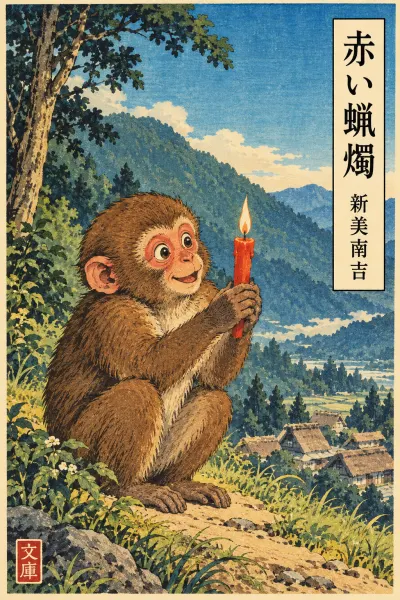
赤い蝋燭 is a short animal fable told in the gentle voice of a storyteller speaking to children. A monkey finds a red candle near a human village and, never having seen one before, decides it must be a firework. The animals of the mountain are delighted and gather to watch it go off, but the problem is that someone has to light it. The humour comes from the gap between what the animals imagine and what the reader knows, and from the very human way they hang back when it is time to be brave. The narrator speaks warmly and politely in です/ます form and sometimes steps in with little asides. The story is only about a thousand characters long, so you can finish it in one sitting. Its vocabulary is concrete: animals, fire, the night sky, ears and eyes. The challenge lies in the slightly old-fashioned style. You will meet set phrases like と申しますのは and 〜であります, older kanji and okurigana spellings such as 大へん, 遂々 and 危い, and a lot of onomatopoeia. It is a good text for practising reading aloud.
Contents
Before you read
- Learn to recognise the narrator's polite storytelling formulas before you start: 〜ました, 〜であります, and と申しますのは〜からです ('the reason is that…'). These explain the animals' thinking and mark the narrator's asides. They are not part of the dialogue.
- The animals speak in plain form, while the narration is in です/ます. Use this switch in register to tell quickly who is talking.
- Expect older spellings: 大へん (大変), 遂々 (とうとう), 危い (危ない), 勇しい (勇ましい), 後込 (尻込み, 'hanging back'), 騒 (騒ぐ). If a word looks strange, read it aloud first and try the modern spelling.
- Watch for patterns that recur in the notes: 〜にしても〜にしても (whether it's X or Y), 〜て聞かせる (telling something to others), 〜たいものだ (a heartfelt wish), 〜ことになる (it was decided that…), and 〜ているばかり (doing nothing but…).
- Onomatopoeia carries much of the action and the suspense. Learn ぱあっと (a sudden burst or spread), きょろきょろ (looking around restlessly), and ぽん (a pop) so you can follow what the animals expect to happen.
Words to know
The most useful words from the notes across the story.
| Word | Meaning | JLPT |
|---|---|---|
| 騒さわぎ | commotion, uproar, fussdictionary form: 騒ぎOlder spelling without okurigana; today written 騒ぎ. | N3 |
| 蝋燭ろうそく | candleUsually written in kana (ろうそく) today; 蝋 means 'wax'. | N2 |
| 思い込んでおもいこむ | to be convinced (wrongly); to assume firmlydictionary form: 思い込むSuggests a belief that is fixed and often mistaken. | N2 |
| 覗きましたのぞく | to peep at, to peer intodictionary form: 覗く | N2 |
| ふさぎましたふさぐ | to cover, to block up (ears, eyes)dictionary form: 塞ぐ | N2 |
| 近眼きんがん | short-sightednessAlso read ちかめ; 近視 (きんし) is the more medical word. | N1 |
| 里さと | village; inhabited countryside where people liveOften contrasted with 山: the mountains are the animals' world, the 里 is the human world. | — |
| 押合いへしあいおしあいへしあい | pushing and shoving (in a crowd)dictionary form: 押し合いへし合いSet expression for jostling crowds; 圧す (へす) is an old verb meaning 'to press'. | — |
| 後込しりごみ | shrinking back, hesitating out of feardictionary form: 尻込みToday usually written 尻込み; 後込 is an older spelling. | — |
| 打上げてうちあげる | to launch, to set off (fireworks)dictionary form: 打ち上げる打ち上げ花火 is a firework shot into the sky. | — |
| うっとりうっとり | entranced, lost in delightUsed with する for being charmed by something beautiful. | — |
| くくりつけてくくりつける | to tie (something) firmly to somethingdictionary form: くくり付ける | — |
| くじくじ | lot, lottery ticketdictionary form: 籤くじを引く = to draw lots. | — |
| うろついてうろつく | to wander about aimlessly, to hang arounddictionary form: うろつく | — |
Plot summary
Show the full summary (contains spoilers)
A monkey picks up a red candle near the village and takes it for a firework. Fireworks are rare and wonderful things to the mountain animals, so they gather on the mountaintop at night to set it off. But when it is time to light it, nobody wants to go near it. They choose by lots. The tortoise and the weasel are both chosen, and both fail to light it. At last the brave boar steps forward and lights the candle. All the animals cover their ears and shut their eyes, waiting for the bang. But the candle makes no sound at all. It just burns quietly.
About the author
Niimi Nankichi was a Japanese writer of children's stories, poems and songs from Handa in Aichi Prefecture. The countryside of that area is widely thought to lie behind the village and hills of Gongitsune. He began writing as a young man. Gongitsune appeared in the children's magazine Akai Tori (The Red Bird), edited by Suzuki Miekichi. Niimi later worked as a teacher at a girls' school while continuing to write. His health was poor, and he died of tuberculosis while still in his twenties. Many of his works were published and became widely known only after his death. Besides Gongitsune, he is especially remembered for Tebukuro wo Kai ni (Buying Mittens).