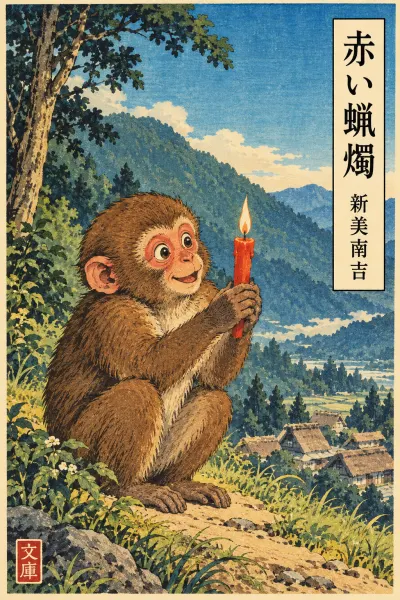
Part 1 of 1 · JLPT N2
赤い蝋燭 Akai Rōsoku, part 1: The Monkey's Wonderful Fireworks
In this part
A monkey picks up a red candle near the village and takes it for a firework. The mountain animals gather on the mountaintop at night to set it off, but nobody wants to light it. The tortoise and the weasel are chosen by lots and fail, and finally the brave boar lights it. Everyone covers their ears and eyes, but the candle just burns quietly without a bang.
AI translation · independently checked
山から里の方へ遊びにいった猿が一本の赤い蝋燭を拾いました。A monkey who had gone down from the mountain to play near the village picked up a red candle.
赤い蝋燭は沢山あるものではありません。Red candles are not things you find just anywhere.
それで猿は赤い蝋燭を花火だと思い込んでしまいました。So the monkey became quite sure that the red candle was a firework.
猿は拾った赤い蝋燭を大事に山へ持って帰りました。The monkey carried the red candle he had found carefully back to the mountain.
山では大へんな騒になりました。On the mountain, there was a tremendous fuss.
何しろ花火などというものは、鹿にしても猪にしても兎にしても、亀にしても、鼬にしても、狸にしても、狐にしても、まだ一度も見たことがありません。After all, a thing like a firework was something that not one of them had ever seen, not the deer, not the boar, not the rabbit, not the tortoise, not the weasel, not the raccoon dog, and not the fox.
その花火を猿が拾って来たというのであります。And the monkey, so it was said, had picked up one of those very fireworks and brought it back.
「ほう、すばらしい」"Oh my, how splendid!"
「これは、すてきなものだ」"Now this is a marvellous thing!"
鹿や猪や兎や亀や鼬や狸や狐が押合いへしあいして赤い蝋燭を覗きました。The deer and the boar and the rabbit and the tortoise and the weasel and the raccoon dog and the fox pushed and shoved one another to peer at the red candle.
すると猿が、Then the monkey
「危い危い。そんなに近よってはいけない。爆発するから」といいました。said, "Careful, careful! You mustn't come so close. It will explode."
みんなは驚いて後込しました。Everyone was startled and shrank back.
そこで猿は花火というものが、どんなに大きな音をして飛出すか、そしてどんなに美しく空にひろがるか、みんなに話して聞かせました。So the monkey told them all about fireworks: what a big noise they made as they shot up, and how beautifully they spread across the sky.
そんなに美しいものなら見たいものだとみんなは思いました。If it was as beautiful as all that, everyone thought, they would very much like to see it.
「それなら、今晩山の頂上に行ってあそこで打上げて見よう」と猿がいいました。"In that case, let's go to the top of the mountain tonight and try setting it off up there," said the monkey.
みんなは大へん喜びました。Everyone was overjoyed.
夜の空に星をふりまくようにぱあっとひろがる花火を眼に浮べてみんなはうっとりしました。They pictured the firework bursting open in the night sky as if scattering stars, and they were all quite enchanted.
さて夜になりました。Well, night came.
みんなは胸をおどらせて山の頂上にやって行きました。With hearts pounding, everyone made their way up to the top of the mountain.
猿はもう赤い蝋燭を木の枝にくくりつけてみんなの来るのを待っていました。The monkey had already tied the red candle to the branch of a tree and was waiting for everyone to arrive.
いよいよこれから花火を打上げることになりました。At last the time had come to set off the firework.
しかし困ったことが出来ました。But a problem came up.
と申しますのは、誰も花火に火をつけようとしなかったからです。You see, nobody would go and light the firework.
みんな花火を見ることは好きでしたが火をつけにいくことは、好きでなかったのであります。They all liked watching fireworks, but none of them liked going to light one.
これでは花火はあがりません。At this rate, the firework would never go up.
そこでくじをひいて、火をつけに行くものを決めることになりました。So they decided to draw lots to choose who would go and light it.
第一にあたったものは亀でありました。The first one chosen was the tortoise.
亀は元気を出して花火の方へやって行きました。The tortoise plucked up his courage and set off towards the firework.
だがうまく火をつけることが出来たでしょうか。But was he able to light it properly?
いえ、いえ。No, no.
亀は花火のそばまで来ると首が自然に引込んでしまって出て来なかったのでありました。As soon as the tortoise came up close to the firework, his head drew back into his shell all by itself and would not come out again.
そこでくじがまたひかれて、こんどは鼬が行くことになりました。So lots were drawn once more, and this time it was the weasel who had to go.
鼬は亀よりは幾分ましでした。The weasel did somewhat better than the tortoise.
というのは首を引込めてしまわなかったからであります。That is to say, he did not pull his head in.
しかし鼬はひどい近眼でありました。But the weasel was terribly short-sighted.
だから蝋燭のまわりをきょろきょろとうろついているばかりでありました。So all he did was wander round and round the candle, looking this way and that.
遂々猪が飛出しました。At last the boar dashed forward.
猪は全く勇しい獣でした。The boar was a truly brave beast.
猪はほんとうにやっていって火をつけてしまいました。The boar really did go up to it and light it.
みんなはびっくりして草むらに飛込み耳を固くふさぎました。Everyone jumped in alarm, dived into the long grass and stopped their ears tight.
耳ばかりでなく眼もふさいでしまいました。And not just their ears: they shut their eyes tight too.
しかし蝋燭はぽんともいわずに静かに燃えているばかりでした。But the candle did not go off with so much as a pop. It just went on burning quietly.
Vocabulary
| Word | Meaning | JLPT |
|---|---|---|
| 里さと | village; inhabited countryside where people liveOften contrasted with 山: the mountains are the animals' world, the 里 is the human world. | — |
| 蝋燭ろうそく | candleUsually written in kana (ろうそく) today; 蝋 means 'wax'. | N2 |
| 思い込んでおもいこむ | to be convinced (wrongly); to assume firmlydictionary form: 思い込むSuggests a belief that is fixed and often mistaken. | N2 |
| 騒さわぎ | commotion, uproar, fussdictionary form: 騒ぎOlder spelling without okurigana; today written 騒ぎ. | N3 |
| 押合いへしあいおしあいへしあい | pushing and shoving (in a crowd)dictionary form: 押し合いへし合いSet expression for jostling crowds; 圧す (へす) is an old verb meaning 'to press'. | — |
| 覗きましたのぞく | to peep at, to peer intodictionary form: 覗く | N2 |
| 後込しりごみ | shrinking back, hesitating out of feardictionary form: 尻込みToday usually written 尻込み; 後込 is an older spelling. | — |
| 打上げてうちあげる | to launch, to set off (fireworks)dictionary form: 打ち上げる打ち上げ花火 is a firework shot into the sky. | — |
| うっとりうっとり | entranced, lost in delightUsed with する for being charmed by something beautiful. | — |
| くくりつけてくくりつける | to tie (something) firmly to somethingdictionary form: くくり付ける | — |
| くじくじ | lot, lottery ticketdictionary form: 籤くじを引く = to draw lots. | — |
| 近眼きんがん | short-sightednessAlso read ちかめ; 近視 (きんし) is the more medical word. | N1 |
| うろついてうろつく | to wander about aimlessly, to hang arounddictionary form: うろつく | — |
| ふさぎましたふさぐ | to cover, to block up (ears, eyes)dictionary form: 塞ぐ | N2 |
Grammar
〜にしても〜にしても N2 whether it's A or B; be it A or B
Repeated after each noun, it lists examples and says the statement applies to every one of them. Here it stresses that none of the animals had seen fireworks.
鹿にしても猪にしても兎にしても
be it the deer, the boar or the rabbit
〜て聞かせる N3 to tell (someone) about something; to explain to
The te-form of a speaking verb plus 聞かせる ('let hear') means telling something to listeners, often at length. The monkey describes fireworks to the whole group.
みんなに話して聞かせました
told everyone all about it
〜たいものだ N2 would really like to ~
Adding ものだ to 〜たい expresses a heartfelt, longing wish. The animals strongly wish to see something so beautiful.
そんなに美しいものなら見たいものだとみんなは思いました
If it was so beautiful, everyone thought, they would really like to see it
〜ことになる N4 it is decided that ~; it turns out that ~
Shows that something was settled by circumstances or group decision rather than by one person's will. The group comes to the decision to draw lots.
火をつけに行くものを決めることになりました
it was decided they would choose who would go and light it
と申しますのは〜からです N2 the reason is that ~; you see, ~
A humble, storyteller-like way to introduce an explanation for what was just said, closed with からです. 申す is the humble form of 言う; というのは in the next lines works the same way.
と申しますのは、誰も花火に火をつけようとしなかったからです。
You see, nobody would go and light the firework.
〜ているばかり N3 do nothing but ~; only keep ~ing
ばかり after 〜ている means only this one thing keeps happening and nothing else, often with frustration. The weasel only wanders, and later the candle only burns quietly.
蝋燭のまわりをきょろきょろとうろついているばかりでありました
all he did was wander round the candle, looking this way and that