Part 1 of 1 · JLPT N3
飴だま Amedama, part 1: A Sleepy Samurai on the Ferry
In this part
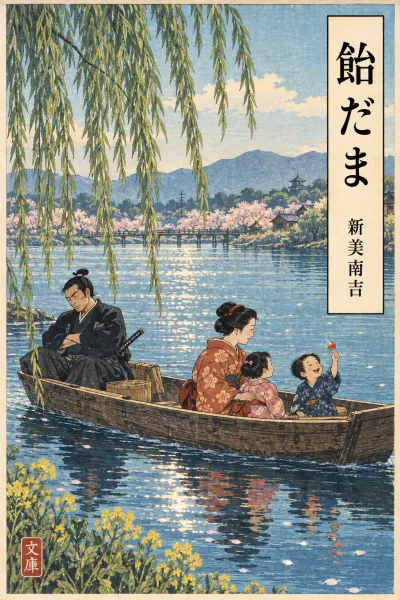
On a warm spring day, a mother and her two small children share a ferry with a fierce-looking samurai who soon dozes off. When the children quarrel over the mother's last sweet, the samurai wakes and draws his sword, and the terrified mother thinks he will kill them. Instead, he splits the sweet in two, gives each child half, and goes back to sleep.
AI translation · independently checked
春のあたたかい日のこと、わたし舟にふたりの小さな子どもをつれた女の旅人がのりました。One warm spring day, a woman traveller with two small children boarded a ferryboat.
舟が出ようとすると、Just as the boat was about to leave,
「おオい、ちょっとまってくれ。」"Heeey, wait a moment!"
と、どての向こうから手をふりながら、さむらいがひとり走ってきて、舟にとびこみました。A samurai came running from the far side of the embankment, waving his hand, and leapt into the boat.
舟は出ました。The boat set off.
さむらいは舟のまん中にどっかりすわっていました。The samurai sat heavily down in the middle of the boat.
ぽかぽかあたたかいので、そのうちにいねむりをはじめました。It was so warm and pleasant that before long he began to doze.
黒いひげをはやして、つよそうなさむらいが、こっくりこっくりするので、子どもたちはおかしくて、ふふふと笑いました。The strong-looking samurai with the black beard kept nodding off, and the children found it so funny that they giggled, hee hee hee.
お母さんは口に指をあてて、Their mother put a finger to her lips
「だまっておいで。」"Hush now."
といいました。and said.
さむらいがおこってはたいへんだからです。If the samurai got angry, it would be terrible.
子どもたちはだまりました。The children fell silent.
しばらくするとひとりの子どもが、After a while, one of the children
「かあちゃん、飴だまちょうだい。」"Mama, give me a sweet."
と手をさしだしました。said, holding out a hand.
すると、もうひとりの子どもも、Then the other child
「かあちゃん、あたしにも。」"Mama, me too."
といいました。said.
お母さんはふところから、紙のふくろをとりだしました。The mother took a paper bag out from the fold of her kimono.
ところが、飴だまはもう一つしかありませんでした。But there was only one sweet left.
「あたしにちょうだい。」"Give it to me!"
「あたしにちょうだい。」"Give it to me!"
ふたりの子どもは、りょうほうからせがみました。The two children pestered her from both sides.
飴だまは一つしかないので、お母さんはこまってしまいました。Since there was only one sweet, the mother didn't know what to do.
「いい子たちだから待っておいで、向こうへついたら買ってあげるからね。」"You're good children, so wait a little. When we get to the other side, I'll buy you some, all right?"
といってきかせても、子どもたちは、ちょうだいよオ、ちょうだいよオ、とだだをこねました。But even when she told them this, the children kept fussing, "Give it to meee, give it to meee!"
いねむりをしていたはずのさむらいは、ぱっちり眼をあけて、子どもたちがせがむのをみていました。The samurai, who should have been dozing, had his eyes wide open and was watching the children beg.
お母さんはおどろきました。The mother was startled.
いねむりをじゃまされたので、このおさむらいはおこっているのにちがいない、と思いました。Surely this samurai must be angry because his nap had been disturbed, she thought.
「おとなしくしておいで。」"Be good and keep quiet."
と、お母さんは子どもたちをなだめました。the mother said, trying to calm the children.
けれど子どもたちはききませんでした。But the children would not listen.
するとさむらいが、すらりと刀をぬいて、お母さんと子どもたちのまえにやってきました。Then the samurai smoothly drew his sword and came over in front of the mother and children.
お母さんはまっさおになって、子どもたちをかばいました。The mother went white as a sheet and shielded her children.
いねむりのじゃまをした子どもたちを、さむらいがきりころすと思ったのです。She thought the samurai was going to cut down the children who had disturbed his nap.
「飴だまを出せ。」"Hand over the sweet."
とさむらいはいいました。said the samurai.
お母さんはおそるおそる飴だまをさしだしました。Fearfully, the mother held out the sweet.
さむらいはそれを舟のへりにのせ、刀でぱちんと二つにわりました。The samurai set it on the edge of the boat and, snap, split it in two with his sword.
そして、And then,
「そオれ。」"There you go."
とふたりの子どもにわけてやりました。he said, and shared it out between the two children.
それから、またもとのところにかえって、こっくりこっくりねむりはじめました。After that, he went back to his old place and began to doze again, nod, nod.
Vocabulary
| Word | Meaning | JLPT |
|---|---|---|
| わたし舟わたしぶね | ferryboatdictionary form: 渡し舟From 渡す (to carry across) + 舟; 舟 becomes ぶね by rendaku. | — |
| 旅人たびびと | travellerA slightly old-fashioned, literary word; 人 becomes びと by rendaku. | — |
| どてどて | embankment, riverbankdictionary form: 土手 | N1 |
| どっかりどっかり | heavily, with a thump (of sitting down)Suggests someone sitting in a solid, self-assured way. | — |
| ぽかぽかぽかぽか | pleasantly warm (of sunshine)Onomatopoeic word for gentle, cosy warmth. | — |
| いねむりいねむり | dozing off, nodding off while sittingdictionary form: 居眠りUsed with をする or をはじめる. | N3 |
| こっくりこっくりこっくりこっくり | nodding repeatedly while dozing | — |
| ふところふところ | the breast fold of a kimonodictionary form: 懐The space inside the front of a kimono, where people kept small items. | — |
| せがみましたせがむ | to pester, to beg insistentlydictionary form: せがむ | — |
| だだをこねましただだをこねる | to throw a tantrum, to fuss like a spoiled childdictionary form: 駄々をこねる | — |
| なだめましたなだめる | to soothe, to calm downdictionary form: 宥める | — |
| かばいましたかばう | to shield, to protectdictionary form: 庇う | — |
| おそるおそるおそるおそる | fearfully, timidlydictionary form: 恐る恐る | — |
| へりへり | edge, rim (of a boat)dictionary form: 縁 | — |
Grammar
〜ようとすると N3 just as (someone/something) was about to ~
The volitional form + とする means 'to be about to do' or 'to try to do'. Adding と marks the moment when something else happens: the boat was about to leave when the samurai called out.
舟が出ようとすると、
Just as the boat was about to leave,
〜ておいで N3 gentle command: 'be ~, stay ~'
〜ておいで comes from いらっしゃい/おいでなさい and gives a soft, affectionate instruction, typically from a parent to a child. The mother uses it several times to quiet her children.
「だまっておいで。」
"Hush now."
〜てはたいへんだ N3 it would be terrible if ~
The て-form + は presents a hypothetical situation, and たいへんだ judges it as a disaster. It explains why the mother silences the children.
さむらいがおこってはたいへんだからです。
If the samurai got angry, it would be terrible.
〜しか〜ない N4 only ~ (and no more)
しか is always followed by a negative verb and stresses that the amount is small. Here only one sweet was left, which causes the problem.
飴だまはもう一つしかありませんでした。
There was only one sweet left.
〜はずの N3 who should have been ~, supposedly ~
はず expresses an expectation. Used before a noun with の, it describes what was expected of that person, and here the reality turns out to be different.
いねむりをしていたはずのさむらいは、ぱっちり眼をあけて
The samurai, who should have been dozing, had his eyes wide open
〜にちがいない N3 must be ~, surely ~
This expresses a strong conviction based on the speaker's reasoning. The mother is sure the samurai is angry, although she is wrong.
このおさむらいはおこっているのにちがいない
Surely this samurai must be angry