Intermediate · JLPT N3
飴だまAmedama — The Samurai and the Last Sweet
- JLPT N3
- 970 characters
- 1 part
- about 8 minutes
- 2 easier versions
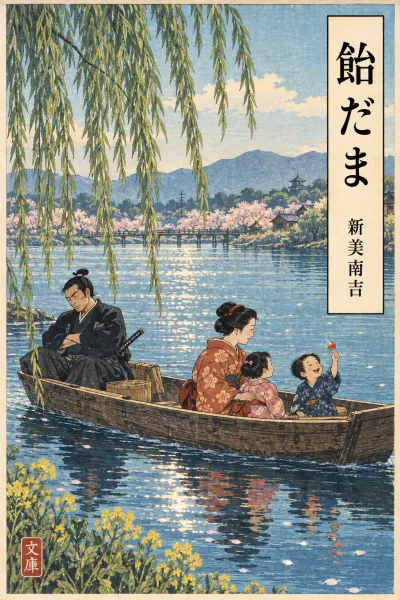
飴だま is a very short children's story by Niimi Nankichi, told in a few scenes aboard a small river ferry on a warm spring day. A mother and her two small children climb down from the embankment and board the boat. Just as it pushes off, a sword-carrying samurai jumps aboard and soon nods off in the spring sunshine. The children beg their mother for a candy drop, but she has only one left, and both of them want it. Their whining grows louder beside the sleeping samurai, and the tension builds quietly. The narration is gentle and polite, full of sound words, and the dialogue is lively and colloquial, so the characters come through clearly. For learners the story is rewarding because it is complete and satisfying at under a thousand characters, and its vocabulary is concrete and easy to picture. The main challenges are the casual spoken forms in the dialogue, drawn-out childish speech, and onomatopoeia that dictionaries do not always explain well.
Contents
Easier versions
This story is also retold in simpler Japanese. Reading an easier version first makes the original much more approachable.
Before you read
- Learn a handful of key nouns before you start: 渡し舟 (ferry), 土手 (embankment), 侍 (samurai), 刀 (sword), 飴だま (candy drop), and いねむり (dozing). Most sentences revolve around them.
- Notice the switch in register. The narration uses polite past forms (のりました, いいました), while the dialogue is plain and casual. Use the narration to follow the plot, and read the dialogue for the characters' personalities.
- The children stretch their words to whine, and the drawn-out sound is written with a small or katakana vowel, as in ちょうだいよオ. Read it as ちょうだいよ plus a long, pleading tone. It is not a separate word.
- The mother's だまっておいで uses the ~ておいで pattern, a soft, motherly command meaning roughly 'be a good child and stay quiet'. Compare it with the samurai's blunt imperative 出せ in 飴だまを出せ. The contrast in how they give orders is part of the drama.
- Onomatopoeia carries much of the atmosphere and action: ぽかぽか (pleasantly warm), こっくりこっくり (nodding off), ぱちん (a sharp snap). Try to imagine each sound instead of translating it word for word, because the story relies on it at key moments.
Words to know
The most useful words from the notes across the story.
| Word | Meaning | JLPT |
|---|---|---|
| いねむりいねむり | dozing off, nodding off while sittingdictionary form: 居眠りUsed with をする or をはじめる. | N3 |
| どてどて | embankment, riverbankdictionary form: 土手 | N1 |
| わたし舟わたしぶね | ferryboatdictionary form: 渡し舟From 渡す (to carry across) + 舟; 舟 becomes ぶね by rendaku. | — |
| 旅人たびびと | travellerA slightly old-fashioned, literary word; 人 becomes びと by rendaku. | — |
| どっかりどっかり | heavily, with a thump (of sitting down)Suggests someone sitting in a solid, self-assured way. | — |
| ぽかぽかぽかぽか | pleasantly warm (of sunshine)Onomatopoeic word for gentle, cosy warmth. | — |
| こっくりこっくりこっくりこっくり | nodding repeatedly while dozing | — |
| ふところふところ | the breast fold of a kimonodictionary form: 懐The space inside the front of a kimono, where people kept small items. | — |
| せがみましたせがむ | to pester, to beg insistentlydictionary form: せがむ | — |
| だだをこねましただだをこねる | to throw a tantrum, to fuss like a spoiled childdictionary form: 駄々をこねる | — |
| なだめましたなだめる | to soothe, to calm downdictionary form: 宥める | — |
| かばいましたかばう | to shield, to protectdictionary form: 庇う | — |
| おそるおそるおそるおそる | fearfully, timidlydictionary form: 恐る恐る | — |
| へりへり | edge, rim (of a boat)dictionary form: 縁 | — |
Plot summary
Show the full summary (contains spoilers)
On a warm spring day, a mother and her two children board a small ferry. A samurai with a beard hurries aboard at the last moment, sits down, and begins to doze. The children ask for a candy drop. The mother has only one left, and each child insists on having it. As they fuss, the mother keeps trying to hush them, afraid they will wake the samurai. Then the samurai opens his eyes, draws his sword, and comes toward them. The mother turns pale and shields her children, sure he is angry about his interrupted nap. Instead he tells her to hand over the candy. He sets it on the edge of the boat, splits it cleanly in two with his sword, gives each child a half, and goes back to sleep.
About the author
Niimi Nankichi was a Japanese writer of children's stories, poems and songs from Handa in Aichi Prefecture. The countryside of that area is widely thought to lie behind the village and hills of Gongitsune. He began writing as a young man. Gongitsune appeared in the children's magazine Akai Tori (The Red Bird), edited by Suzuki Miekichi. Niimi later worked as a teacher at a girls' school while continuing to write. His health was poor, and he died of tuberculosis while still in his twenties. Many of his works were published and became widely known only after his death. Besides Gongitsune, he is especially remembered for Tebukuro wo Kai ni (Buying Mittens).