Advanced · JLPT N1
形Katachi — The Scarlet Surcoat
- JLPT N1
- 1,674 characters
- 1 part
- about 14 minutes
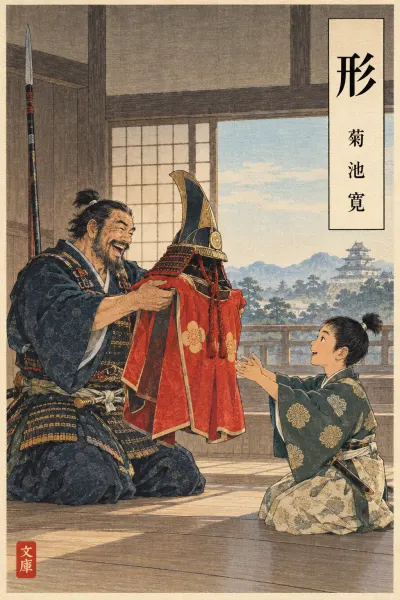
形 (Katachi, literally 'Form' or 'Outward Appearance') is a very short historical tale by Kikuchi Kan, set when rival lords divided the Kinai region among themselves. Its hero is Nakamura Shinbē, a spearman so famous that enemy soldiers recognise him at once by his scarlet surcoat and Chinese-style helmet and fall back before him. Before his first battle, a young lord whom Shinbē has raised asks to borrow these famous pieces of gear, and Shinbē agrees with a laugh. The story then follows Shinbē onto the battlefield on the plain of Settsu. At about 1,700 characters in a single part, it can be read in one sitting, but it is not easy. The narration is early-twentieth-century literary prose full of archaic military vocabulary, and the dialogue uses old samurai speech. It also contains classical-style grammar such as 〜ぬ, 〜ずして and 〜んとする. Because the text is so short and compact, it suits close, sentence-by-sentence study, and it introduces vocabulary that appears again and again in Japanese historical fiction.
Contents
Before you read
- Learn the classical negatives before you start. 〜ぬ means 〜ない, and 〜ずして means 'without doing'. You will also meet 〜んとする ('to be about to'). The narration uses these where modern Japanese would not.
- Learn the key items of equipment first: 猩々緋 (しょうじょうひ, a deep scarlet colour) and 唐冠 (とうかん, a Chinese-style helmet). The whole story turns on Shinbē's famous gear, so these words come back at key moments.
- Read the dialogue as samurai speech. じゃ = だ, ござる = ある/です, and そなた and われら are 'you' and 'we'. Requests such as たもらぬか mean roughly 'won't you give me…?'. Shinbē speaks warmly but with authority. The young lord speaks politely to his elder guardian.
- Watch for 〜たかと思うと ('no sooner had… than') and どれほど〜かわからない ('no telling how much…'). The narrator uses them to pack quick action and strong emphasis into single sentences.
- Do not be thrown by the place names. 中国 here means the Chūgoku region of western Honshū, not China. 五畿内 and 畿内 refer to the provinces around the old capital. Most of the house names listed early on (筒井, 松永, 荒木, 和田, 別所) are only background.
Words to know
The most useful words from the notes across the story.
| Word | Meaning | JLPT |
|---|---|---|
| 形かたち | outward form; appearanceThe story's title: what the enemy fears is the form, not the man. | N4 |
| 侍大将さむらいだいしょう | samurai commander; leader of a lord's warriorsHistorical military rank in the warring period. | — |
| 功名こうみょう | distinguished deeds; glory won in battleCompare 功名心 (longing for glory). | — |
| 猩々緋しょうじょうひ | vivid scarlet (cloth)A deep red woollen cloth, imported and prized by warriors. | — |
| 兜かぶと | helmet (of armour) | — |
| 雑兵ぞうひょう | common foot soldierLow-ranking soldiers, as opposed to mounted warriors. | — |
| 脅威きょうい | threat; menace | — |
| 殺到さっとうする | to rush at; to charge indictionary form: 殺到するIn modern Japanese also 'to flood in' (orders, people). | — |
| 初陣ういじん | one's first battle初 is read うい here, as in 初々しい. | — |
| 手柄てがら | great deed; achievement | — |
| 鎬しのぎをけずる | to fight fiercelydictionary form: 鎬を削る鎬 is the ridge of a blade; the idiom is still used for fierce competition. | — |
| 浮き足立ったうきあしだつ | to waver; to be ready to fleedictionary form: 浮き足立つ | — |
| 怖気おじけ | fear; timidityCommon in 怖気づく (to lose one's nerve). | — |
| 後悔こうかいする | to regretdictionary form: 後悔する | — |
Plot summary
Show the full summary (contains spoilers)
Nakamura Shinbē, a commander serving Matsuyama Shinsuke, lord of half of Settsu, is a renowned spearman. His scarlet surcoat and Chinese-style helmet are so well known that enemy troops lose their nerve at the sight of them. Before his first battle, the young lord whom Shinbē has raised asks to borrow the surcoat and helmet. Shinbē laughs and agrees. When Matsuyama's army meets the troops of Tsutsui Junkei of Yamato on the plain of Settsu, Shinbē fights in plain black armour. This time the enemy soldiers do not shrink from him. They attack him fearlessly and fiercely. Shinbē begins to regret lending out his famous gear, and at that moment an enemy spear pierces his side.
About the author
Kikuchi Kan (1888–1948) was a novelist, playwright and publisher from Takamatsu in Kagawa Prefecture. He was a friend and contemporary of Akutagawa Ryūnosuke. He is known for short historical fiction such as 恩讐の彼方に (Onshū no Kanata ni), for the play 父帰る (Chichi Kaeru), and for popular serial novels such as 真珠夫人 (Shinju Fujin). He founded the magazine 文藝春秋 (Bungei Shunjū), and he established the Akutagawa Prize and the Naoki Prize, which are still among Japan's most important literary awards. He was a major figure in the literary and publishing world of his time.