Part 1 of 1 · JLPT N1
形 Katachi, part 1: The Borrowed Scarlet Surcoat
In this part
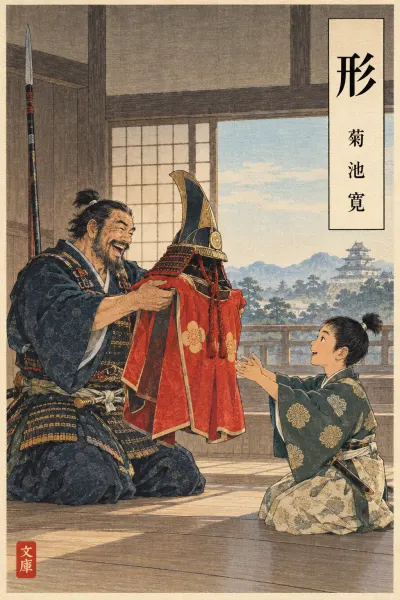
Nakamura Shinbē is a famous spearman whose scarlet surcoat and Chinese-style helmet terrify enemy soldiers. Before his first battle, the young lord he has raised asks to borrow them, and Shinbē laughingly agrees. In plain black armour, Shinbē finds the enemy fearless and fierce against him, and while he is beginning to regret the loan, an enemy spear pierces his side.
AI translation · independently checked
摂津半国の主であった松山新介の侍大将中村新兵衛は、五畿内中国に聞こえた大豪の士であった。Nakamura Shinbē, the samurai commander of Matsuyama Shinsuke, lord of half the province of Settsu, was a warrior of great valour whose name was known throughout the Gokinai and Chūgoku.
そのころ、畿内を分領していた筒井、松永、荒木、和田、別所など大名小名の手の者で、『鎗中村』を知らぬ者は、おそらく一人もなかっただろう。In those days there was probably not a single man among the followers of the great and lesser lords who divided the Kinai between them, such as Tsutsui, Matsunaga, Araki, Wada and Bessho, who did not know of 'Yari Nakamura'.
それほど、新兵衛はその扱き出す三間柄の大身の鎗の鋒先で、さきがけ殿の功名を重ねていた。So many were the honours Shinbē had won, leading the charge and guarding the rear, with the point of the great broad-bladed spear on its eighteen-foot shaft that he thrust out.
そのうえ、彼の武者姿は戦場において、水ぎわ立ったはなやかさを示していた。What is more, his figure in armour showed a striking splendour on the battlefield.
火のような猩々緋の服折を着て、唐冠纓金の兜をかぶった彼の姿は、敵味方の間に、輝くばかりのあざやかさをもっていた。Clad in a surcoat of fiery scarlet and wearing a helmet in the Chinese style with golden streamers, he had a brilliance among friend and foe that seemed almost to shine.
「ああ猩々緋よ唐冠よ」と敵の雑兵は、新兵衛の鎗先を避けた。"Ah, the scarlet! The Chinese helmet!" cried the enemy foot soldiers, and they shrank from the point of Shinbē's spear.
味方がくずれ立ったとき、激浪の中に立つ巌のように敵勢をささえている猩々緋の姿は、どれほど味方にとってたのもしいものであったかわからなかった。When his own side began to give way, there was no telling how reassuring that scarlet figure was to his comrades, holding back the enemy like a rock standing amid raging waves.
また嵐のように敵陣に殺到するとき、その先頭に輝いている唐冠の兜は、敵にとってどれほどの脅威であるかわからなかった。And when they swept down on the enemy lines like a storm, there was no telling how great a menace the Chinese helmet shining at their head was to the enemy.
こうして鎗中村の猩々緋と唐冠の兜は、戦場の華であり敵に対する脅威であり味方にとっては信頼の的であった。In this way, Yari Nakamura's scarlet surcoat and Chinese helmet were the glory of the battlefield, a menace to the enemy, and the very object of his comrades' trust.
「新兵衛どの、おり入ってお願いがある」と元服してからまだ間もないらしい美男の士は、新兵衛の前に手を突いた。"Lord Shinbē, I have a special favour to ask of you," said a handsome young samurai who seemed to have come of age only recently, and he bowed with his hands to the floor before Shinbē.
「なにごとじゃ、そなたとわれらの間に、さような辞儀はいらぬぞ。望みというを、はよういうて見い」と育ぐくむような慈顔をもって、新兵衛は相手を見た。"What is it, lad? There's no need for such ceremony between you and me. Come now, tell me quickly what you wish," said Shinbē, looking at him with a kindly, fatherly face.
その若い士は、新兵衛の主君松山新介の側腹の子であった。The young samurai was a son of Shinbē's master, Matsuyama Shinsuke, by a secondary wife.
そして、幼少のころから、新兵衛が守り役として、わが子のようにいつくしみ育ててきたのであった。And from his early childhood, Shinbē had been his guardian and had raised him lovingly, like a son of his own.
「ほかのことでもおりない。明日はわれらの初陣じゃほどに、なんぞはなばなしい手柄をしてみたい。ついてはお身さまの猩々緋と唐冠の兜を借してたもらぬか。あの服折と兜とを着て、敵の眼をおどろかしてみとうござる」"It is nothing else. Tomorrow is my first battle, and so I wish to do some glorious deed. To that end, would you not lend me your scarlet surcoat and your Chinese helmet? I would put on that surcoat and helmet and dazzle the enemy's eyes."
「ハハハハ念もないことじゃ」新兵衛は高らかに笑った。"Ha-ha-ha! Nothing could be easier!" Shinbē laughed loudly.
新兵衛は、相手の子供らしい無邪気な功名心をこころよく受け入れることができた。Shinbē could gladly accept the young man's innocent, childlike longing for glory.
「が、申しておく、あの服折や兜は、申さば中村新兵衛の形じゃわ。そなたが、あの品々を身に着けるうえは、われらほどの肝魂を持たいではかなわぬことぞ」と言いながら、新兵衛はまた高らかに笑った。"But let me tell you this: that surcoat and helmet are, so to speak, the very form of Nakamura Shinbē. If you are to wear those things, you'll not manage it without a heart and nerve as stout as mine," said Shinbē, and again he laughed loudly.
そのあくる日、摂津平野の一角で、松山勢は、大和の筒井順慶の兵と鎬をけずった。On the following day, on one corner of the plain of Settsu, the Matsuyama army fought fiercely against the troops of Tsutsui Junkei of Yamato.
戦いが始まる前いつものように猩々緋の武者が唐冠の兜を朝日に輝かしながら、敵勢を尻目にかけて、大きく輪乗りをしたかと思うと、駒の頭を立てなおして、一気に敵陣に乗り入った。Before the fighting began, as always, the warrior in scarlet, his Chinese helmet gleaming in the morning sun, rode a wide circle in full view of the enemy as if scorning them, then turned his horse's head and charged straight into the enemy lines.
吹き分けられるように、敵陣の一角が乱れたところを、猩々緋の武者は鎗をつけたかと思うと、早くも三、四人の端武者を、突き伏せて、またゆうゆうと味方の陣へ引き返した。As a corner of the enemy lines fell into disorder as though blown apart, the warrior in scarlet brought his spear to bear, and in no time had struck down three or four lowly soldiers, then calmly rode back to his own lines.
その日に限って、黒皮縅の冑を着て、南蛮鉄の兜をかぶっていた中村新兵衛は、会心の微笑を含みながら、猩々緋の武者のはなばなしい武者ぶりをながめていた。On that day alone, Nakamura Shinbē wore armour laced with black leather and a helmet of foreign iron, and with a smile of deep satisfaction he watched the splendid fighting of the warrior in scarlet.
そして自分の形だけすらこれほどの力をもっているということに、かなり大きい誇りを感じていた。And he felt no small pride that even his mere outward form had such power.
彼は二番鎗は、自分が合わそうと思ったので、駒を乗り出すと、一文字に敵陣に殺到した。Since he meant to strike the second spear himself, he spurred his horse forward and charged straight into the enemy lines.
猩々緋の武者の前には、戦わずして浮き足立った敵陣が、中村新兵衛の前には、ビクともしなかった。The enemy lines, which had wavered without even fighting before the warrior in scarlet, did not budge at all before Nakamura Shinbē.
そのうえに彼らは猩々緋の『鎗中村』に突きみだされたうらみを、この黒皮縅の武者の上に復讐せんとして、たけり立っていた。Moreover, they were raging, bent on taking out on this warrior in black-laced armour their resentment at having been thrown into disarray by the scarlet 'Yari Nakamura'.
新兵衛は、いつもとは、勝手が違っていることに気がついた。Shinbē noticed that things were not as they usually were.
いつもは虎に向かっている羊のような怖気が、敵にあった。Usually the enemy had the fear of sheep facing a tiger.
彼らは狼狽え血迷うところを突き伏せるのに、なんの雑作もなかった。It had been no trouble at all to strike them down as they panicked and lost their heads.
今日は、彼らは戦いをする時のように、勇み立っていた。Today they were full of fighting spirit, as men are when they truly do battle.
どの雑兵もどの雑兵も十二分の力を新兵衛に対し発揮した。Every foot soldier, every single one, turned his full strength and more against Shinbē.
二、三人突き伏せることさえ容易ではなかった。Even striking down two or three of them was no easy matter.
敵の鎗の鋒先が、ともすれば身をかすった。Again and again the points of the enemy spears grazed his body.
新兵衛は必死の力を振るった。Shinbē fought with desperate strength.
平素の二倍もの力さえ振るった。He fought with even twice his usual strength.
が、彼はともすれば突き負けそうになった。But again and again he was on the point of being outmatched.
手軽に兜や猩々緋を借したことを、後悔するような感じが頭の中をかすめたときであった。It was just as a feeling of regret at having so lightly lent his helmet and scarlet surcoat flashed through his mind.
敵の突き出した鎗が、縅の裏をかいて彼の脾腹を貫いていた。An enemy spear, thrust out, had pierced right through the lacing of his armour and run him through the flank.
Vocabulary
| Word | Meaning | JLPT |
|---|---|---|
| 侍大将さむらいだいしょう | samurai commander; leader of a lord's warriorsHistorical military rank in the warring period. | — |
| 功名こうみょう | distinguished deeds; glory won in battleCompare 功名心 (longing for glory). | — |
| 猩々緋しょうじょうひ | vivid scarlet (cloth)A deep red woollen cloth, imported and prized by warriors. | — |
| 兜かぶと | helmet (of armour) | — |
| 雑兵ぞうひょう | common foot soldierLow-ranking soldiers, as opposed to mounted warriors. | — |
| 脅威きょうい | threat; menace | — |
| 殺到さっとうする | to rush at; to charge indictionary form: 殺到するIn modern Japanese also 'to flood in' (orders, people). | — |
| 初陣ういじん | one's first battle初 is read うい here, as in 初々しい. | — |
| 手柄てがら | great deed; achievement | — |
| 形かたち | outward form; appearanceThe story's title: what the enemy fears is the form, not the man. | N4 |
| 鎬しのぎをけずる | to fight fiercelydictionary form: 鎬を削る鎬 is the ridge of a blade; the idiom is still used for fierce competition. | — |
| 浮き足立ったうきあしだつ | to waver; to be ready to fleedictionary form: 浮き足立つ | — |
| 怖気おじけ | fear; timidityCommon in 怖気づく (to lose one's nerve). | — |
| 後悔こうかいする | to regretdictionary form: 後悔する | — |
Grammar
〜ぬ N2 classical negative (= 〜ない)
ぬ attaches to the negative stem of a verb and works like ない. It appears in literary narration and old-style speech, as in 知らぬ and いらぬ.
『鎗中村』を知らぬ者は、おそらく一人もなかっただろう
there was probably not a single man who did not know of 'Yari Nakamura'
どれほど〜かわからない N2 no telling how much; immeasurably
An embedded question with どれほど followed by わからない stresses that the degree was too great to measure. The narration uses it twice to praise the scarlet figure.
どれほど味方にとってたのもしいものであったかわからなかった
there was no telling how reassuring it was to his comrades
〜たかと思うと N2 no sooner had … than
Joins two actions that follow each other very quickly. Here the rider finishes his circle and immediately charges.
大きく輪乗りをしたかと思うと、駒の頭を立てなおして、一気に敵陣に乗り入った
no sooner had he ridden a wide circle than he turned his horse's head and charged straight into the enemy lines
〜ずして N1 without doing
A literary form of 〜ないで. 戦わずして means the enemy wavered without even fighting.
戦わずして浮き足立った敵陣
the enemy lines that wavered without even fighting
〜んとする N1 to try to; to be about to
ん is a classical volitional ending on the negative stem (せん from する), and とする expresses the intention. It equals 〜ようとする.
この黒皮縅の武者の上に復讐せんとして、たけり立っていた
they were raging, eager to take revenge on this warrior in black-laced armour
〜ほどに N1 because; since (archaic)
In old speech ほどに after a clause gives a reason, like から or ので. The young lord explains why he wants to win glory.
明日はわれらの初陣じゃほどに、なんぞはなばなしい手柄をしてみたい
Tomorrow is my first battle, and so I wish to do some glorious deed