Part 1 of 2 · JLPT N3
キキリツツリ Kikiritsutsuri, part 1: A Stepdaughter's Wish and a Tiny Visitor
In this part
Tsuyuko, a stepdaughter overworked and mistreated by her stepmother, asks to be allowed to enter girls' school, but her stepmother harshly refuses. That night, weeping in bed, she hears a small rhythmic sound. On the rain-shutter rail she finds a tiny, courteous insect in Western clothes and spectacles, reading in a rocking chair, who greets her and asks what is troubling her.
AI translation · independently checked
露子さんは継子で、いつもお母さんからいじめられて泣いてばかりいました。Tsuyuko was a stepchild. Her mother was always bullying her, and she did nothing but cry.
夜は毎晩おそくまで御飯のあと片付けをしたり、お使いに遣られたりしました。Every night she cleared away after supper until late, and she was sent out on errands.
寝る時はまた、お台所の際の板張りの上に薄い薄い蒲団を敷いて、たった一人ふるえながら寝なければなりませんでした。And when it was time for bed, she had to spread a thin, thin quilt on the wooden boards beside the kitchen and sleep there all alone, shivering.
ようやく寒いつめたい冬が過ぎてあたたかくなりましたので、露子さんは大喜びでした。At last the cold, chilly winter passed and the days grew warm, and Tsuyuko was overjoyed.
けれどもそれと一所に悲しくてならぬ事が出来ました。But along with the warmth came something that made her unbearably sad.
露子さんは尋常の四年生でしたが、六年生にも負けぬ位学校がよく出来ましたので、今年から女学校に這入りたいと思って、或る日思い切ってお父さまやお母様に願って見たのですが、お父様は宜しいとおっしゃっても、お母様がお聞きになりません。Tsuyuko was in her fourth year of ordinary elementary school, but she did so well in her lessons that she was a match even for the sixth-years. So she wished to enter girls' school starting this year, and one day she gathered her courage and asked her father and mother. But although her father said it would be all right, her mother would not hear of it.
「女の癖に女学校へ行くなんて余計な事です。女学校へ這入るには試験を受けねばならぬでしょう。"A girl, going off to girls' school? What nonsense. And to enter girls' school you must sit an examination, must you not?
試験を受けるために勉強するからといって、うちの仕事をなまけようと思うから、そんな事を云うのです。You say such things only because you mean to shirk your work in this house on the excuse of studying for the examination.
試験の前に勉強して女学校に這入れたって、本当に這入れたのではありませぬ。勉強しないで這入れたのが本当です。Even if you studied before the examination and got into girls' school, that would not be truly getting in. Getting in without studying, that is the real thing.
まだ尋常四年の癖に生意気な事を云うものではありませぬ」A mere fourth-year of ordinary school has no business saying such impertinent things."
こう云って、お母さんは何といっても御承知なさいませんでした。With these words, her mother would not give her consent, no matter what Tsuyuko said.
露子さんも勉強しないではとても女学校へ這入れまいと思って、泣く泣くだまってしまいました。Tsuyuko, too, thought that without studying she could never get into girls' school, and, weeping, she fell silent.
そうして静かに台所の電気を消して寝ました。Then she quietly switched off the kitchen light and went to bed.
けれども露子さんは、女学校に這入りたくて這入りたくてたまりませんでした。Yet Tsuyuko longed so very, very much to enter girls' school that she could hardly bear it.
床に就いてから涙が止め度なく出て寝られませんでした。After she lay down, her tears flowed without end, and she could not sleep.
その中に近所が静かになると、露子さんは不図妙な音に気がつきました。By and by, when the neighbourhood had grown quiet, Tsuyuko suddenly noticed a strange sound.
雨戸の真中あたりと思う処から、From what seemed to be somewhere around the middle of the rain shutters,
「キキリココリ。ククリキキリ。フフリチチリ。リリリツツリ」"Kikiri-kokori. Kukuri-kikiri. Fufuri-chichiri. Ririri-tsutsuri."
と小さな音が面白く調子よく聞こえて来ます。came a tiny sound, merry and nicely in rhythm.
露子さんはそっと起き上って、そっと電気をひねって、音のする方に近寄りました。Tsuyuko got up softly, softly switched on the light, and crept toward where the sound was coming from.
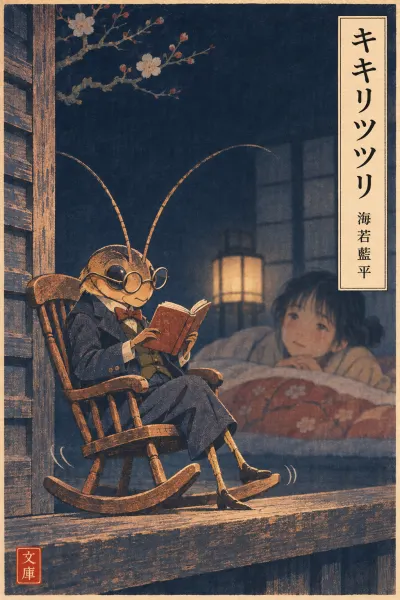
見ると、その雨戸の桟の上に小さい小さい虫が一匹、洋服を着て眼鏡を掛けて、揺れ椅子に腰をかけて書物を読んでいます。When she looked, there on the rail of the rain shutter was a tiny, tiny insect, dressed in Western clothes and wearing spectacles, sitting in a rocking chair and reading a book.
今の音は虫が揺れ椅子をゆする音でした。The sound she had heard was the insect rocking its rocking chair.
露子さんは驚いて眼をまん丸くしていると、虫は小さな赤い帽子を取って、椅子に腰をかけたまま露子さんにていねいにお辞儀をしました。As Tsuyuko stared, round-eyed with astonishment, the insect took off its little red cap and, still seated in its chair, made her a polite bow.
露子さんも何だか変に思いながら、相手が丁寧ですからこちらもていねいにお辞儀を返しますと、虫は二本の長い髯を動かしながら、椅子をゆすりゆすり小さな声で口を利き初めました。Tsuyuko thought it all rather odd, but since the other was so courteous, she politely bowed in return. At that, the insect, twitching its two long feelers and rocking, rocking its chair, began to speak in a small voice.
「キリリコロコロ、私はいつもこの雨戸の桟に御厄介になっているもので御座います。キリリコロコロ、私のうちはここで御座います。チチリツツリ、チチリツツリ、今夜は今年になってはじめて暖かいので、久し振りにここへ出て勉強をしているところでした。リリリココリココリ」"Kiriri-korokoro, I am one who is always imposing upon the hospitality of this shutter rail. Kiriri-korokoro, my home is right here. Chichiri-tsutsuri, chichiri-tsutsuri, tonight is the first warm night of the year, and so, for the first time in a long while, I had come out here to pursue my studies. Ririri-kokori-kokori."
と椅子をゆすりながら、横にある小さな虫穴を指さしました。So saying, still rocking its chair, it pointed to a tiny insect hole beside it.
露子さんは只もう呆れて眼を瞠っておりますと、虫はなおも言葉を続けました。Tsuyuko could only stare, wide-eyed and dumbfounded, while the insect went on speaking.
「あなたが毎日お母様の云い付けをよく聞いて働いておいでになる事は、私はよく存じています。"I am well aware that every day you faithfully do as your honoured mother tells you and work very hard.
キキリキキリ、チチリチチリチチリチチリ、いつも御同情申し上げておりますので、一度はお眼にかかってお話したいと考えておりましたが、今度はほんとに宜い折りで御座いました。Kikiri-kikiri, chichiri-chichiri-chichiri-chichiri, I have always felt the deepest sympathy for you, and I had hoped that one day I might have the honour of meeting you and speaking with you. And now, indeed, a most fortunate opportunity has come.
ツツリツツリ、キキリキキリ。そこでお尋ねしますが、あなたは最前から寝床の中で泣いておいでになったようですが、何かお困りになったような事はありませぬか」Tsutsuri-tsutsuri, kikiri-kikiri. And so, if I may ask: it seemed to me that you have been weeping in your bed for some while now. Is there not something troubling you?"
Vocabulary
| Word | Meaning | JLPT |
|---|---|---|
| 継子ままこ | stepchild継 means 'to succeed, to join on'; the related 継母 (ままはは) is 'stepmother'. | — |
| いじめられていじめる | to bully, to treat cruellydictionary form: いじめるHere in the passive: 'being bullied by'. | N4 |
| 敷いてしく | to spread out (bedding, a mat)dictionary form: 敷くThe standard verb for laying out a futon. | N2 |
| 思い切っておもいきる | to make up one's mind; (as 思い切って) boldly, summoning one's couragedictionary form: 思い切る | — |
| なまけようなまける | to be lazy, to shirk (work)dictionary form: 怠けるVolitional form + と思う: 'to intend to shirk'. | N3 |
| 生意気なまいき | cheeky, impertinent, presumptuousOften said by elders to children who speak above their place. | N2 |
| 承知しょうち | consent, agreement; (御承知なさる) honorific: to consentAlso 'being aware of'. 御承知なさる is an old honorific form, used here ironically by the narrator. | N4 |
| 止め度なくとめどない | endless, without stoppingdictionary form: 止め処無いAlmost always used with tears, talk or laughter. | — |
| 不図ふと | suddenly, by chance, unexpectedlydictionary form: ふとUsually written in hiragana today; 不図 is an old kanji spelling. | N3 |
| 雨戸あまど | rain shutter (sliding wooden shutter outside a window) | N2 |
| 桟さん | rail or crosspiece of a door or shutterThe wooden frame strip on which the insect lives. | — |
| 厄介やっかい | trouble, burden; (ご厄介になる) to depend on someone's hospitalityA humble set phrase: 'I am a burden to / staying with'. | N3 |
| 存じていますぞんじる | to know (humble)dictionary form: 存じるHumble equivalent of 知っている. | N2 |
| 呆れてあきれる | to be astounded, dumbfoundeddictionary form: 呆れるCan also mean 'to be appalled'; here pure amazement. | N2 |
Grammar
〜てばかりいる N3 do nothing but ~; always ~ing
Attached to the て-form, ばかりいる stresses that one action happens constantly, often with a negative or pitiful feeling.
いつもお母さんからいじめられて泣いてばかりいました
she was always being bullied by her mother and did nothing but cry
〜てならない N2 unbearably ~; can't help feeling ~
After the て-form of a feeling adjective or verb, ならない shows that the feeling is overwhelming. ならぬ is the older form of ならない.
悲しくてならぬ事が出来ました
something happened that made her unbearably sad
〜ねばならぬ N2 must ~
A literary, old-fashioned version of 〜なければならない. The negative stem + ねば means 'if not', and ならぬ means 'won't do', giving the stepmother's speech a stern tone.
女学校へ這入るには試験を受けねばならぬでしょう
to enter girls' school you must sit an examination, must you not?
〜ものではない N2 one should not ~
After the dictionary form, this states a general rule of behaviour and is often used to scold. ありませぬ is an old polite negative.
生意気な事を云うものではありませぬ
has no business saying such impertinent things
〜まい N2 probably not ~; surely won't ~
まい is a literary negative of conjecture, roughly 〜ないだろう. Here 這入れまい means 'surely could not get in'.
勉強しないではとても女学校へ這入れまいと思って
thought that without studying she could never get into girls' school
〜たくてたまらない N2 want to ~ so badly one can't stand it
The たい form in its て-form plus たまらない expresses an unbearably strong desire. Repeating 這入りたくて adds even more emphasis.
女学校に這入りたくて這入りたくてたまりませんでした
longed so very, very much to enter girls' school that she could hardly bear it