Intermediate · JLPT N3
キキリツツリKikiritsutsuri — Kikiri-Tsutsuri: The Insect on the Shutter Rail
- JLPT N3
- 3,037 characters
- 2 parts
- about 25 minutes
- 2 easier versions
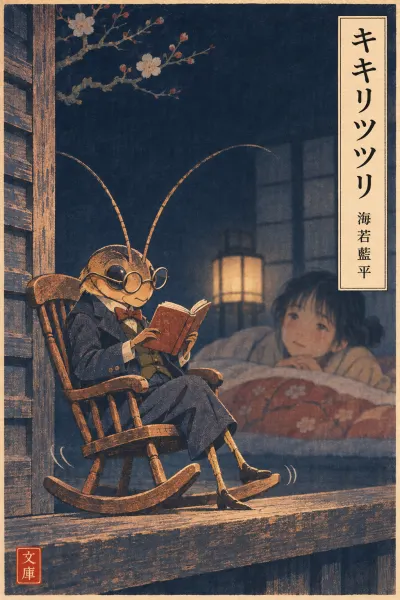
Kikiri-Tsutsuri is a short, gentle fairy tale with a moral, written for children and told in polite です/ます narration. Tsuyuko is a stepdaughter who works hard at home under a strict stepmother and longs to go on to girls' school. One night, crying in bed, she hears a faint rhythmic creaking. On the rail of the rain shutters she finds a tiny, very polite insect in Western clothes and spectacles, reading in a rocking chair. The tale mixes ordinary household hardship with a small, whimsical bit of magic. Its real interest is in how kindness and patience are rewarded. For learners, the narration is clear and the plot is easy to follow. The challenge is in the voices. The stepmother uses clipped, old-fashioned forms such as ませぬ and ねばならぬ. The insect speaks in elaborate keigo (御座います, 存じています, 申し上げて), broken up by sound-words like キキリ, ツツリ and ココリ. Tsuyuko speaks humbly and calls herself 妾. The older spellings, such as 云う and 裡, take a little getting used to. This makes the story a compact way to practise reading formal and archaic registers within a simple plot.
Contents
Easier versions
This story is also retold in simpler Japanese. Reading an easier version first makes the original much more approachable.
Before you read
- Learn the older spellings before you start. 云う is 言う, 裡 (うち) is 内, as in 〜と云う裡に ('while saying…'), and 御座います is ございます. Tsuyuko's first-person 妾 is usually read わたし here.
- Each speaker has a distinct register, so the speech style tells you who is talking. The stepmother uses stern classical negatives and obligations (〜ませぬ, 〜ねばならぬ, 〜まい, 〜ものではない). The insect uses heavy keigo (存じています, 申し上げて, 〜ないでもよろしゅう御座います, 〜ようにして差し上げる).
- Treat the katakana sound-words キキリ, ツツリ and ココリ as the creaking of the insect's rocking chair, not as words to translate. They often interrupt the insect's sentences mid-phrase, so read past them to find where the grammar continues.
- Watch for expressions of strong feeling that recur in Tsuyuko's scenes: 〜てならない and 〜でなりません ('can't help…', 'terribly'), and 〜たくてたまらない ('dying to…'). Also note 〜てばかりいる ('doing nothing but…'), which describes both her crying and her endless chores.
- Words worth learning first: 女学校 (girls' school), 尋常 (ordinary elementary school), 雨戸 (rain shutters), 敷居 (the rail they slide on), 継母 (stepmother), 校長 (headmaster), and 卒業 (graduation).
Words to know
The most useful words from the notes across the story.
| Word | Meaning | JLPT |
|---|---|---|
| 雨戸あまど | rain shutter (sliding wooden shutter outside a window) | N2 |
| 思い切っておもいきる | to make up one's mind; (as 思い切って) boldly, summoning one's couragedictionary form: 思い切る | — |
| 桟さん | rail or crosspiece of a door or shutterThe wooden frame strip on which the insect lives. | — |
| いじめられていじめる | to bully, to treat cruellydictionary form: いじめるHere in the passive: 'being bullied by'. | N4 |
| 承知しょうち | consent, agreement; (御承知なさる) honorific: to consentAlso 'being aware of'. 御承知なさる is an old honorific form, used here ironically by the narrator. | N4 |
| なまけようなまける | to be lazy, to shirk (work)dictionary form: 怠けるVolitional form + と思う: 'to intend to shirk'. | N3 |
| 不図ふと | suddenly, by chance, unexpectedlydictionary form: ふとUsually written in hiragana today; 不図 is an old kanji spelling. | N3 |
| 厄介やっかい | trouble, burden; (ご厄介になる) to depend on someone's hospitalityA humble set phrase: 'I am a burden to / staying with'. | N3 |
| 学問がくもん | learning, education, scholarship | N3 |
| 敷いてしく | to spread out (bedding, a mat)dictionary form: 敷くThe standard verb for laying out a futon. | N2 |
| 生意気なまいき | cheeky, impertinent, presumptuousOften said by elders to children who speak above their place. | N2 |
| 存じていますぞんじる | to know (humble)dictionary form: 存じるHumble equivalent of 知っている. | N2 |
| 呆れてあきれる | to be astounded, dumbfoundeddictionary form: 呆れるCan also mean 'to be appalled'; here pure amazement. | N2 |
| 同情どうじょう | sympathy, compassion | N1 |
| 継子ままこ | stepchild継 means 'to succeed, to join on'; the related 継母 (ままはは) is 'stepmother'. | — |
Plot summary
Show the full summary (contains spoilers)
Tsuyuko is overworked and treated harshly by her stepmother. She asks to be allowed to enter girls' school, and her stepmother sternly refuses. That night, weeping in bed, Tsuyuko hears a small rhythmic sound. On the rain-shutter rail she finds a tiny insect in Western clothes and spectacles, sitting in a rocking chair. The insect courteously asks what is wrong and promises that her parents will let her go to girls' school. Then it vanishes. The next day the headmaster of her school visits and persuades her parents to agree. He also arranges a study hour for her, but Tsuyuko politely declines it because she does not want to burden her stepmother. Her consideration moves everyone to tears, even her stepmother. Tsuyuko graduates with honours and enters girls' school. She never sees the insect again, and only its tiny hole remains in the shutter rail.
About the author
Kaijaku Ranpei is a pen name of Sugiyama Taidō, who is far better known as Yumeno Kyūsaku. He came from Fukuoka and was the son of the political activist Sugiyama Shigemaru. As Yumeno Kyūsaku he became famous for strange, dark detective and fantasy fiction, above all the novel Dogra Magra. Before that reputation was established, he wrote a large number of short children's stories for a Fukuoka newspaper under several pen names, including Kaijaku Ranpei. These tales are usually gentle and moralising, quite unlike his later adult fiction, and they often feature talking animals, insects and small magical events.