Upper intermediate · JLPT N2
きのこ会議Kinokokaigi — The Mushrooms Hold a Meeting
- JLPT N2
- 1,499 characters
- 1 part
- about 12 minutes
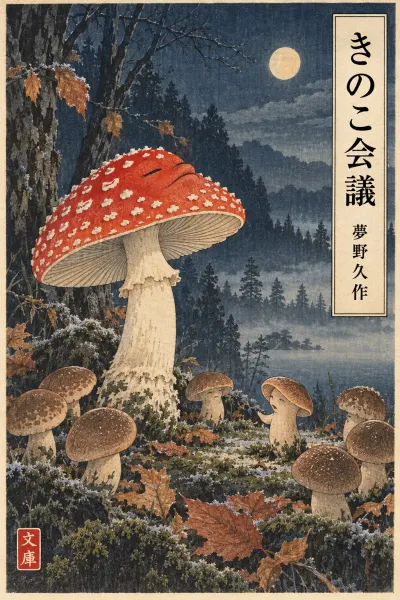
"The Mushrooms Hold a Meeting" is a short children's fable by Yumeno Kyūsaku, told in the gentle, polite voice of a storyteller reading aloud. One night, as the weather turns cold and the mushroom season draws to a close, the mushrooms of the hunting grounds gather for a farewell meeting. One by one, the edible mushrooms stand up and give formal speeches about their troubles with the people who come to pick them. Then the poisonous mushrooms, led by a loud and boastful Fly Agaric, interrupt with their own very different view of how to survive in the world. The next morning brings a family of mushroom hunters, and with them the story's answer. The fable is brief, but it is sharper than it first looks, with a quiet irony that rewards careful reading. For learners, the text is a good bridge into slightly older written Japanese: forms like ねばならぬ and なぞ appear alongside everyday grammar. The contrast between the polite speeches and the Fly Agaric's rude, plain speech is also useful practice in register.
Contents
Before you read
- Learn the older negative ぬ before you start. 〜ねばならぬ means the same as 〜なければならない ("must"), and 〜まい is a negative volition or conjecture, roughly "will not" or "probably won't". Both appear in the mushrooms' speeches.
- Watch the change in speech styles. The narrator and the good mushrooms use です/ます and formal speech-making language. The Fly Agaric switches to rough plain forms (俺, お前達, 馬鹿だ). Noticing who says 俺 will tell you who is speaking even without speech tags.
- Recognise the older spellings and words: 畠 is the same as 畑 (field), なぞ is an older form of など, and 処 in 〜処でなく is the kanji spelling of どころでなく ("far from ~" / "no time for ~").
- Learn 茸 (きのこ, also read たけ in compounds) before reading. The mushroom species are written as compounds ending in 茸, such as 蠅取り茸 (the Fly Agaric, literally "fly-catching mushroom"). Once you spot the 茸 ending, the speakers are easy to identify.
- Pay attention to two patterns in the complaints and the boasting. 〜ないうち(に) means "before ~ happens", as in picking mushrooms before they are grown. 〜さえ〜ば means "if only ~", and 〜てたまらない means "unbearably ~". These patterns carry the argument of the fable.
Words to know
The most useful words from the notes across the story.
| Word | Meaning | JLPT |
|---|---|---|
| 殖えてふえる | to increase, to multiply (of living things)dictionary form: 殖えるUsually written 増える today. 殖 suggests breeding. | N4 |
| 演説えんぜつ | a speech (to an audience) | N3 |
| 子孫しそん | descendants, offspring | N2 |
| 威張っていばる | to act proud, to swagger, to show offdictionary form: 威張る | N2 |
| 連中れんちゅう | a crowd, a group of people (here, of mushrooms)Casual and slightly dismissive, like 'that lot'. | N1 |
| 理屈りくつ | reasoning, logic; an argument | N1 |
| 同情どうじょう | sympathy; to feel sorry for someone (with する) | N1 |
| 繁昌はんじょう | flourishing, thrivingUsually written 繁盛 today, as in 商売繁盛 (thriving business). | N1 |
| 重宝がってちょうほうがる | to find useful, to value highlydictionary form: 重宝がる〜がる attaches to adjectives and nouns to describe how someone else feels or behaves. | — |
| 根絶やしねだやし | complete extermination, wiping out root and all | — |
| 片っぱしからかたっぱしから | one after another, every last onedictionary form: 片っ端からWritten 片っ端から in the final sentence. | — |
| 征伐せいばつ | to conquer, to crush (enemies or wrongdoers)Used in folk tales, as in 鬼征伐 (defeating the ogres). It sounds grand in a child's mouth. | — |
| 木っ葉微塵こっぱみじん | into tiny pieces, smashed to smithereensdictionary form: 木っ端微塵 | — |
Plot summary
Show the full summary (contains spoilers)
When the cold weather arrives, the mushrooms hold a farewell meeting. The good, edible mushrooms take turns making polite speeches. They complain that people pick them before they have grown, before they can scatter their spores, so their families are in danger of dying out. The poisonous mushrooms, led by the Fly Agaric, jeer at them. They call the edible mushrooms fools and boast that being useless and deadly to people is the best way to stay alive, since nobody dares to pick them. The next morning a family comes mushroom hunting. The father gathers the good mushrooms and warns everyone to keep away from the poisonous ones. The children then stamp every one of the poisonous mushrooms to pieces, so the Fly Agaric's boast turns out to be wrong.
About the author
Yumeno Kyūsaku was the pen name of Sugiyama Taidō, a writer from Fukuoka. He is best known for his strange, dreamlike mystery and horror fiction, above all the novel Dogra Magra (ドグラ・マグラ), which is often counted among the great oddities of Japanese literature. Stories such as "Bottled Hell" (瓶詰地獄) also remain widely read. Alongside this darker work, he wrote many children's stories and fables, of which "The Mushrooms Hold a Meeting" is one. His career was cut short by his sudden death in 1936.