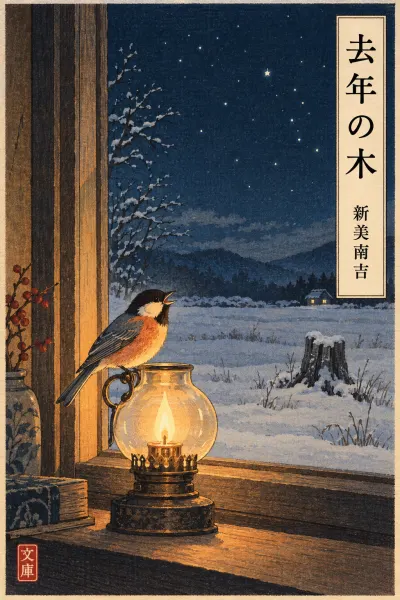
Part 1 of 1 · JLPT N4
去年の木 Kyonen no Ki, part 1: A Bird Searches for Its Friend
In this part
A little bird and a tree are close friends, and before flying south for the winter the bird promises to come back and sing again. In spring the tree is gone: it was cut down, taken to a factory, and made into matches that were sold to a village. There the bird finds a girl whose lamp is still lit by one of those matches, so it sings last year's song to the flame and then flies away.
AI translation · independently checked
いっぽんの木と、いちわの小鳥とはたいへんなかよしでした。A tree and a little bird were the very best of friends.
小鳥はいちんちその木の枝で歌をうたい、木はいちんちじゅう小鳥の歌をきいていました。All day long the little bird sang on the tree's branches, and all day long the tree listened to the little bird's songs.
けれど寒い冬がちかづいてきたので、小鳥は木からわかれてゆかねばなりませんでした。But cold winter was drawing near, so the little bird had to leave the tree.
「さよなら。また来年きて、歌をきかせてください。」"Goodbye. Please come again next year and let me hear your songs."
と木はいいました。said the tree.
「え。それまで待っててね。」"Sure. Wait for me until then, okay?"
と、小鳥はいって、南の方へとんでゆきました。said the little bird, and it flew away toward the south.
春がめぐってきました。Spring came around again.
野や森から、雪がきえていきました。The snow melted away from the fields and the woods.
小鳥は、なかよしの去年の木のところへまたかえっていきました。The little bird went back once more to its friend, last year's tree.
ところが、これはどうしたことでしょう。But what could this mean?
木はそこにありませんでした。The tree wasn't there.
根っこだけがのこっていました。Only its roots were left.
「ここに立ってた木は、どこへいったの。」"Where did the tree that stood here go?"
と小鳥は根っこにききました。the little bird asked the roots.
根っこは、The roots
「きこりが斧でうちたおして、谷のほうへもっていっちゃったよ。」"A woodcutter chopped it down with his axe and carried it off toward the valley."
といいました。said.
小鳥は谷のほうへとんでいきました。The little bird flew off toward the valley.
谷の底には大きな工場があって、木をきる音が、びィんびィん、としていました。At the bottom of the valley there was a big factory, and the sound of wood being cut went bzzing, bzzing.
小鳥は工場の門の上にとまって、The little bird perched on top of the factory gate
「門さん、わたしのなかよしの木は、どうなったか知りませんか。」"Excuse me, Mr. Gate, do you know what became of my friend the tree?"
とききました。and asked.
門は、The gate
「木なら、工場の中でこまかくきりきざまれて、マッチになってあっちの村へ売られていったよ。」"The tree? Inside the factory it was chopped up into tiny pieces, made into matches, and sold off to that village over there."
といいました。said.
小鳥は村のほうへとんでいきました。The little bird flew off toward the village.
ランプのそばに女の子がいました。Beside a lamp there was a girl.
そこで小鳥は、So the little bird
「もしもし、マッチをごぞんじありませんか。」"Excuse me, would you happen to know anything of some matches?"
とききました。asked.
すると女の子は、Then the girl
「マッチはもえてしまいました。けれどマッチのともした火が、まだこのランプにともっています。」"The matches have all burned up. But the fire a match lit is still burning in this lamp."
といいました。said.
小鳥は、ランプの火をじっとみつめておりました。The little bird gazed steadily at the lamp's flame.
それから、去年の歌をうたって火にきかせてやりました。Then it sang last year's song for the flame to hear.
火はゆらゆらとゆらめいて、こころからよろこんでいるようにみえました。The flame flickered and swayed, and it looked as though it was happy with all its heart.
歌をうたってしまうと、小鳥はまたじっとランプの火をみていました。When it had finished singing, the little bird again gazed quietly at the lamp's flame.
それから、どこかへとんでいってしまいました。Then it flew away somewhere.
Vocabulary
| Word | Meaning | JLPT |
|---|---|---|
| なかよしなかよし | close friends; good frienddictionary form: 仲良しCan be a noun for the friend itself, as in なかよしの木 'my friend the tree'. | N2 |
| 枝えだ | branch (of a tree) | N4 |
| ちかづいてちかづく | to draw near, approachdictionary form: 近づくOften written 近づく; with 〜てくる it shows something coming closer to the speaker's time or place. | N1 |
| わかれてわかれる | to part from, leave (someone)dictionary form: 別れるTakes から or と for the person or thing left behind. | N4 |
| めぐってめぐる | to come around (as seasons do)dictionary form: 巡るSuggests the natural cycle; 春がめぐってくる is a set literary phrase. | N2 |
| 根っこねっこ | roots; stumpColloquial form of 根 (ね). | — |
| きこりきこり | woodcutterdictionary form: 木こりFrom 木 + 樵る 'to cut wood'; common in folk tales. | — |
| 斧おの | axe | — |
| 谷たに | valley | N3 |
| 底そこ | bottomDo not confuse with そこ 'there'; context and kanji tell them apart. | N3 |
| きりきざまれてきりきざむ | to chop up finely, cut to piecesdictionary form: 切り刻むCompound of 切る 'cut' + 刻む 'mince'; here in the passive form. | — |
| ともしたともす | to light (a lamp, a fire)dictionary form: 灯すTransitive; the intransitive partner ともる 'to be lit, burn' appears in the same sentence. | — |
| みつめてみつめる | to gaze at, stare atdictionary form: 見つめるOften paired with じっと 'fixedly, still'. | — |
| ゆらめいてゆらめく | to flicker, swaydictionary form: 揺らめくUsed for flames, light and reflections; ゆらゆら is the matching sound-symbolic word. | — |
Grammar
〜ねばならない N2 must, have to (literary)
A written-style equivalent of 〜なければならない. The verb takes its negative stem (ゆか-) plus ねば, and here ならない is made polite and past: ねばなりませんでした 'had to'.
小鳥は木からわかれてゆかねばなりませんでした。
The little bird had to leave the tree.
〜ちゃった (〜てしまった) N4 went and did; did completely (often with regret)
ちゃう is the casual contraction of てしまう. The roots use it to report, a little sadly, that the tree is gone for good.
谷のほうへもっていっちゃったよ。
He carried it off toward the valley.
Passive 〜られる N4 to be done (to)
The passive puts the tree in the subject position as the one things happen to: きりきざまれる 'be chopped up', 売られる 'be sold'. The te-form links the stages of what happened to it.
工場の中でこまかくきりきざまれて、マッチになってあっちの村へ売られていったよ。
Inside the factory it was chopped up into tiny pieces, made into matches, and sold off to that village over there.
Noun + なら N4 as for...; if it's ... you mean
なら picks up a topic the other person has just raised and answers about it. The gate repeats 木 from the bird's question: 'If it's the tree you mean...'.
木なら、工場の中でこまかくきりきざまれて
The tree? Inside the factory it was chopped up into tiny pieces
ごぞんじ (ご存じ) N4 to know (honorific)
ご存じ is the respectful way of saying someone else knows. ごぞんじありませんか is a very polite 'Do you know...?', which suits the bird speaking to a stranger.
もしもし、マッチをごぞんじありませんか。
Excuse me, would you happen to know anything of some matches?
〜ようにみえる N3 to look as if, seem to
The plain form plus ように見える describes how something appears to an observer without claiming it is true. Here the flame's flickering looks like joy.
こころからよろこんでいるようにみえました。
It looked as though it was happy with all its heart.