Elementary · JLPT N4
去年の木Kyonen no Ki — The Tree the Bird Sang To
- JLPT N4
- 791 characters
- 1 part
- about 7 minutes
- 1 easier version
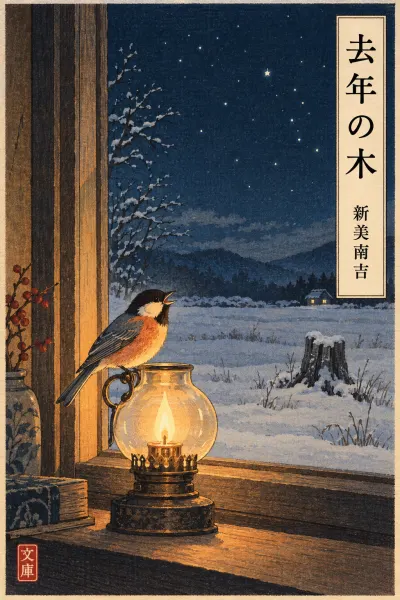
去年の木 (The Tree the Bird Sang To) is a very short fable by Niimi Nankichi, the children's author best known for ごんぎつね. A small bird and a tree are close friends, and every day the bird sings to the tree. When winter comes the bird has to fly away, and it promises to return next year and sing again. In spring the bird comes back and finds that the tree is gone. It sets out to find its friend, asking a root, a factory gate and a young girl what happened to the tree. The story is quiet and plain but carries real feeling, and its simple surface holds a meaning about loss, memory and keeping a promise. At under 800 characters it is a manageable first complete story for learners at about N4. The narration uses polite です/ます forms and a lot of hiragana. The dialogue gives useful contrast between casual speech and polite questions to strangers. Because the bird's search repeats a question-and-answer pattern, each new scene reinforces what you have just read.
Contents
Easier versions
This story is also retold in simpler Japanese. Reading an easier version first makes the original much more approachable.
Before you read
- Watch for colloquial contractions in the dialogue. 待っててね is 待っていてね, and もっていっちゃった is もっていってしまった, with ~ちゃう adding a sense of something done and gone. いちんち is a spoken form of いちにち.
- Notice how the bird's speech changes with the listener. It talks casually to its friend the tree and to the root, but asks the gate and the girl politely with 知りませんか and the humble-respectful ごぞんじありませんか.
- Learn the chain of key nouns before you start: 根っこ (root), きこり (woodcutter), 谷 (valley), 工場 (factory), 門 (gate), マッチ (match), 村 (village), ランプ (lamp), 火 (flame). The plot moves along this chain, one link per scene.
- The narration is mostly in hiragana, so read aloud and look for word boundaries at particles such as は, を, に and へ. Recognising polite past endings (でした, ました) will help you split sentences quickly.
- Pay attention to the final scene's small verbs of looking and moving, such as じっと見つめる and ゆらゆらゆらめく. They carry the story's emotion without any explanation, so read slowly there.
Words to know
The most useful words from the notes across the story.
| Word | Meaning | JLPT |
|---|---|---|
| 枝えだ | branch (of a tree) | N4 |
| わかれてわかれる | to part from, leave (someone)dictionary form: 別れるTakes から or と for the person or thing left behind. | N4 |
| 谷たに | valley | N3 |
| 底そこ | bottomDo not confuse with そこ 'there'; context and kanji tell them apart. | N3 |
| なかよしなかよし | close friends; good frienddictionary form: 仲良しCan be a noun for the friend itself, as in なかよしの木 'my friend the tree'. | N2 |
| めぐってめぐる | to come around (as seasons do)dictionary form: 巡るSuggests the natural cycle; 春がめぐってくる is a set literary phrase. | N2 |
| ちかづいてちかづく | to draw near, approachdictionary form: 近づくOften written 近づく; with 〜てくる it shows something coming closer to the speaker's time or place. | N1 |
| 根っこねっこ | roots; stumpColloquial form of 根 (ね). | — |
| きこりきこり | woodcutterdictionary form: 木こりFrom 木 + 樵る 'to cut wood'; common in folk tales. | — |
| 斧おの | axe | — |
| きりきざまれてきりきざむ | to chop up finely, cut to piecesdictionary form: 切り刻むCompound of 切る 'cut' + 刻む 'mince'; here in the passive form. | — |
| ともしたともす | to light (a lamp, a fire)dictionary form: 灯すTransitive; the intransitive partner ともる 'to be lit, burn' appears in the same sentence. | — |
| みつめてみつめる | to gaze at, stare atdictionary form: 見つめるOften paired with じっと 'fixedly, still'. | — |
| ゆらめいてゆらめく | to flicker, swaydictionary form: 揺らめくUsed for flames, light and reflections; ゆらゆら is the matching sound-symbolic word. | — |
Plot summary
Show the full summary (contains spoilers)
A bird and a tree are good friends, and the bird sings to the tree all day. As winter approaches, the bird must leave. The tree asks it to come back next year and sing again, and the bird promises. In spring the bird returns, but only the tree's root remains. The root says a woodcutter cut the tree down and took it to the valley. At the bottom of the valley, the gate of a factory tells the bird the tree was cut into small pieces, made into matches, and sold to a village. In the village the bird asks a girl sitting by a lamp about the matches. She says they are used up, but the flame she lit with one is still burning in the lamp. The bird looks at the flame and sings last year's song to it. The flame flickers as if it is happy. Then the bird looks at it a while longer and flies away.
About the author
Niimi Nankichi was a Japanese writer of children's stories, poems and songs from Handa in Aichi Prefecture. The countryside of that area is widely thought to lie behind the village and hills of Gongitsune. He began writing as a young man. Gongitsune appeared in the children's magazine Akai Tori (The Red Bird), edited by Suzuki Miekichi. Niimi later worked as a teacher at a girls' school while continuing to write. His health was poor, and he died of tuberculosis while still in his twenties. Many of his works were published and became widely known only after his death. Besides Gongitsune, he is especially remembered for Tebukuro wo Kai ni (Buying Mittens).