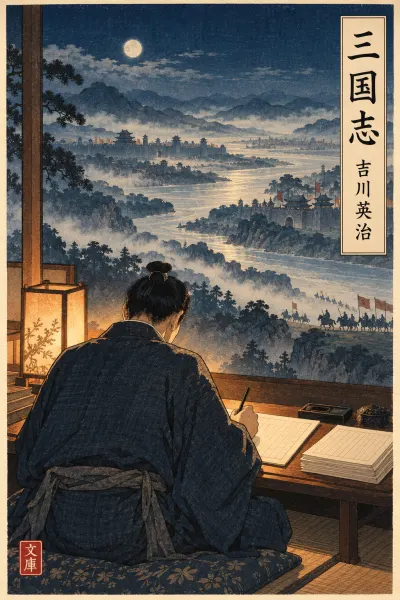
Advanced · JLPT N1
三国志Mikunishi — The Three Kingdoms: An Author's Foreword
- JLPT N1
- 1,414 characters
- 1 part
- about 12 minutes
This is not the novel itself but Yoshikawa Eiji's short preface to his retelling of the Chinese classic of the Three Kingdoms. In about 1,400 characters he explains why this ancient story still feels alive to him, why he chose to write it at full length as a newspaper serial instead of an abridged digest, and how he approached the material. He also introduces the scale of what is to come: a tale that opens under Reitei, emperor of the Later Han, and runs for about 112 years. Heroes such as Ryū Gentoku, Sōsō, Kan'u and Chōhi are named here before the story proper begins. The tone is earnest and personal. Yoshikawa writes as a working novelist talking directly to his readers, and he closes with a warm memory from his own boyhood. For a learner, the challenge is the register. The plain である prose is packed with literary Sino-Japanese vocabulary and four-character compounds, and some spellings are older than modern usage. The text is short, though, and its argument is clear, so it rewards slow, careful reading. It also makes a useful orientation before tackling the long novel.
Contents
Before you read
- This is an essay-style preface, not a narrative. Read it as an argument: the author states why the story matters, how he wrote it, and what its scope is, then ends with a personal memory. Tracking these sections will help you follow long sentences.
- Expect dense literary Sino-Japanese vocabulary and four-character compounds such as 治乱興亡 (rise and fall amid order and chaos) and 悲歌慷慨 (lamenting and stirred to indignation). Look up compounds as whole units rather than kanji by kanji.
- Several expressions explained in the notes are worth learning before you start: 〜といっても過言でない (it is no exaggeration to say), 〜こそ〜が (it is precisely X that…, but…), and 〜おそれがある (there is a risk that). They often signal where the author is stressing a point.
- Some spellings are older than standard modern usage, for example 変って where modern texts usually write 変わって. If a word looks slightly off, try reading it aloud or comparing it with the modern form.
- Learn the name readings in advance: 劉玄徳 (りゅうげんとく), 曹操 (そうそう), 関羽 (かんう), 張飛 (ちょうひ), 霊帝 (れいてい), 後漢 (ごかん), 呉 (ご). Japanese readings of Chinese names differ greatly from the Chinese pronunciations you may know, such as Liu Bei or Cao Cao.
Words to know
The most useful words from the notes across the story.
| Word | Meaning | JLPT |
|---|---|---|
| 古典こてん | a classic; classical literature | N2 |
| 活躍かつやく | being active; playing an important partUsed for characters in a story as well as for real people doing well in their field. | N2 |
| 強いてしいて | forcibly; deliberately, against what is natural (te-form of 強いる)Adverb from 強いる (to force); note the irregular reading し. | N1 |
| 治乱興亡ちらんこうぼう | order and chaos, rise and fall (of states)Four-character compound: 治 order, 乱 disorder, 興 rise, 亡 ruin. | — |
| 抄訳しょうやく | abridged translation抄 means 'excerpt'; contrast 全訳 (complete translation) and 直訳 (literal translation). | — |
| 創意そうい | original ideas; invention | — |
| 正史せいし | official (dynastic) historyContrasted with fiction based on history. | — |
| 比類ないひるいない | unrivalled; without equalLiterally 'no comparable kind'. | — |
| 浮沈ふちん | ups and downs; rise and fall (of fortunes)浮 float + 沈 sink. | — |
| 耽らしめるふける | to be absorbed in, to lose oneself indictionary form: 耽るOften 物思いに耽る (to be lost in thought); here in the literary causative form. | — |
| 群雄割拠ぐんゆうかっきょ | rival warlords each holding their own territorySet phrase for periods of fragmented power. | — |
| 絵巻えまき | picture scrollA horizontal hand scroll telling a story in pictures; used figuratively for a vivid panorama. | — |
| 書肆しょし | publisher; booksellerOld-fashioned word; today 出版社 or 書店. | — |
| 上梓じょうし | publication; bringing out in printFormal word, originally 'putting onto woodblocks (梓)'. | — |
Plot summary
Show the full summary (contains spoilers)
Yoshikawa explains that the Three Kingdoms story, though ancient and Chinese, still feels vividly alive. He believes its poetry and spirit would be lost if it were cut down to a summary. For that reason he chose to write it at full length as a newspaper serial, adding his own interpretations and handling of the material. He describes the vast scope of the tale. It begins in the reign of Reitei of the Later Han, which he places alongside Japan's Emperor Seimu, around AD 168. It ends when Butei destroys Go in the first year of Taikō (AD 280), a span of about 112 years. He notes how he has treated place names and official titles. Finally he recalls reading the story as a boy late into the night, in the version by Kubo Tenzui, and being scolded by his father for it.
About the author
Yoshikawa Eiji was one of the most widely read Japanese novelists of the twentieth century, best known for historical fiction. Family hardship forced him to leave school young, and he worked a series of jobs before establishing himself as a writer. Much of his fiction first appeared as newspaper serials and reached a very large popular readership. His best-known works include Miyamoto Musashi, a fictionalised life of the swordsman, and Shin Heike Monogatari, a retelling of the Heike saga. His Sangokushi brought the Chinese Three Kingdoms story to a broad Japanese audience.