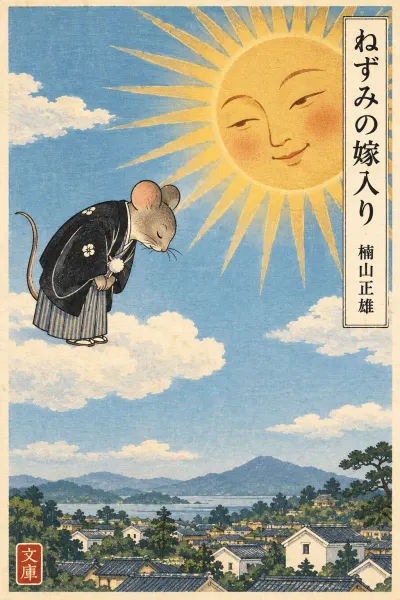
Part 1 of 1 · JLPT N3
ねずみの嫁入り Nezumi no Yomeiri, part 1: A Father Searches for the Greatest Son-in-Law
In this part
A rich mouse couple has a beautiful daughter and decides she must marry the greatest being in the world. The father asks the Sun, the Cloud, the Wind and a Wall in turn, and each one says that someone else is greater, until the Wall admits that mice are stronger than it. Delighted, the father goes home and marries his daughter to Chūsuke, the young mouse next door, and the family prospers.
AI translation · independently checked
むかし、むかし、ある家のお倉の中に、お米を持って、麦を持って、粟を持って、豆を持って、たいそうゆたかに暮らしているお金持ちのねずみが住んでおりました。Once upon a time, long, long ago, in the storehouse of a certain house, there lived a wealthy mouse who had rice, and barley, and millet, and beans, and lived a very comfortable life.
子供がないので神さまにお願いしますと、やっと女の子が生まれました。He had no children, so he prayed to the gods, and at last a baby girl was born.
その子はずんずん大きくなって、かがやくほど美しくなって、それはねずみのお国でだれ一人くらべるもののない日本一のいい娘になりました。The little girl grew bigger and bigger and more and more beautiful, until she shone with beauty, and in all the land of mice there was no one to compare with her: she became the finest daughter in all Japan.
こうなると、もうねずみの仲間には見わたしたところ、とても娘のお婿さんにするような者はありませんでした。Now that things had come to this, when they looked around at all the other mice, there was simply no one fit to be their daughter's husband.
ねずみのおとうさんとおかあさんは、The mouse father and mother said,
「うちの娘は日本一の娘なのだから、何でも日本一のお婿さんをもらわなければならない。」"Our daughter is the finest daughter in Japan, so whatever happens, we must find her the finest husband in Japan."
と言いました。That is what they said.
そこでこの世の中でだれがいちばんえらいかというと、それは高い高い空の上から世界中をあかるく照らしておいでになるお日さまの外にはありませんでした。So, if you asked who was the greatest in all the world, it could be no one but the Sun, who shines brightly on the whole world from high, high up in the sky.
そこでおとうさんはおかあさんと娘を連れて、天へ上っていきました。So the father took the mother and their daughter and went up to the heavens.
そしてお日さまに、And to the Sun he said,
「お日さま、お日さま、あなたは世の中でいちばんえらいお方です。どうぞわたくしの娘をお嫁にもらって下さいまし。」"Great Sun, great Sun, you are the greatest one in all the world. Please, I beg you, take my daughter as your bride."
といって、ていねいにおじぎをしました。And he bowed very politely.
するとお日さまはにこにこなさりながら、The Sun smiled kindly and said,
「それはありがたいが、世の中にはわたしよりもっとえらいものがあるよ。」"That's very kind of you, but there's someone in this world even greater than I am."
とおっしゃいました。That is what the Sun said.
おとうさんはびっくりしました。The father was astonished.
「まあ、あなたよりもえらい方があるのですか。それはどなたでございますか。」"Oh my, is there someone even greater than you? And who might that be, if I may ask?"
「それは雲さ。わたしがいくら空でかんかん照っていようと思っても、雲が出てくるともうだめになるのだからね。」"Why, the Cloud. However much I want to blaze away up in the sky, once the Cloud comes out, that's the end of it, you see."
「なるほど。」"I see."
おとうさんはそこで、こんどは雲の所へ出かけました。So this time the father set off to see the Cloud.
「雲さん、雲さん、あなたは世の中でいちばんえらいお方です。どうぞわたくしの娘をお嫁にもらって下さいまし。」"Mr. Cloud, Mr. Cloud, you are the greatest one in all the world. Please, I beg you, take my daughter as your bride."
「それはありがたいが、世の中にはわたしよりもっとえらいものがあるよ。」"That's very kind of you, but there's someone in this world even greater than I am."
おとうさんはびっくりしました。The father was astonished.
「まあ、あなたよりもえらい方があるのですか。それはどなたでございますか。」"Oh my, is there someone even greater than you? And who might that be, if I may ask?"
「それは風さ。風に吹きとばされてはわたしもかなわないよ。」"Why, the Wind. When the Wind blows me away, even I can't stand up to it."
「なるほど。」"I see."
おとうさんはそこで、こんどは風の所へ出かけていきました。So this time the father set off to see the Wind.
「風さん、風さん、あなたは世の中でいちばんえらいお方です。どうぞわたくしの娘をお嫁にもらって下さいまし。」"Mr. Wind, Mr. Wind, you are the greatest one in all the world. Please, I beg you, take my daughter as your bride."
「それはありがたいが、世の中にはわたしよりもっとえらいものがあるよ。」"That's very kind of you, but there's someone in this world even greater than I am."
おとうさんはびっくりしました。The father was astonished.
「まあ、あなたよりもえらい方があるのですか。それはどなたでございますか。」"Oh my, is there someone even greater than you? And who might that be, if I may ask?"
「それは、壁さ。壁ばかりはわたしの力でもとても、吹きとばすことはできないからね。」"Why, the Wall. A wall is the one thing that, strong as I am, I just can't blow away, you see."
「なるほど。」"I see."
おとうさんはそこでまた、のこのこ壁の所へ出かけていきました。So once again the father trotted off, this time to see the Wall.
「壁さん、壁さん、あなたは世の中でいちばんえらいお方です。どうぞうちの娘をお嫁にもらって下さいまし。」"Mr. Wall, Mr. Wall, you are the greatest one in all the world. Please, I beg you, take our daughter as your bride."
「それはありがたいが、世の中にはわたしよりもっとえらいものがあるよ。」"That's very kind of you, but there's someone in this world even greater than I am."
おとうさんはびっくりしました。The father was astonished.
「まあ、あなたよりもえらい方があるのですか。それはどなたでございますか。」"Oh my, is there someone even greater than you? And who might that be, if I may ask?"
「それはだれでもない、そういうねずみさんさ。わたしがいくらまっ四角な顔をして、固くなって、がんばっていても、ねずみさんはへいきでわたしの体を食い破って、穴をあけて通り抜けていくじゃないか。だからわたしはどうしてもねずみさんにはかなわないよ。」"Why, it's none other than a mouse, just like you. However square-faced I make myself, however hard I stiffen and stand firm, a mouse just gnaws straight through my body without a care, makes a hole, and slips right through, doesn't it? So I simply can't stand up to a mouse."
「なるほど。」"I see!"
とねずみのおとうさんは、こんどこそほんとうにしんから感心したように、ぽんと手を打って、And this time the mouse father, truly impressed from the bottom of his heart, clapped his hands together and said,
「これは今まで気がつかなかった。じゃあわたしどもが世の中でいちばんえらいのですね。ありがたい。ありがたい。」"I never noticed that until now. Why, then we mice are the greatest in all the world! How wonderful! How wonderful!"
とにこにこしながら、いばって帰っていきました。And beaming with smiles, he went home, full of pride.
そして帰るとさっそく、お隣のちゅう助ねずみを娘のお婿さんにしました。As soon as he got home, he made Chūsuke, the mouse next door, his daughter's husband.
若いお婿さんとお嫁さんは、仲よく暮らして、おとうさんとおかあさんをだいじにしました。The young husband and bride lived happily together and took good care of the father and mother.
そしてたくさん子供を生んで、お倉のねずみの一家はますます栄えました。And they had lots of children, and the mouse family in the storehouse grew more and more prosperous.
Vocabulary
| Word | Meaning | JLPT |
|---|---|---|
| 倉くら | storehouse, granaryA thick-walled building for storing rice and valuables; the お here is polite storytelling style. | N1 |
| 暮らしてくらす | to live, to get bydictionary form: 暮らすRefers to one's way of life; ゆたかに暮らす = to live in comfort. | N3 |
| ずんずんずんずん | steadily and quickly (growing, moving forward)Onomatopoeic adverb. | — |
| 婿むこ | bridegroom; son-in-lawお婿さん is the polite form; 婿にする = to take someone as a son-in-law. | N1 |
| えらいえらい | great, important, mightydictionary form: 偉いHere about power and rank; in modern speech it can also mean 'admirable' or, in Kansai, 'terrible'. | N2 |
| おいでになるおいでになる | (honorific) to be, to be doingRespectful equivalent of いる; 照らしておいでになる = 'is (graciously) shining'. | N4 |
| 嫁よめ | bride, wifeお嫁にもらう = to take (someone) as one's wife; 嫁入り in the title means a bride marrying into a family. | N3 |
| かなわないかなう | to be a match for (negative: to be no match for)dictionary form: 敵うAlmost always used in the negative with に: 〜にはかなわない. | — |
| 吹きとばされてふきとばす | to blow awaydictionary form: 吹き飛ばす吹く (blow) + 飛ばす (send flying); here in the passive. | — |
| のこのこのこのこ | casually, unconcernedly (going somewhere)Suggests going along without thinking, often a little foolishly. | — |
| 食い破ってくいやぶる | to gnaw through, to chew a hole indictionary form: 食い破る食う is a rough word for 'eat', used for animals. | — |
| 感心かんしん | being impressed, admiration感心する = to be impressed; しんから = from the heart. | N3 |
| いばっていばる | to be proud, to swaggerdictionary form: 威張るUsually negative ('act big'), here humorous. | N2 |
| 栄えましたさかえる | to prosper, to flourishdictionary form: 栄えるOften used of families, towns and countries. | N1 |
Grammar
〜ておりました N3 was (doing) — humble/polite form of 〜ていました
おる is the humble equivalent of いる. Storytellers use 〜ておりました to sound polite and gentle toward the listener.
お金持ちのねずみが住んでおりました。
There lived a wealthy mouse.
〜ほど N3 to the extent that…, so … that…
A verb + ほど describes the degree of the following adjective. かがやくほど美しい means so beautiful that she seemed to shine.
かがやくほど美しくなって
became so beautiful she seemed to shine
〜なければならない N4 must, have to
The negative conditional of a verb + ならない expresses obligation. With 何でも ('no matter what') it becomes a strong determination.
何でも日本一のお婿さんをもらわなければならない。
Whatever happens, we must find her the finest husband in Japan.
いくら〜ても N3 no matter how much…, however much…
いくら strengthens the concessive 〜ても: whatever effort is made, the result stays the same. Here 〜ようと思っても means 'even if I intend to…'.
わたしがいくら空でかんかん照っていようと思っても、雲が出てくるともうだめになるのだからね。
However much I want to blaze away up in the sky, once the Cloud comes out, that's the end of it, you see.
〜ばかりは N2 … alone, … is the one thing that
ばかり + は picks out one thing as the exception. The Wind can blow away everything else, but a wall is the one thing it cannot.
壁ばかりはわたしの力でもとても、吹きとばすことはできないからね。
A wall is the one thing that, strong as I am, I just can't blow away, you see.
〜じゃないか N3 …, doesn't it? / isn't it so?
A rhetorical sentence ending that points out something the listener should already know or agree with. The Wall uses it to show how obvious the mouse's strength is.
穴をあけて通り抜けていくじゃないか。
Makes a hole and slips right through, doesn't it?