Intermediate · JLPT N3
ねずみの嫁入りNezumi no Yomeiri — The Finest Match in All the Land
- JLPT N3
- 1,596 characters
- 1 part
- about 13 minutes
- 2 easier versions
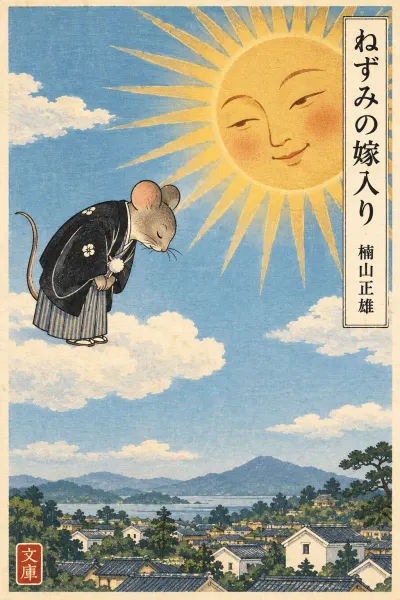
This is Kusuyama Masao's retelling of a traditional Japanese folktale, told in the gentle voice of a storyteller reading aloud to children. A well-off mouse couple has a daughter so lovely that they decide only the greatest being in the world will do as her husband. Her father sets out on a journey up to the sky to find this perfect match. He calls first on the Sun, and then on the Cloud, the Wind and a Wall. The story is short and built on repetition. Each visit follows almost the same pattern: the father's very polite request, then a relaxed and kindly reply. That structure is its greatest help to a learner. Once you have understood the first exchange, each later one reuses most of its grammar and vocabulary, with only a few new words. The main challenges are the contrast between the father's formal, slightly old-fashioned speech and the easy-going plain speech of the others, and the lively onomatopoeia that runs through the narration. At about 1,600 characters, it can be read comfortably in one sitting.
Contents
Easier versions
This story is also retold in simpler Japanese. Reading an easier version first makes the original much more approachable.
Before you read
- The narrator uses the humble ~ておりました alongside ~ました throughout. Read ~ておりました as a polite storyteller's version of ~ていました ('was ~ing', 'had been ~ing') rather than as something the characters are doing humbly.
- Treat the four visits as one repeated template. Work through the first exchange carefully, noting ~ほど (degree or comparison), いくら~ても ('no matter how much ~'), ~じゃないか ('isn't it ~?') and ~ばかりは ('this alone', 'only this'). Then read each later visit and check what has changed.
- Listen for the two registers. The father speaks formally with ございます and 下さいまし, an old-fashioned polite form of 下さい. The Sun, Cloud, Wind and Wall answer in casual plain speech ending in ~さ, ~よ and ~ね. The shift in speech style tells you who is talking even when no speaker is named.
- Learn a few key words before you start: 嫁入り (a bride marrying into a household), 日本一 (the finest in Japan), ~なければならない ('must') for the parents' resolve, and the words for the Sun, the Cloud, the Wind and a wall.
- Enjoy the onomatopoeia rather than translating it word for word. にこにこ is a beaming smile, のこのこ is plodding along without a care, かんかん is blazing (or furious), and ぽんと is a light pop or tap. They set the mood of each scene.
Words to know
The most useful words from the notes across the story.
| Word | Meaning | JLPT |
|---|---|---|
| おいでになるおいでになる | (honorific) to be, to be doingRespectful equivalent of いる; 照らしておいでになる = 'is (graciously) shining'. | N4 |
| 暮らしてくらす | to live, to get bydictionary form: 暮らすRefers to one's way of life; ゆたかに暮らす = to live in comfort. | N3 |
| 嫁よめ | bride, wifeお嫁にもらう = to take (someone) as one's wife; 嫁入り in the title means a bride marrying into a family. | N3 |
| 感心かんしん | being impressed, admiration感心する = to be impressed; しんから = from the heart. | N3 |
| えらいえらい | great, important, mightydictionary form: 偉いHere about power and rank; in modern speech it can also mean 'admirable' or, in Kansai, 'terrible'. | N2 |
| いばっていばる | to be proud, to swaggerdictionary form: 威張るUsually negative ('act big'), here humorous. | N2 |
| 倉くら | storehouse, granaryA thick-walled building for storing rice and valuables; the お here is polite storytelling style. | N1 |
| 婿むこ | bridegroom; son-in-lawお婿さん is the polite form; 婿にする = to take someone as a son-in-law. | N1 |
| 栄えましたさかえる | to prosper, to flourishdictionary form: 栄えるOften used of families, towns and countries. | N1 |
| ずんずんずんずん | steadily and quickly (growing, moving forward)Onomatopoeic adverb. | — |
| かなわないかなう | to be a match for (negative: to be no match for)dictionary form: 敵うAlmost always used in the negative with に: 〜にはかなわない. | — |
| 吹きとばされてふきとばす | to blow awaydictionary form: 吹き飛ばす吹く (blow) + 飛ばす (send flying); here in the passive. | — |
| のこのこのこのこ | casually, unconcernedly (going somewhere)Suggests going along without thinking, often a little foolishly. | — |
| 食い破ってくいやぶる | to gnaw through, to chew a hole indictionary form: 食い破る食う is a rough word for 'eat', used for animals. | — |
Plot summary
Show the full summary (contains spoilers)
A rich mouse couple living in the storehouse of a house has a beautiful daughter. They decide she must marry the greatest being in the world. The father travels up to the sky and asks the Sun to be her husband. The Sun declines and says that someone else is greater, so the father goes on to the Cloud, then the Wind, then a Wall. Each one in turn says there is someone greater than itself. Finally the Wall admits that mice are stronger than it is. Delighted to learn that his own kind is the greatest of all, the father returns home. He marries his daughter to Chūsuke, the young mouse who lives next door, and the family prospers.
About the author
Kusuyama Masao (1884–1950) was a Japanese writer, editor and translator who did much to shape children's literature in modern Japan. He studied at Waseda University and was also active in theatre, working as a critic and translator of Western drama. He is best remembered for his retellings of Japanese folk tales and legends for young readers. His retellings are written in clear, rhythmic Japanese meant to be read aloud.