Advanced · JLPT N1
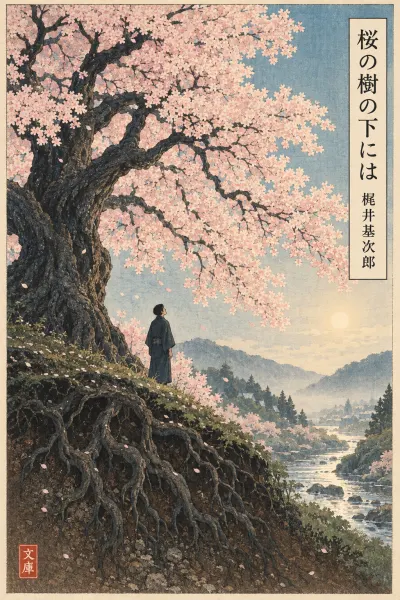
桜の樹の下にはSakura no Ki no Shita ni wa — At the Roots of the Cherry Trees
- JLPT N1
- 1,730 characters
- 1 part
- about 14 minutes
This is a very short prose piece, closer to a prose poem than a story. A man speaks to someone he calls おまえ, who never answers, and makes a startling claim about the cherry trees in bloom. The famous opening line, 桜の樹の下には屍体が埋まっている!, is widely known in Japan, and the rest of the text explains why he needs to believe it. There is almost no plot. The whole piece is one feverish outburst: rough, masculine, conversational Japanese laid over dense, precise, decadent imagery of blossoms, decay, sunlight on a valley stream and dead insects. That mix makes it rewarding but demanding. The sentence endings (〜んだよ, 〜じゃないか) are easy colloquial speech, but the vocabulary is literary and sometimes unusual, with older kanji spellings such as 屍体, 聚めて and 撲たず. The text is only about 1,700 characters long, so you can read it several times. Each pass shows more of how Kajii turns beauty and unease into a single mood, and how much meaning the speaker packs into insistent repetition and direct appeals to his listener.
Contents
Before you read
- Read the title as an unfinished sentence: 桜の樹の下には… The first line completes it (屍体が埋まっている), and the whole text keeps returning to that claim.
- The speaker constantly addresses おまえ and pushes for agreement with 〜じゃないか, 〜んだよ and imperatives such as 〜てみるがいい ('just try ~ and see'). Read these as someone pressing a listener, not as neutral narration.
- Watch for the emotional grammar the notes highlight. 〜ずにはおかない means 'cannot fail to ~ / inevitably makes one ~'. 〜がる / 〜がらせる describe others' feelings or making someone feel something. 〜て、はじめて means 'only after ~ did...'. 〜ことはない means 'there's no need to ~'. なんぞ is a scornful, colloquial version of など.
- Learn a few key words before you start: 屍体(したい, corpse; the modern spelling is 死体), 腐爛(ふらん, rotting), 根(ね, roots), 花見・酒宴 (blossom viewing, drinking party), and 薄羽かげろう (mayfly). Unusual kanji such as 聚める (=集める) and 撲つ (=打つ) are older spellings of common verbs.
- Long sentences often stack images joined with て-forms and の. Find the main verb at the end first, then work back through the descriptive chain rather than translating word by word.
Words to know
The most useful words from the notes across the story.
| Word | Meaning | JLPT |
|---|---|---|
| 見事みごと | splendid, magnificentUsed as な-adjective; 見事に = splendidly. | N3 |
| 屍体したい | corpse, dead bodyOlder spelling; today usually written 死体. | N2 |
| 埋まっているうまる | to be burieddictionary form: 埋まるIntransitive; transitive partner is 埋める (to bury). | N1 |
| 憂鬱ゆううつ | melancholy, gloomA key word of the story; famously hard kanji. | N1 |
| 千里眼せんりがん | second sight, clairvoyanceLiterally 'eye that sees a thousand ri'. | — |
| 真っ盛りまっさかり | the height, full bloom真っ intensifies 盛り (peak). | — |
| 幻覚げんかく | hallucination, illusion | — |
| 後光ごこう | halo, aureoleOriginally the light behind a Buddha's head. | — |
| 爛漫らんまん | in full, glorious bloomLiterary; common in 桜が爛漫と咲く. | — |
| 腐爛ふらん | rotting, decompositionModern spelling 腐乱. | — |
| 貪婪どんらん | greedy, voraciousLiterary; also spelled 貪欲 (どんよく) in everyday use. | — |
| 薄羽かげろううすばかげろう | mayfly-like insect (lit. thin-winged ephemera)かげろう suggests a creature that lives only a day; strictly an antlion, here the short-lived flies of the stream. | — |
| 磧かわら | dry, stony riverbedUsually written 河原 or 川原. | — |
| 惨劇さんげき | tragedy, gruesome event | — |
Plot summary
Show the full summary (contains spoilers)
A narrator abruptly tells a silent listener that corpses are buried under the cherry trees. He explains that the blossoms' overwhelming beauty has unsettled him for days, and that this belief is the only way he can accept it. He recalls walking down to a valley stream and finding a pool covered with the dead bodies of mayflies. The sight gave him a grim, cruel pleasure and made him realize that beauty feels real to him only when balanced by something tragic. He pictures the roots of the cherry trees drinking the fluid of rotting bodies, sending it up into the blossoms. With that image his unease finally lifts. He ends by declaring that he now feels he has the right, like the villagers, to drink sake under the cherry blossoms.
About the author
Kajii Motojirō was born in Ōsaka and studied at the Third Higher School in Kyōto before entering Tokyo Imperial University to study English literature, which he did not complete. With friends he helped found the coterie magazine Aozora (Blue Sky), where "Lemon" first appeared. His precise, sensuous style later won him a lasting place in modern Japanese literature.