Part 1 of 1 · JLPT N1
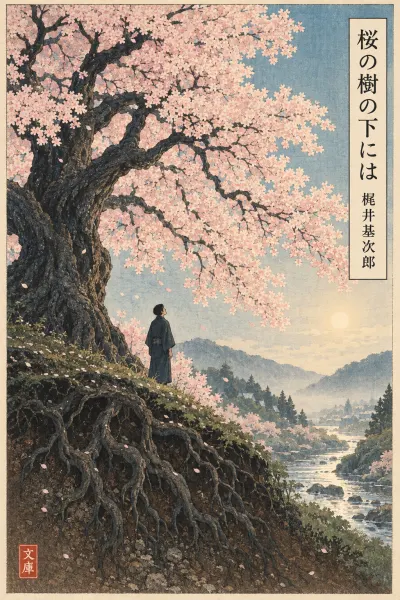
桜の樹の下には Sakura no Ki no Shita ni wa, part 1: Corpses Beneath the Blossoming Cherries
In this part
A narrator tells a silent listener that corpses are buried under the cherry trees. He says this is the only way he can accept the blossoms' beauty, which has unsettled him for days. He recalls a pool in a valley stream covered with dead mayflies, which gave him a grim pleasure and made him realize he needs tragedy to balance beauty. Picturing the trees' roots drinking the fluid of rotting bodies frees him from his unease, and he feels he now has the right to drink under the blossoms like the villagers.
AI translation · independently checked
桜の樹の下には屍体が埋まっている!There are corpses buried under the cherry trees!
これは信じていいことなんだよ。That's something you can believe, you know.
何故って、桜の花があんなにも見事に咲くなんて信じられないことじゃないか。Why? Because cherry blossoms blooming as gorgeously as that—it's unbelievable, isn't it?
俺はあの美しさが信じられないので、この二三日不安だった。I couldn't believe in that beauty, and so for the past two or three days I've been uneasy.
しかしいま、やっとわかるときが来た。But now, at last, the moment has come when I understand.
桜の樹の下には屍体が埋まっている。There are corpses buried under the cherry trees.
これは信じていいことだ。That's something you can believe.
どうして俺が毎晩家へ帰って来る道で、俺の部屋の数ある道具のうちの、選りに選ってちっぽけな薄っぺらいもの、安全剃刀の刃なんぞが、千里眼のように思い浮かんで来るのか――おまえはそれがわからないと言ったが――そして俺にもやはりそれがわからないのだが――それもこれもやっぱり同じようなことにちがいない。Why is it that every night, on my way back home, out of all the many things in my room, the one that surfaces in my mind, as if by second sight, is of all things some tiny, flimsy object—the blade of a safety razor? You said you couldn't understand it—and I can't understand it either—but this and that must surely be the same kind of thing.
いったいどんな樹の花でも、いわゆる真っ盛りという状態に達すると、あたりの空気のなかへ一種神秘な雰囲気を撒き散らすものだ。When the blossoms of any tree at all reach what we call full bloom, they scatter a kind of mysterious atmosphere into the air around them.
それは、よく廻った独楽が完全な静止に澄むように、また、音楽の上手な演奏がきまってなにかの幻覚を伴うように、灼熱した生殖の幻覚させる後光のようなものだ。It's like the way a top spinning well settles into perfect stillness, or the way a fine musical performance always brings some hallucination with it—it's something like a halo, a hallucination conjured up by white-hot procreation.
それは人の心を撲たずにはおかない、不思議な、生き生きとした、美しさだ。It's a strange, vivid beauty that can't help but strike a person's heart.
しかし、昨日、一昨日、俺の心をひどく陰気にしたものもそれなのだ。But it was also that very thing that made my heart so gloomy yesterday and the day before.
俺にはその美しさがなにか信じられないもののような気がした。To me, that beauty felt somehow like something I couldn't believe in.
俺は反対に不安になり、憂鬱になり、空虚な気持になった。Instead, I grew uneasy, I grew melancholy, I felt empty.
しかし、俺はいまやっとわかった。But now, at last, I understand.
おまえ、この爛漫と咲き乱れている桜の樹の下へ、一つ一つ屍体が埋まっていると想像してみるがいい。You—just try imagining that under these cherry trees, blooming wild in all their splendour, a corpse is buried beneath each and every one.
何が俺をそんなに不安にしていたかがおまえには納得がいくだろう。Then you'll understand what it was that had made me so uneasy.
馬のような屍体、犬猫のような屍体、そして人間のような屍体、屍体はみな腐爛して蛆が湧き、堪らなく臭い。Corpses like horses, corpses like dogs and cats, and corpses like human beings—the corpses are all rotting and swarming with maggots, and they stink unbearably.
それでいて水晶のような液をたらたらとたらしている。And yet they drip, drip, drip a fluid like crystal.
桜の根は貪婪な蛸のように、それを抱きかかえ、いそぎんちゃくの食糸のような毛根を聚めて、その液体を吸っている。The cherry roots clasp them like greedy octopuses, gathering their root hairs, like the feeding tentacles of sea anemones, and suck up that fluid.
何があんな花弁を作り、何があんな蕊を作っているのか、俺は毛根の吸いあげる水晶のような液が、静かな行列を作って、維管束のなかを夢のようにあがってゆくのが見えるようだ。What makes those petals, what makes those stamens? I can almost see the crystal fluid drawn up by the root hairs forming a quiet procession and rising, as in a dream, through the vascular bundles.
――おまえは何をそう苦しそうな顔をしているのだ。—Why are you making such a pained face?
美しい透視術じゃないか。Isn't it a beautiful kind of clairvoyance?
俺はいまようやく瞳を据えて桜の花が見られるようになったのだ。Only now have I finally become able to fix my eyes on the cherry blossoms and look at them.
昨日、一昨日、俺を不安がらせた神秘から自由になったのだ。I've been set free from the mystery that made me so uneasy yesterday and the day before.
二三日前、俺は、ここの溪へ下りて、石の上を伝い歩きしていた。Two or three days ago, I went down into the valley here and was walking along, stepping from stone to stone.
水のしぶきのなかからは、あちらからもこちらからも、薄羽かげろうがアフロディットのように生まれて来て、溪の空をめがけて舞い上がってゆくのが見えた。Out of the spray of the water, from here and from there, I could see mayflies being born like Aphrodite and fluttering up, heading for the sky above the valley.
おまえも知っているとおり、彼らはそこで美しい結婚をするのだ。As you know, up there they make their beautiful marriage.
しばらく歩いていると、俺は変なものに出喰わした。After I'd walked for a while, I came across something strange.
それは溪の水が乾いた磧へ、小さい水溜を残している、その水のなかだった。It was in the water of a small puddle the stream had left behind on the dry, stony riverbed.
思いがけない石油を流したような光彩が、一面に浮いているのだ。An unexpected sheen, like spilled oil, was floating all over its surface.
おまえはそれを何だったと思う。What do you think it was?
それは何万匹とも数の知れない、薄羽かげろうの屍体だったのだ。It was the corpses of mayflies, tens of thousands of them, more than anyone could count.
隙間なく水の面を被っている、彼らのかさなりあった翅が、光にちぢれて油のような光彩を流しているのだ。Their overlapping wings, covering the surface of the water without a gap, were crinkled by the light and gave off an oily sheen.
そこが、産卵を終わった彼らの墓場だったのだ。That was the graveyard of mayflies that had finished laying their eggs.
俺はそれを見たとき、胸が衝かれるような気がした。When I saw it, I felt as if my heart had been struck.
墓場を発いて屍体を嗜む変質者のような残忍なよろこびを俺は味わった。I tasted a cruel pleasure, like a pervert who digs up graves and relishes the corpses.
この溪間ではなにも俺をよろこばすものはない。In this valley, nothing gives me any pleasure.
鶯や四十雀も、白い日光をさ青に煙らせている木の若芽も、ただそれだけでは、もうろうとした心象に過ぎない。The bush warblers and the great tits, the young buds on the trees that blur the white sunlight into a hazy blue—on their own, they're nothing more than vague images in the mind.
俺には惨劇が必要なんだ。I need a tragedy.
その平衡があって、はじめて俺の心象は明確になって来る。Only with that counterweight do the images in my mind become clear.
俺の心は悪鬼のように憂鬱に渇いている。My heart thirsts for melancholy like a demon.
俺の心に憂鬱が完成するときにばかり、俺の心は和んでくる。Only when melancholy is complete in my heart does my heart grow calm.
――おまえは腋の下を拭いているね。—You're wiping your armpits, aren't you?
冷汗が出るのか。Are you breaking into a cold sweat?
それは俺も同じことだ。So am I.
何もそれを不愉快がることはない。There's no reason to find it unpleasant.
べたべたとまるで精液のようだと思ってごらん。Try thinking it's sticky, just like semen.
それで俺達の憂鬱は完成するのだ。That's how our melancholy becomes complete.
ああ、桜の樹の下には屍体が埋まっている!Ah, there are corpses buried under the cherry trees!
いったいどこから浮かんで来た空想かさっぱり見当のつかない屍体が、いまはまるで桜の樹と一つになって、どんなに頭を振っても離れてゆこうとはしない。The corpses, a fantasy that came from who knows where, have now become one with the cherry trees, and no matter how I shake my head, they won't go away.
今こそ俺は、あの桜の樹の下で酒宴をひらいている村人たちと同じ権利で、花見の酒が呑めそうな気がする。Now, at last, I feel I could drink blossom-viewing sake with the same right as the villagers holding their drinking party under those cherry trees.
Vocabulary
| Word | Meaning | JLPT |
|---|---|---|
| 屍体したい | corpse, dead bodyOlder spelling; today usually written 死体. | N2 |
| 埋まっているうまる | to be burieddictionary form: 埋まるIntransitive; transitive partner is 埋める (to bury). | N1 |
| 見事みごと | splendid, magnificentUsed as な-adjective; 見事に = splendidly. | N3 |
| 千里眼せんりがん | second sight, clairvoyanceLiterally 'eye that sees a thousand ri'. | — |
| 真っ盛りまっさかり | the height, full bloom真っ intensifies 盛り (peak). | — |
| 幻覚げんかく | hallucination, illusion | — |
| 後光ごこう | halo, aureoleOriginally the light behind a Buddha's head. | — |
| 憂鬱ゆううつ | melancholy, gloomA key word of the story; famously hard kanji. | N1 |
| 爛漫らんまん | in full, glorious bloomLiterary; common in 桜が爛漫と咲く. | — |
| 腐爛ふらん | rotting, decompositionModern spelling 腐乱. | — |
| 貪婪どんらん | greedy, voraciousLiterary; also spelled 貪欲 (どんよく) in everyday use. | — |
| 薄羽かげろううすばかげろう | mayfly-like insect (lit. thin-winged ephemera)かげろう suggests a creature that lives only a day; strictly an antlion, here the short-lived flies of the stream. | — |
| 磧かわら | dry, stony riverbedUsually written 河原 or 川原. | — |
| 惨劇さんげき | tragedy, gruesome event | — |
Grammar
〜ずにはおかない N1 cannot fail to; inevitably causes
Negative ず + にはおかない says something is bound to produce an effect. Here the beauty inevitably strikes the heart.
それは人の心を撲たずにはおかない、不思議な、生き生きとした、美しさだ。
It's a strange, vivid beauty that can't help but strike a person's heart.
〜てみるがいい N1 go ahead and try ~
て-form + みる (try) + がいい gives a slightly lofty or challenging invitation. The narrator pushes his listener to imagine the scene.
一つ一つ屍体が埋まっていると想像してみるがいい。
Just try imagining that a corpse is buried beneath each and every one.
〜がる / 〜がらせる N3 to show signs of feeling ~ / make someone feel ~
がる attaches to feeling words to describe a feeling seen from outside; its causative がらせる means 'make someone feel it'. 不愉快がる in a later sentence works the same way.
昨日、一昨日、俺を不安がらせた神秘から自由になったのだ。
I've been set free from the mystery that made me so uneasy yesterday and the day before.
〜て、はじめて N3 only after ~ does …
て-form + はじめて marks the condition that must come first before the result can happen. Clarity comes only once there is a counterweight of horror.
その平衡があって、はじめて俺の心象は明確になって来る。
Only with that counterweight do the images in my mind become clear.
〜ことはない N3 there's no need to ~
Dictionary form + ことはない tells someone an action is unnecessary; 何も strengthens it to 'no reason at all'.
何もそれを不愉快がることはない。
There's no reason to find it unpleasant.
〜なんぞ N1 something like ~ (dismissive)
An older, more colloquial form of なんか/など that adds a slightly contemptuous 'of all things'. It stresses how trivial the razor blade is.
安全剃刀の刃なんぞが、千里眼のように思い浮かんで来るのか
why something like a safety-razor blade surfaces in my mind as if by second sight