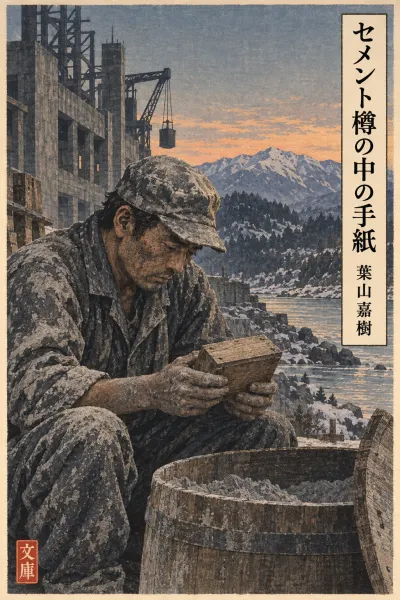
Part 2 of 2 · JLPT N2
セメント樽の中の手紙 Sementodaru no Naka no Tegami, part 2: A Dead Man's Lover Pleads, Yozō Drinks
In this part
The letter goes on. The young woman who sews cement sacks asks whoever finds it, if he is a fellow worker, to tell her where the cement made from her sweetheart's body was used. She sends him a scrap of the dead man's work clothes in return. Yozō gulps down his saké and shouts that he wants to get blind drunk and smash everything, but his heavily pregnant wife scolds him, and he sees their seventh child in her belly.
AI translation · independently checked
骨も、肉も、魂も、粉々になりました。Bones, flesh, soul: everything was ground to powder.
私の恋人の一切はセメントになってしまいました。All that was my sweetheart has turned into cement.
残ったものはこの仕事着のボロ許りです。All that is left is the rags of these work clothes.
私は恋人を入れる袋を縫っています。I am sewing the sacks that my sweetheart will be packed into.
私の恋人はセメントになりました。My sweetheart has become cement.
私はその次の日、この手紙を書いて此樽の中へ、そうと仕舞い込みました。The next day I wrote this letter and slipped it quietly into this cask.
あなたは労働者ですか、あなたが労働者だったら、私を可哀相だと思って、お返事下さい。Are you a working man? If you are a working man, then take pity on me and write back.
此樽の中のセメントは何に使われましたでしょうか、私はそれが知りとう御座います。What was the cement in this cask used for? I should so like to know.
私の恋人は幾樽のセメントになったでしょうか、そしてどんなに方々へ使われるのでしょうか。How many casks of cement did my sweetheart become, I wonder, and in how many different places will he be used?
あなたは左官屋さんですか、それとも建築屋さんですか。Are you a plasterer, or are you a builder?
私は私の恋人が、劇場の廊下になったり、大きな邸宅の塀になったりするのを見るに忍びません。I cannot bear to see my sweetheart become the corridor of a theatre, or the wall around some great mansion.
ですけれどそれをどうして私に止めることができましょう!And yet how could I ever stop it!
あなたが、若し労働者だったら、此セメントを、そんな処に使わないで下さい。If you are a working man, please do not use this cement in places like that.
いいえ、ようございます、どんな処にでも使って下さい。No, never mind. Use it wherever you like.
私の恋人は、どんな処に埋められても、その処々によってきっといい事をします。Wherever my sweetheart is buried, he will surely do some good in each and every place.
構いませんわ、あの人は気象の確かりした人ですから、きっとそれ相当な働きをしますわ。I don't mind. He is a man of steady character, so he will surely do work fitting for him.
あの人は優しい、いい人でしたわ。He was a kind, good man.
そして確かりした男らしい人でしたわ。And he was steady and manly.
未だ若うございました。He was still young.
二十六になった許りでした。He had only just turned twenty-six.
あの人はどんなに私を可愛がって呉れたか知れませんでした。I cannot tell you how dearly he loved me.
それだのに、私はあの人に経帷布を着せる代りに、セメント袋を着せているのですわ!And yet, instead of dressing him in a burial shroud, I am dressing him in cement sacks!
あの人は棺に入らないで回転窯の中へ入ってしまいましたわ。He did not go into a coffin; he went into the rotary kiln instead.
私はどうして、あの人を送って行きましょう。How am I to see him off on his last journey?
あの人は西へも東へも、遠くにも近くにも葬られているのですもの。For he lies buried to the west and to the east, far away and close by.
あなたが、若し労働者だったら、私にお返事下さいね。If you are a working man, please do write back to me.
その代り、私の恋人の着ていた仕事着の裂を、あなたに上げます。In return, I will give you a piece of the work clothes my sweetheart was wearing.
この手紙を包んであるのがそうなのですよ。That is what this letter is wrapped in.
この裂には石の粉と、あの人の汗とが浸み込んでいるのですよ。Stone dust and his sweat have soaked into this cloth.
あの人が、この裂の仕事着で、どんなに固く私を抱いて呉れたことでしょう。How tightly he used to hold me in the work clothes made of this very cloth.
お願いですからね。I beg of you.
此セメントを使った月日と、それから委しい所書と、どんな場所へ使ったかと、それにあなたのお名前も、御迷惑でなかったら、是非々々お知らせ下さいね。Please, please let me know the date you used this cement, the exact address, and what sort of place it went into. Tell me your name too, if it is no trouble.
あなたも御用心なさいませ。Do take care of yourself as well.
さようなら。Goodbye.
松戸与三は、湧きかえるような、子供たちの騒ぎを身の廻りに覚えた。Matsudo Yozō became aware of the children's racket boiling up all around him.
彼は手紙の終りにある住所と名前を見ながら、茶碗に注いであった酒をぐっと一息に呻った。Looking at the address and name at the end of the letter, he gulped down in one go the saké that had been poured into his rice bowl.
「へべれけに酔っ払いてえなあ。そうして何もかも打ち壊して見てえなあ」と怒鳴った。"I wanna get blind drunk. And then smash every damn thing to bits," he bellowed.
「へべれけになって暴れられて堪るもんですか、子供たちをどうします」"As if I'd put up with you getting blind drunk and running riot! What about the children?"
細君がそう云った。That was what his wife said.
彼は、細君の大きな腹の中に七人目の子供を見た。In his wife's great swollen belly he saw their seventh child.
(大正十五年一月)(January, Taishō 15)
Vocabulary
| Word | Meaning | JLPT |
|---|---|---|
| 粉々こなごな | into tiny pieces, to powderUsually used with になる or にする. 々 repeats the previous kanji. | N1 |
| 一切いっさい | all, everythingWith a negative it means 'not at all' (一切ない). | N1 |
| 仕舞い込みましたしまいこむ | to put away inside, to tuck awaydictionary form: 仕舞い込む込む adds the sense of 'into'. Normally written in kana today: しまい込む. | — |
| 邸宅ていたく | mansion, residenceA large house of the wealthy, which stresses the class contrast. | N1 |
| 気象きしょう | temperament, characterdictionary form: 気性Here written 気象 (now 'weather'), an older spelling for 気性. | — |
| 経帷布きょうかたびら | burial shrouddictionary form: 経帷子White robe printed with sutras, worn by the dead in a Buddhist burial. Usually written 経帷子. | — |
| 回転窯かいてんがま | rotary kilnRotating furnace used to make cement. 窯 becomes がま through rendaku. | — |
| 葬られてほうむる | to bury (the dead)dictionary form: 葬る | N1 |
| 裂きれ | piece of cloth, scrap of fabricCommonly written 切れ. As a verb, 裂く (さく) means 'to tear'. | — |
| 浸み込んでしみこむ | to soak in, to seep intodictionary form: 浸み込むNow usually written 染み込む. | — |
| 呻ったあおる | to gulp down (a drink)dictionary form: 呷るThe text uses 呻 ('groan') where 呷 is meant. It always suggests drinking hard in one go. | — |
| へべれけへべれけ | dead drunk, blind drunkColloquial. | — |
| 怒鳴ったどなる | to shout, to bellowdictionary form: 怒鳴る | N2 |
| 細君さいくん | wifeOld-fashioned word for one's own or another man's wife, common in prewar prose. | — |
Grammar
〜に忍びない N1 cannot bear to …
A verb in dictionary form plus に忍びない expresses that doing something is too painful to endure. Here it is used with 見る: she cannot bear to watch her lover's remains become part of rich people's buildings.
大きな邸宅の塀になったりするのを見るに忍びません。
I cannot bear to see him become the wall around some great mansion.
〜たり〜たりする N4 doing things like … and …
Lists representative actions or states without being exhaustive. Here になったり…になったり lists examples of what the cement might become.
劇場の廊下になったり、大きな邸宅の塀になったりする
becoming the corridor of a theatre or the wall of a great mansion
どんなに〜か知れない N2 I cannot say how much …; ever so much
どんなに plus a clause plus か知れない emphasises an immeasurable degree. Here the past form 知れませんでした keeps the narration in the past.
あの人はどんなに私を可愛がって呉れたか知れませんでした。
I cannot tell you how dearly he loved me.
〜てえ (= 〜たい) N2 want to … (rough colloquial)
In rough male speech the ai sound shifts to ee, so 酔っ払いたい becomes 酔っ払いてえ. 見てえ is 〜てみたい, 'want to try doing'.
へべれけに酔っ払いてえなあ。
I wanna get blind drunk.
〜て堪るもんですか N1 as if I'd put up with …; I won't stand for …
て堪る(も)のか is a strong rhetorical refusal: 'could I possibly endure …?', meaning 'certainly not'. The passive 暴れられて shows she is the one who would suffer from his rampage.
へべれけになって暴れられて堪るもんですか
As if I'd put up with you getting blind drunk and running riot!