Part 2 of 4 · JLPT N1
忘れ形見 Wasuregatami, part 2: Gossip About the Lady's Past
In this part
Village gossips whisper that the lord married beneath his rank. The story goes that the lady was a young widow with a baby, and that she was forced to give up her child forever before she could become a viscountess; ever since, she has seemed joyless. The narrator recalls seeing her weep while talking with Tokuzō in the woods, and remembers how tenderly she held him and listened to his childish dreams.
AI translation · independently checked
近処のものは、折ふし怪しからぬお噂をする事があって、冬の夜、炉の周囲をとりまいては、不断こわがってる殿様が聞咎めでもなさるかのように、つむりを集めて潜々声に、御身分違の奥様をお迎えなさったという話を、殿様のお家柄にあるまじき瑕瑾のようにいいました。The people of the neighbourhood would now and then pass around improper rumours. On winter nights, gathered round the hearth, they would put their heads together and whisper, as if the lord they always feared might overhear and take them to task, and they spoke of the tale that he had taken a wife of unequal station as though it were a blemish unworthy of his noble house.
この噂を聞いて「それは嘘だ、殿様に限ってそんな白痴をなさろうはずがない」といい罵るものもありましたが、また元の奥様を知っていた人から、すぐに聞たッて、一々ほんとうだといい張る者さえあったんです。Some who heard this shouted, "That's a lie! His lordship, of all people, would never do anything so foolish!" But others even insisted that every word of it was true, because they had heard it straight from someone who had known the lady in her former days.
その話というはこうなんです。The story went like this.
人の知らない遠い片田舎に、今の奥さまが、まだ新嫁でいらしッたころ、一人の緑子を形見に残して、契合た夫が世をお去りなすったので、迹に一人淋しく侘住いをして、いらっしゃった事があったそうです。It seems that, in a remote stretch of countryside far away where no one knew her, back when the present lady was still a new bride, the husband she had pledged herself to departed this world and left her a baby as his keepsake, and for a time she lived on alone after him in lonely, humble circumstances.
さすがの美人が憂に沈でる有様、白そうびが露に悩むとでもいいそうな風情を殿がフト御覧になってからは、優に妙なお容姿に深く思いを寄られて、子爵の御名望にも代られぬ御執心と見えて、行つ戻りつして躊躇っていらっしゃるうちに遂々奥方にと御所望なさったんだそうです。The lord happened to catch sight of her, a true beauty sunk in grief, with the air of a white rose, one might say, bowed down by the dew. From then on he gave his heart deeply to her graceful, exquisite looks. It seems his devotion was such that not even his good name as a viscount could outweigh it, and after wavering back and forth in hesitation, he at last asked for her as his wife.
ところがいよいよ子爵夫人の格式をお授けになるという間際、まだ乳房にすがってる赤子を「きょうよりは手放して以後親子の縁はなきものにせい」という厳敷お掛合があって涙ながらにお請をなさってからは今の通り、やん事なき方々と居並ぶ御身分とおなりなさったのだそうです。But just when she was at last to be granted the rank of viscountess, there came a stern demand: "From this day you must give up the baby still clinging to your breast, and from now on the bond between parent and child shall be as if it had never been." She accepted it in tears, and since then, as you see her now, she has become a lady of rank who takes her place among the most exalted people.
ところがあの通りこの上もない出世をして、重畳の幸福と人の羨むにも似ず、何故か始終浮立ぬようにおくらし成るのに不審を打ものさえ多く、それのみか、御寵愛を重ねられる殿にさえろくろく笑顔をお作りなさるのを見上た人もないとか、鬱陶しそうにおもてなしなさるは、お側のチンも子爵様も変った事はないとお附の女中が申たとか、マアとりどりに口賢なく雑談をしました。Yet though she had risen as high as anyone could, and people envied her abundant good fortune, for some reason she always lived as though nothing could lift her spirits, and many even found this strange. On top of that, people said that no one had ever seen her give so much as a proper smile, even to the lord who loved her more and more. They said the maid who waited on her had reported that she received her little lapdog and his lordship the viscount with the same weary air. Well, they gossiped about it in every way, with no restraint at all.
徳蔵おじがこんな噂をするのを聞でもしようもんなら、いつも叱り止るので、僕なんかは聞ても聞流しにしちまって人に話した事もありません。If Uncle Tokuzō ever happened to hear anyone spreading rumours like that, he would always scold them into silence. So as for me, even when I heard them I just let them go in one ear and out the other, and I never repeated them to anyone.
徳蔵おじは大層な主人おもいで格別奥さまを敬愛している様子でしたが、度々林の中でお目通りをしてる処を木の影から見た事があるんです。Uncle Tokuzō was tremendously devoted to his master and seemed to hold the lady in especially loving respect. Many a time I watched from behind a tree as he stood before her in the woods.
そういう時は、徳蔵おじは、いつも畏って奥様の仰事を承っているようでした。At such times Uncle Tokuzō always seemed to be listening humbly, standing respectfully, to whatever the lady was telling him.
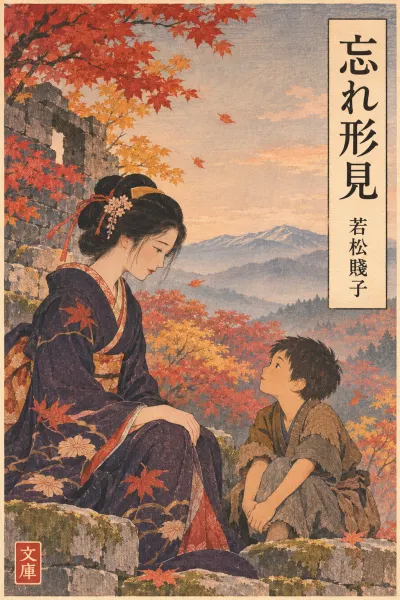
勿論何のことか判然聞取なかったんですが、ある時茜さす夕日の光線が樅の木を大きな篝火にして、それから枝を通して薄暗い松の大木にもたれていらっしゃる奥さまのまわりを眩く輝かさせた残りで、お着衣の辺を、狂い廻り、ついでに落葉を一と燃させて行頃何か徳蔵おじが仔細ありげに申上るのをお聞なさって、チョット俯向きにおなりなさるはずみに、はらはらと落る涙が、お手にお持なさった一と房の花の上へかかるのを、たしかに見た事があるんですが、これをおもえば、徳蔵おじの実貞な処を愛して、深い思召のある事をおおせにでもなったものと見えます。Of course I couldn't make out clearly what it was about. But once, the crimson rays of the setting sun turned a fir tree into a great bonfire, then passed through the branches and lit up the lady in a dazzling glow as she leaned against a huge, dim pine; what was left of the light danced wildly about her robes and set the fallen leaves briefly ablaze as it went. Just then, as she listened to Uncle Tokuzō say something that seemed to carry some weight and bowed her head a little, I distinctly saw tears fall, drop after drop, onto the spray of flowers she held in her hand. Thinking of it now, it seems she cherished Uncle Tokuzō's honest, faithful nature and must have confided to him something that lay deep in her heart.
おもえばあのように陰気で冷淡そうな方が僕のようなものを可愛がって下さるのは、不思議なようですが、ほんとうにそうなんでした。When I think of it, it seems strange that someone so gloomy and cold-seeming should have been so fond of someone like me, but that really was how it was.
よく僕は奥さまの仰しゃる通りに、頭を胸へよせ掛けて、いつまでか抱れていると、ジット顔を見つめていながら色々仰ったその言葉の柔和さ!Often, just as the lady told me to, I would rest my head against her breast and stay in her arms for who knows how long. And how gentle were the words she spoke to me, all the while gazing steadily into my face!
それからトント赤子でもあやすように、お口の内で朧におっしゃることの懐かしさ!And then, just as if she were soothing a baby, she would murmur softly under her breath. How dear that was to me!
僕は少さい内から、まじめで静かだったもんだから、近処のものがあたりまえの子供のあどけなく可愛ところがないといいいいしましたが、どうしたものか奥さまは僕を可愛やとおっしゃらぬ斗りに、しっかり抱〆て下すったことの嬉しさは、忘れられないで、よく夢に見い見いしました。I'd been serious and quiet ever since I was small, so the neighbours kept saying I had none of the innocent sweetness of an ordinary child. Yet for some reason the lady would hug me tight, all but saying "You dear little thing." I could never forget how happy that made me, and I dreamed of it over and over again.
僕はモウ先から孤になってたんだそうでお袋なんかはちっとも覚えがないんですから、僕の子供心に思うことなんざあ、聞てくれる人はなかったんですが、奥さま斗りには、なんでも好なことがいえたんです、「いいからどんなことでもかまわずお話し」と仰しゃるもんだから、お目に掛ったその日は木登りをして一番大きな松ぼっくりを落したというような事から、いつか船に乗って海へ行って見たいなんていう事まで、いっちまうと、面白がって聞ていて下すったんです。I'm told I was orphaned long ago, and I don't remember my mother at all, so there was nobody to listen to the things I thought about in my childish heart. But with the lady, and with her alone, I could say anything I liked. She would say, "It's all right, tell me anything at all, don't hold back," and so I'd come straight out with everything. I'd tell her how, on the day I saw her, I had climbed a tree and knocked down the biggest pine cone, and how someday I wanted to board a ship and go out to sea. And she would listen to it all with delight.
Vocabulary
| Word | Meaning | JLPT |
|---|---|---|
| 噂うわさ | rumour, gossipお噂 is honorific here because the gossip is about the lady. | N3 |
| 炉ろ | hearth, sunken fireplaceThe open fireplace (囲炉裏) where families gathered on winter nights. | — |
| 瑕瑾かきん | flaw, blemish (on one's honour)A literary word; here it is glossed with the everyday reading きず. | — |
| 片田舎かたいなか | remote countryside, out-of-the-way village | — |
| 緑子みどりご | newborn baby, infantA poetic, old-fashioned word, also written 嬰児. | — |
| 形見かたみ | keepsake, memento of someone who has diedA key word for the story; the title 忘れ形見 means a child left behind by a dead parent. | — |
| 侘住いわびずまい | lonely, humble way of livingdictionary form: 侘び住まい | — |
| 執心しゅうしん | infatuation, strong attachment | — |
| 所望しょもう | request, wish (formal)奥方にと所望する means to ask for a woman's hand as one's wife. | — |
| 縁えん | bond, tie (of family)親子の縁を切る means to formally sever the parent-child relationship. | N1 |
| 口賢なくくちさがない | gossipy, loose-tongueddictionary form: 口さがないThe kanji 口賢 is an unusual ateji spelling. | — |
| 聞流しききながす | to let pass unheeded, ignore what one hearsdictionary form: 聞き流す | — |
| 畏ってかしこまる | to stand or sit respectfully, be humbledictionary form: 畏まる | — |
| 孤みなしご | orphandictionary form: 孤児みなしご is the native word; こじ is the Sino-Japanese reading. | N1 |
Grammar
〜にあるまじき N1 unbecoming of, should not exist in
まじき is the attributive form of the classical まじ, meaning 'must not'. Xにあるまじき describes something that has no place in X. Here it marks the marriage as a disgrace to the lord's noble house.
殿様のお家柄にあるまじき瑕瑾のようにいいました
They spoke of it as a blemish unworthy of his lordship's noble house.
〜に限って〜はずがない N2 X of all people would never…
に限って singles out a person as the one least likely to do something. はずがない then denies the possibility strongly. Together they express the speaker's firm disbelief.
殿様に限ってそんな白痴をなさろうはずがない
His lordship, of all people, would never do anything so foolish.
〜つ〜つ N1 alternately doing A and B
The masu-stem plus つ, used twice with opposite verbs, describes repeated back-and-forth actions. 行きつ戻りつ means going forward and back again, a picture of hesitation.
行つ戻りつして躊躇っていらっしゃるうちに
while he wavered back and forth in hesitation
〜ながらに N1 while in a state of…
Attached to a noun, ながら(に) describes the state in which an action is done. 涙ながらに means 'in tears' or 'tearfully'.
涙ながらにお請をなさってからは
after she tearfully accepted
〜(よう)ものなら N2 if (by any chance)…, then (something bad follows)
The volitional form plus ものなら sets up a hypothetical event that would bring a bad result. Here もんなら is the colloquial contraction, and でもしよう adds 'ever happened to'.
徳蔵おじがこんな噂をするのを聞でもしようもんなら、いつも叱り止るので
If Uncle Tokuzō ever happened to hear anyone spreading rumours like that, he would always scold them into silence.
〜ぬばかりに N1 as if about to…, all but…
The negative form plus ばかりに, a variant of 〜んばかりに, means the person almost does the action, though not quite. The lady does not say 'dear child' aloud, but her hug says it. Here ばかり is written with the ateji 斗.
奥さまは僕を可愛やとおっしゃらぬ斗りに、しっかり抱〆て下すった
the lady hugged me tight, all but saying 'You dear little thing'