Upper intermediate · JLPT N2
予感Yokan — The Shiver Down His Spine
- JLPT N2
- 1,886 characters
- 1 part
- about 16 minutes
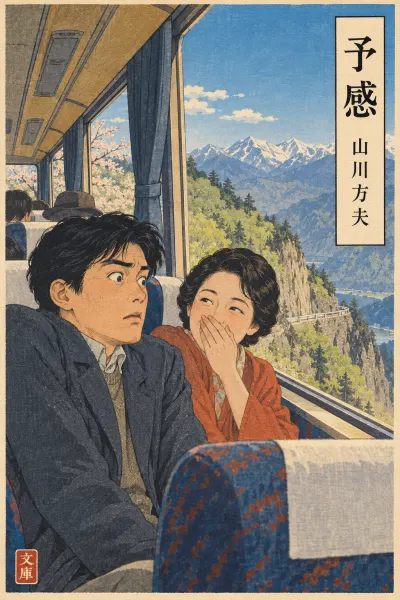
予感 is a very short story by Yamakawa Masao, a writer known for compact stories that turn on a final twist. A young married couple are riding a large sightseeing bus up a winding cliffside road towards Kozaru Pass on a clear early-spring day. Partway up, the husband feels a shiver down his spine, a sensation he believes warns him of coming good or bad luck. His wife laughs at him, but he refuses to drop it, and the trip takes a turn neither of them planned. The narration is close third-person and plain-form, dry and understated, and lets the couple's bickering carry most of the story. For learners, the text is short enough to read in one sitting, but it is rated N2. The challenge is in the natural, clipped dialogue: the husband's blunt casual speech, the wife's feminine sentence endings, the driver's stiff politeness, and a closing newspaper item written in terse journalistic Japanese. Reading it lets you compare four distinct registers on a single page.
Contents
Before you read
- Learn 〜どころではない and 〜どころか before you start. Both appear in the notes and express 'far from…' or 'no time for…', which suits the couple's escalating argument.
- Track who is speaking by register rather than by name. The husband uses ぼく and blunt plain forms, the wife ends sentences with わ, の and ねえ, and the driver uses です/ます. The text often gives no speaker tags, so these endings are your main clue.
- Watch for argumentative colloquial patterns such as 〜もんじゃない ('you shouldn't…') and 〜たっていいじゃないか ('surely it's fine to…'). They carry the tone of the quarrel and are worth adding to your speaking vocabulary.
- Read the final newspaper paragraph slowly. Journalistic Japanese drops particles and favours dense kanji compounds, so it reads very differently from the dialogue before it. Note how 〜たところだった ('had just…') pins down the timing of what happened.
- Notice 〜ないようにしている ('make a point of not…'). It reveals the husband's habits and how he treats his 'premonitions'.
Words to know
The most useful words from the notes across the story.
| Word | Meaning | JLPT |
|---|---|---|
| 予感よかん | premonition, forebodingThe title word. 予 'beforehand' + 感 'feel'. | N1 |
| 露骨ろこつ | open, blatant, undisguised | N1 |
| 転落てんらく | falling off (a road or cliff), plunging down墜落 (ついらく) in the husband's next speech usually refers to falling from a height, as with planes. | N1 |
| 気がかりきがかり | worry, something weighing on one's mind | — |
| 吉凶きっきょう | good or bad fortune吉 = lucky, 凶 = unlucky, as on omikuji fortune slips. Compare 吉兆 (good omen) and 凶兆 (bad omen). | — |
| 戦慄せんりつ | shiver, shudder (of fear)A literary word. In everyday speech you would say ゾクゾクする, as the husband does later. | — |
| 頬ばりほおばる | to stuff one's mouth (cheeks) with fooddictionary form: 頬張る | — |
| 苦笑くしょう | wry or bitter smileUsed with する. Also read as にがわらい when written 苦笑い. | — |
| 笑いとばしわらいとばす | to laugh off, dismiss with a laughdictionary form: 笑い飛ばす | — |
| ケチをつけるけちをつける | to put a damper on, find fault with, jinxdictionary form: けちを付けるColloquial. ケチ here means 'bad luck' or 'a flaw', not 'stingy'. | — |
| ひっきりなしにひっきりなし | constantly, without a breakdictionary form: 引っ切り無し | — |
| 下敷きしたじき | being pinned or crushed underneathUsed as 〜の下敷きになる. It also means a pencil board for writing on. | — |
| 即死そくし | instant deathTypical news style: the sentence ends on the noun with no verb. | — |
| 寸前すんぜん | just before, at the last moment | — |
Plot summary
Show the full summary (contains spoilers)
A young man and his wife are on a sightseeing bus climbing towards Kozaru Pass when he feels a shiver run down his spine. He believes this sensation has always warned him of good or bad fortune, and he takes it seriously. His wife mocks the idea, but he insists. He ends up in a row with the driver, and the couple are put off the bus. That evening a newspaper reports that the bus went off the road and landed on the road below, where it crushed and killed a couple who had just got off.
About the author
Yamakawa Masao (山川方夫) was a Tokyo-born writer and the son of the nihonga painter Yamakawa Shūhō. His own fiction was nominated several times for the Akutagawa Prize. He died at the age of thirty-four from injuries suffered in a traffic accident.