Part 1 of 1 · JLPT N2
予感 Yokan, part 1: A Warning Only He Can Feel
In this part
On a sightseeing bus climbing towards Kozaru Pass, a young man feels the shiver that he believes warns him of good or bad fortune. His wife mocks it, but he insists, and after a row with the driver the couple are put off the bus. That evening a newspaper reports that the bus went off the road and landed on the road below, where it crushed and killed a couple who had just got off.
AI translation · independently checked
深い谿をへだてた小さな山の斜面に、ぽつぽつ新緑が目立ちはじめ、その山肌に明暗の模様をつくりながら、いくつかの雲の落す影が動いている。On the slope of a small mountain across a deep valley, patches of fresh green were beginning to stand out here and there, and the shadows cast by a few clouds were drifting across it, making a pattern of light and dark on the mountainside.
遠く近く、早春の褐色の山の起伏がつらなり、それと明るくみずみずしい真青な空との対照は、美しいといえば美しく、和やかといえば和やかな景色だったが、でも、彼はそれどころではなかった。Near and far, the brown ridges of early spring rolled on one after another, and their contrast with the bright, fresh, deep-blue sky made a scene that was beautiful, if you wanted to call it that, and peaceful, if you wanted to call it that. But he was in no state to enjoy it.
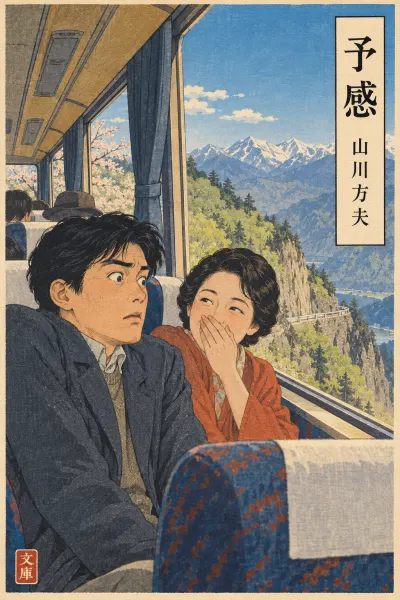
彼は、妻とならび、山腹を削りとった道をのぼってゆく、大型バスの座席に揺られていた。He sat beside his wife, rocking in his seat on a large bus that was climbing a road cut into the side of the mountain.
妻はキャラメルを頬ばり、幼いころのピクニックなんかの話をしている。His wife, her cheeks full of caramels, was talking about picnics and such from when she was little.
その声が、なんだか水の中で聞いているような気がするのは、つまりそれほど標高のたかいところにきたせいなのだろうか。Was it simply because they had climbed so high that her voice seemed to reach him as if he were hearing it underwater?
「耳がいたいの? 弱むし」"Do your ears hurt? You big baby."
「いや。ただボワーンとしてるだけさ」"No. They just feel kind of muffled, that's all."
彼は苦笑して答えた。He answered with a wry smile.
だが、気がかりはそんなことではなかった。But that wasn't what was bothering him.
彼は、自分に一種の予感の能力があるのを信じていた。He believed that he had a kind of gift for premonition.
当面の問題の吉凶が予知できるのである。He could tell in advance whether the matter at hand would turn out well or badly.
それは、ふいに背すじにはしり下りる、しびれるような短い戦慄で彼に報じられる。The message came to him as a brief, tingling shiver that suddenly ran down his spine.
その戦慄の微妙な差で、彼は、それが吉兆か凶兆かを区別するのである。From subtle differences in that shiver, he could tell whether it was a good omen or a bad one.
その警笛が、じつはさっきから背中で鳴りつづけているのだ。And that alarm, in fact, had been going off in his back for a while now.
学年試験のとき、入社試験のとき、そして妻とはじめて会社のそばの喫茶店で出逢ったとき――もっとも、このときは全身がガタガタとふるえつづけ、吉か凶かの差違がよくわからなかったが、――ともあれ、かならずこの戦慄が、結果を彼にあらかじめ教えたのだ。At his end-of-year exams, at his company entrance exam, and when he first met his wife at a coffee shop near the office (though that time his whole body kept shaking so hard that he couldn't really tell whether the sign was good or bad), at any rate, this shiver had always told him the outcome beforehand.
でも、妻はそれを信じない。But his wife didn't believe in it.
信じないどころか笑いとばし、しまいには怒りはじめるのだ。Far from believing in it, she laughed it off, and in the end she would start getting angry.
それはたいへん彼のプライドを傷つけることだったが、彼は我慢をして、近ごろでは、なるべくその予感を口に出さないようにしていた。This hurt his pride badly, but he put up with it, and lately he had been trying, as far as possible, not to speak his premonitions aloud.
予言者というものは、がんらい孤独なのだ。Prophets are, by their very nature, lonely.
――でも……でも……。But... but...
幾重にも屈折する道を、大型のバスはあえぐようなエンジンのうなりをあげ、かなりのスピードで坂道にかじりつくように登ってゆく。Along the road that doubled back on itself again and again, the big bus climbed with a panting groan of its engine, clinging to the slope at quite a speed.
窓ガラスに青空が旋回して、タイヤからはじけとぶ小石が弧を描いて音もなく崖の下に吸いこまれる。The blue sky wheeled across the window glass, and pebbles flung from the tyres traced arcs and were swallowed without a sound into the depths below the cliff.
……もう、黙っていることはできない。...He could not keep quiet any longer.
彼は立ち上った。He stood up.
「おい、下りよう、このバス」"Hey, let's get off this bus."
「なんですって?」"What did you say?"
妻はぽかんとした。His wife stared at him blankly.
「危いんだ。ほら、あの例のやつでぼくにはちゃんとわかる。きっと、このバスは転落する。ぼくたちには、死の危険があるんだ」"It's dangerous. You know, that thing of mine. It's telling me loud and clear. This bus is going to go over the edge, I'm sure of it. Our lives are in danger."
「また、バカをいって、……」"Talking nonsense again..."
妻は真赤になり、彼の服をつかんだ。His wife turned bright red and grabbed hold of his clothes.
「やめてよ、へんなこというもんじゃないの。バカねえ」"Stop it. You shouldn't say such weird things. You idiot."
「バカじゃないよ」"I'm not an idiot."
「バカよ、あなたは。狂人だわ」"Yes, you are. You're out of your mind."
「信じないのはわかってるよ、でも、一度ぐらい信じたっていいじゃないか」"I know you don't believe me, but couldn't you believe me just this once?"
また戦慄がはしり落ちて、恐怖が、彼の全身をつかんだ。Another shiver shot down his back, and terror seized his whole body.
「ほんというと、昨夜からなんだよ? 君にいうとせっかくの旅行にケチをつけるとかなんとか、また怒ったりするから黙っていたんだ。"To tell the truth, it's been going on since last night, okay? I kept quiet because if I told you, you'd get angry again and say I was spoiling our trip or something.
でも、もう我慢できない。今日、このバスに乗るまでに三回、乗ってからはひっきりなしに背中が悪くゾクゾクしつづけているんだ。But I can't stand it any more. Three times today before we got on this bus, and ever since we got on, my back hasn't stopped shivering, a bad kind of shivering.
こんなひどいのははじめてだよ。とにかく、絶対にこのバスはよくないんだ。墜落する」It's never been this bad before. Anyway, this bus is absolutely no good. It's going to fall."
「あなた風邪じゃないの? でなきゃ脊髄カリエスかなんかじゃない? それは、きっとお医者さまに診てもらえってだけのことだわ」"Haven't you just caught a cold? Or else it's spinal tuberculosis or something, isn't it? All it means is that you should go and get a doctor to look at you."
「ちがう、ちがうったら!」"No, I said no!"
彼の大声が耳に入ったのか、不機嫌な顔を露骨にした運転手が振りかえった。Perhaps his raised voice had reached the driver's ears, because the man turned round, openly scowling.
「私の運転が、信用できないっていうんですか?」Are you saying you can't trust my driving?
「いや、いや」"No, no."
あわてて彼はいった。He said hastily.
「ぼくは事故をおそれているんだ。どんな事故かわからないし、みんなにたいして関係がないかもしれない。しかしぼくらには生命の問題だっていう気がする。ぼくの予感は正確なんだ」"I'm afraid of an accident. I don't know what kind of accident, and maybe it won't have much to do with everyone else. But I have a feeling it's a matter of life and death for the two of us. My premonitions are accurate."
「もう少しですよ、小猿峠までは」It isn't far now to Kozaru Pass.
「かまわん、かまわんから下ろしてくれ、ぼくたちは歩いてゆく」"I don't care, I don't care, just let us off. We'll walk."
中年の運転手は、あきらかに怒っていた。The middle-aged driver was clearly angry.
「よし、じゃ下りてもらいましょう、ほかのお客さん方にご迷惑だ」"Very well, then I must ask you to get off. You are disturbing the other passengers."
バスは無事に停り、彼と妻を下ろして出発した。The bus came to a safe stop, let him and his wife off, and drove away.
乗客たちは、それぞれのおしゃべりをつづけながら、荷物を赤土の道に置き、真赤な顔でさかんに口論をつづけているこの若い夫婦を、バスの後方の窓から眺めた。The passengers kept up their own chatter as they watched from the rear window of the bus. The young couple had put their bags down on the red-earth road and were still arguing heatedly, both red in the face.
バスはすぐカーブを切り、二人の姿は赤茶色の崖の斜面にかくれた。The bus soon swung round a bend, and the two of them disappeared behind the reddish-brown slope of the cliff.
その日。That same day.
……夕刊は次のような記事をのせた。...The evening paper ran the following article.
『――今日午後二時ごろ、××観光の大型バスが、小猿峠付近でハンドルを切りそこねて転落した。さいわい一段下の道に落ちただけで止ったので、乗客には死者はなかった。"At about 2 p.m. today, a large bus belonging to XX Tours failed to make a turn near Kozaru Pass and went off the road. Fortunately, it came to rest after falling only as far as the road one level below, and there were no deaths among the passengers.
だが、下の道を歩いていた一組の夫婦がバスの下敷きとなって即死。However, a married couple walking along the road below were crushed beneath the bus and killed instantly.
この夫婦は、その寸前にこのバスから下りたところだった。』The couple had got off the same bus only moments before."
Vocabulary
| Word | Meaning | JLPT |
|---|---|---|
| 予感よかん | premonition, forebodingThe title word. 予 'beforehand' + 感 'feel'. | N1 |
| 気がかりきがかり | worry, something weighing on one's mind | — |
| 吉凶きっきょう | good or bad fortune吉 = lucky, 凶 = unlucky, as on omikuji fortune slips. Compare 吉兆 (good omen) and 凶兆 (bad omen). | — |
| 戦慄せんりつ | shiver, shudder (of fear)A literary word. In everyday speech you would say ゾクゾクする, as the husband does later. | — |
| 頬ばりほおばる | to stuff one's mouth (cheeks) with fooddictionary form: 頬張る | — |
| 苦笑くしょう | wry or bitter smileUsed with する. Also read as にがわらい when written 苦笑い. | — |
| 笑いとばしわらいとばす | to laugh off, dismiss with a laughdictionary form: 笑い飛ばす | — |
| ケチをつけるけちをつける | to put a damper on, find fault with, jinxdictionary form: けちを付けるColloquial. ケチ here means 'bad luck' or 'a flaw', not 'stingy'. | — |
| ひっきりなしにひっきりなし | constantly, without a breakdictionary form: 引っ切り無し | — |
| 露骨ろこつ | open, blatant, undisguised | N1 |
| 転落てんらく | falling off (a road or cliff), plunging down墜落 (ついらく) in the husband's next speech usually refers to falling from a height, as with planes. | N1 |
| 下敷きしたじき | being pinned or crushed underneathUsed as 〜の下敷きになる. It also means a pencil board for writing on. | — |
| 即死そくし | instant deathTypical news style: the sentence ends on the noun with no verb. | — |
| 寸前すんぜん | just before, at the last moment | — |
Grammar
〜どころではない N2 in no position to; far from being able to
それどころではない says the situation leaves no room for the thing just mentioned. Here he is too worried to enjoy the scenery.
でも、彼はそれどころではなかった。
But he was in no state to enjoy it.
〜どころか N2 far from ~, on the contrary
This pattern rejects the first idea and replaces it with something even further in the opposite direction. She not only refuses to believe him but also laughs at him.
信じないどころか笑いとばし、しまいには怒りはじめるのだ。
Far from believing in it, she laughed it off, and in the end would start getting angry.
〜ないようにしている N4 to try (habitually) not to ~
〜ようにする means making an ongoing effort, and the ている form shows a continuing habit. なるべく ('as far as possible') softens it.
なるべくその予感を口に出さないようにしていた
he had been trying, as far as possible, not to speak his premonitions aloud
〜もんじゃない N3 one shouldn't ~ (general advice or reproach)
This is the casual form of ものではない. It states what is improper as a general rule, and here it scolds him for saying such things.
やめてよ、へんなこというもんじゃないの。
Stop it. You shouldn't say such weird things.
〜たっていいじゃないか N3 surely it's fine to ~, wouldn't it be all right to ~
〜たって is the colloquial form of 〜ても. Combined with いいじゃないか, it makes a pleading or indignant appeal for permission.
一度ぐらい信じたっていいじゃないか
couldn't you believe me just this once?
〜たところだった N4 had just ~
The past form of a verb plus ところだ marks an action that has only just been completed. In the news report, it reveals that the dead couple had got off the bus moments earlier.
この夫婦は、その寸前にこのバスから下りたところだった。
The couple had got off the same bus only moments before.