Upper intermediate · JLPT N2
ああ華族様だよ と私は嘘を吐くのであったAa Kazokusamada yo to Watakushi wa Uso o Haku Node Ata — A Nobleman, of Course," I Lied
- JLPT N2
- 3,032 characters
- 2 parts
- about 25 minutes
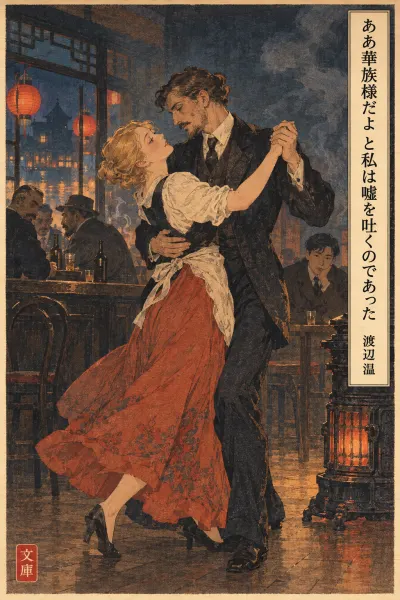
This is a short first-person sketch of one night out in Yokohama in the years after the Russian Revolution. The narrator, new to the city's nightlife, is guided by his neighbour Alexander, a handsome and penniless émigré who once danced at the Russian imperial court and now plays the cello in Ginza. The two drift from the cosmopolitan bars of Chinatown to a dance hall in Motomachi, and then on into the hillside and seaside brothel quarters as the night grows late. The story is less about plot than about mood. It is full of foreign drinkers, worn-out dancers, closing times and cold rooms, and it carries a wry, melancholy humour that sharpens towards the quiet final scene. The subject matter is adult, though it is handled without explicitness. For learners, the text is short but dense. It uses prewar kanji and spellings, many katakana loanwords in quaint forms, and a long list of real Yokohama place names. Alexander's stiff, over-polite foreigner's Japanese is easy to spot and fun to follow, and it contrasts with the narrator's casual male speech.
Contents
Before you read
- Learn the narrative ending 〜のであった before you start. It appears in the title itself (嘘を吐くのであった) and gives the narration its reflective, slightly ironic tone. It means roughly 'and so it was that…'.
- Expect older kanji spellings of common grammar: 〜に依れば (=によれば), 〜にも拘らず (=にもかかわらず), 已を得ず (=やむを得ず), and 〜度い for 〜たい. Once you recognise them, they read like normal modern grammar.
- Alexander's lines stand out through forms like 〜ませんです. This is deliberately clumsy, over-polite foreigner's Japanese, so don't try to copy it. Use it as a cue for who is speaking.
- Many katakana words use old long-vowel spellings with a vowel letter instead of ー, such as インタアナショナル, バンガロオ and ハイデルベルヒ (Heidelberg). Read them aloud to find the familiar word.
- Skim the place-name list before reading: 山下町, 元町, 大丸谷, 本牧, 十二天, 小港. The second part is essentially a route through Yokohama, and knowing which names are districts and which are hotels makes it much easier to follow.
Words to know
The most useful words from the notes across the story.
| Word | Meaning | JLPT |
|---|---|---|
| 到頭とうとう | in the end, finallyUsually written in kana today: とうとう. | N4 |
| サクラさくら | shill, planted customerSlang: someone who poses as a customer to draw others in. | N3 |
| やっかいやっかい | troublesome, a nuisancedictionary form: 厄介 | N3 |
| 心得てこころえる | to know well, to be familiar withdictionary form: 心得るImplies practical, experienced knowledge. | N2 |
| 満員まんいん | full (no room left)Today often used of crowded trains: 満員電車. | N2 |
| 忽たちまち | at once, instantlydictionary form: 忽ち | N2 |
| 催促さいそく | urging, pressing someone to act | N2 |
| 大方おおかた | mostly, for the most part | N1 |
| 咄嗟とっさ | on the spur of the momentUsed as 咄嗟に, 'instantly, without thinking'. | N1 |
| 居留地きょりゅうち | foreign settlement (district where foreigners lived)Historical term for the treaty-port areas such as Yokohama's Yamate and Yamashitachō. | — |
| 名告るなのる | to call oneself, to give one's name asdictionary form: 名乗る名告る is an older spelling of 名乗る. | — |
| 生業せいぎょう | livelihood, occupationWritten style; also read なりわい. | — |
| 羅紗らしゃ | woollen clothFrom Portuguese raxa. Russian cloth peddlers were a familiar sight in prewar Japan. | — |
| 眉目秀麗びもくしゅうれい | handsome, good-looking (of a man)A four-character compound; here the author glosses it as ハンサム. | — |
| 拙いつたない | clumsy, unskilful | — |
Plot summary
Show the full summary (contains spoilers)
The narrator spends his first night out in Yokohama with Alexander, a Caucasus-born former imperial dancer who came to Japan via Shanghai. At the International bar in Chinatown, Alexander teases the blonde waitress Marusha about her love for a Japanese novelist and dances with her. Afterwards they kill time at the Bungalow dance hall, where a drunken, ageing dancer insists on teaching the narrator to dance. The hall closes at midnight. They walk to Daimarudani, but there a hotel turns them away as 'full', even after Alexander claims they are Chinese. They take a taxi to Honmoku and settle on the Étoile in Kominato. There the narrator chooses a pale, thin woman, who admits in bed that she is ill. He lies that he is a baron. He embraces her anyway, remembering Alexander's saying that such disease binds men and women just as love does.
About the author
Watanabe On was a Japanese modernist writer of short fiction. He is closely associated with the magazine Shinseinen (新青年), which he also worked on as an editor. His stories are brief, stylish and often fantastical or bittersweet, and they are marked by the urban, cosmopolitan atmosphere of the 1920s: cafés, bars, dance halls and foreigners. His elder brother, Watanabe Keisuke, was also a writer of mystery fiction.