Part 2 of 2 · JLPT N2
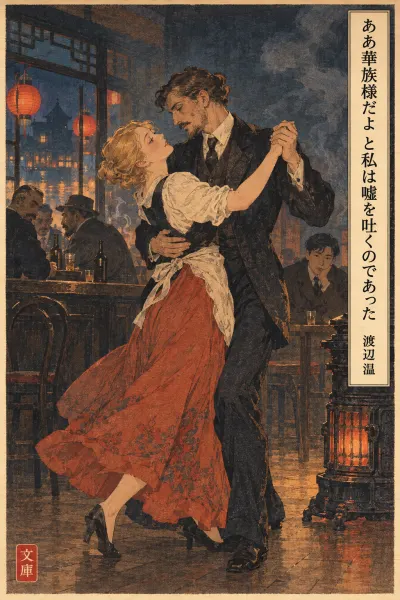
ああ華族様だよ と私は嘘を吐くのであった Aa Kazokusamada yo to Watakushi wa Uso o Haku Node Ata, part 2: A Night in Honmoku and a Lie
In this part
After a dancer's tumbles at the Bungalow, the narrator and Alexander are turned out at midnight and walk to Daimarudani, where a hotel turns them away as 'full' even after Alexander claims they are Chinese. They take a taxi to Honmoku and enter the Étoile, where the narrator chooses a pale, thin woman who later admits she is ill. In bed he lies that he is a baron and embraces her despite her illness, recalling Alexander's saying that such disease links men and women just as love does.
AI translation · independently checked
だが、彼女は直ぐに、蝋引きの床の上に滑ってころがった。But she promptly slipped and went tumbling across the waxed floor.
何度でもころがった。Down she went, again and again.
私は到頭、やっかいな老踊子を、静かに長椅子の上に寝かしてやらなければならなかった。In the end I had to lay the troublesome old dancer gently down on the couch.
十二時にバンガロオを追い出されて、私達はさて、大方寝てしまった元町通りを、真直に徒歩で大丸谷へ向った。At twelve o'clock we were turned out of the Bungalow, and so we set off on foot, straight along Motomachi's main street, which had mostly gone to sleep, towards Daimarudani.
『大丸谷は本牧より半分安いですが、悪い。そして、日本人は好かれませんよ。』と、アレキサンダー君は、私と腕を組ませて歩きながら云った。"Daimarudani is half the price of Honmoku, but it is bad. And Japanese are not liked there, you know," said Alexander, walking with his arm linked through mine.
草の生えている真暗な坂道を上がって行くと、左側に何々ホテルと記した、軒燈りの見える家が幾軒となく立ち並んでいた。As we climbed a pitch-dark, grass-grown slope, we saw on the left a whole row of houses with lamps glowing under their eaves, each bearing a sign reading Such-and-such Hotel.
私達はその中で、一等堂々として見える新九番館を的にして行ったのだったが、玄関も窓も、すっかり暗くなっていたので、已を得ず、その裏側にある東京ホテルの玄関を敲いた。Of these we had made for the Shinkyūbankan, which looked by far the grandest, but its entrance and windows were completely dark, so we had no choice but to knock at the door of the Tōkyō Hotel round the back of it.
『何国?――』と云う声と共に、傍の小窓が開いた。"What country?" a voice called, and a small window beside the door slid open.
窓明りを背負って現われた黒い女の顔は、玄関の扉にくっ着いているアレキサンダー君よりも、その後に立った私の方を主に窺った。The woman's face that appeared there, dark against the light behind her, peered mostly past Alexander, who was pressed close to the door, at me, standing behind him.
『支那人。』とアレキサンダー君が咄嗟に答えた。"Chinese," Alexander answered on the spot.
が、『満員!――』そして忽ち、窓は閉まった。But: "Full up!" And at once the window shut.
『ちえッ!――』アレキサンダー君は、唾を甃石の上へ吐きつけた。"Tch!" Alexander spat onto the paving stones.
『チボリへ行っても寝ています、本牧へ行きましょう。』"Even if we go to Tivoli, they will be sleeping. Let us go to Honmoku."
『オールライト!』"All right!"
と、私は答へた。I answered.
私達は、それから本牧へタキシイを駛らせながら、十二天と小港の何れを択ぶべきかと相談した。After that, as we sped a taxi towards Honmoku, we discussed whether we ought to choose Jūniten or Kominato.
そして結局、キヨ・ホテルはブルジョワ・イデオロギイであると云うので、後者をとることになった。In the end, since the Kiyo Hotel was declared to be bourgeois ideology, we decided on the latter.
車は夜更けの海辺を疾走した。The car raced along the shore in the dead of night.
狭い横町を左へ折れて、梅に鴬の燈りが灯っているホテルの前を過ぎると、間もなくアレキサンダー君は車を停めさせた。We turned left into a narrow side street and passed a hotel whose lamp bore a design of a bush warbler on a plum branch, and soon afterwards Alexander had the car stop.
私達は、エトワールと云うホテルに入った。We went into a hotel called the Étoile.
ひきつけとも云うべき明るい広間に、十人もの六月の牡丹の如く絢爛たる女が並んでいた。In a bright hall that might be called the receiving room, as many as ten women stood in a row, gorgeous as peonies in June.
アレキサンダー君には、すでに馴染があったが、私はその中で、最も自分の気に入ったどの女をでも、選択することが出来たのである。Alexander already had a favourite there, but I was free to choose whichever of them pleased me most.
女達はアレキサンダー君を、『サーシャ』『サーシャ』と呼んで取り巻いた。The women crowded around Alexander, calling, "Sasha! Sasha!"
アレキサンダー君の女は、頭を美事な男刈にした、眉根の険しい感じのする、十七八にしか見えない小娘であった。Alexander's woman was a slip of a girl who looked no more than seventeen or eighteen, her hair cropped splendidly short like a boy's, and with a fierce look about her brows.
『サーシャ、タンゴ――』と、その女は直ぐに男の体に絡みついた。"Sasha, tango—" said the girl, and at once she twined herself around him.
私は自分の女を択ぶことを、『酒場さん』なる鴇母さんに催促された。The madam, known as Sakaba-san, pressed me to choose my woman.
私は大勢の女の一等後の方で、蒼い顔をして外っぽを向いている、痩せた女を指してしまった。Without quite meaning to, I pointed to a thin woman at the very back of the crowd, pale-faced and looking away.
彼女はさっきから、私の心を殊の外惹いていた。For some time already she had been drawing my heart to her in a particular way.
それと云うのは、彼女は他の女達のように、私へ笑いをかけることをちっともしなかったし、それに脆弱な花のように、ひどくオドオドとした哀れな風情が、その大きな愁しげな眼や、尖った肩さきなどに感じられたからである。That was because, unlike the other women, she made no effort at all to smile at me, and because about her large, sorrowful eyes and her sharp, bony shoulders I sensed a pitiful air, timid and trembling, like a fragile flower.
併し、これは鴇母さんにも、他の女達にもまたサーシャにも、少からず意外であるらしかった。This, however, seemed to come as no small surprise to the madam, to the other women, and to Sasha too.
が、私は彼女を膝の上に腰かけさせて、その艶のない頬を撫でてやった。But I sat her on my knee and stroked her lustreless cheek.
私共は二人分として二十五円払った。We paid twenty-five yen for the two of us.
勘定が済むと、それぞれの寝室へ入った。When the bill was settled, we each went to our bedrooms.
私の女は、私の衣服をたたんで、鏡台のついた箪笥へしまってくれた。My woman folded my clothes and put them away for me in a chest of drawers fitted with a mirror.
『あなた、偉い方?』と女は私の髪を骨ばった指で弄びながら訊いた。"Are you somebody important?" she asked, toying with my hair with her bony fingers.
女の声は喉もとで嗄がれて、長い溜息のような音を立てた。Her voice was hoarse in her throat and made a sound like a long sigh.
『ああ、華族様さ。けれども男爵だよ。』と、私は嘘を吐くのであった。"Yes, I'm a nobleman. Only a baron, though," I lied.
『そう、いいわねえ。』彼女の声は風のように鳴った。"Really? How lovely." Her voice whistled like the wind.
『君、病気なんだね。肺病だろう?』"You're ill, aren't you? It's consumption, isn't it?"
『ごめんなさいね――あたし、死ぬかもわからないの。』"I'm sorry—I might die, you know."
『いいよ、いいよ。君が死ねば、僕だって死ぬよ。』"It's all right, it's all right. If you die, I'll die too."
『まあ――調子がいいわね。』私は彼女の、小さな頭を胸の中に抱いた。"Oh, how smooth you are." I held her small head against my chest.
『お止しなさいな。あたし、もっと悪い病気なのよ。』と、彼女は唇をそらそうと踠いた。"Please don't. I've got a worse illness than that," she said, struggling to turn her lips away.
『いいよ、いいよ。』私は、そして、無理遣りに彼女の頬を両腕の中におさえた。"It's all right, it's all right." And I held her cheeks firmly between my arms, whether she would or no.
――そんな病気は、世界中の何万何億と云う男と女とを、久しい時代に渡って一人一人つないで来た――云いかえれば、男女の間の愛と同じ性質のものである――と云った、アレキサンダー君の言葉を思い出しながら……—remembering as I did so Alexander's words: that such a disease has linked, one by one and across long ages, untold millions upon millions of men and women all over the world—that, in other words, it is of the same nature as the love between man and woman…
Vocabulary
| Word | Meaning | JLPT |
|---|---|---|
| 到頭とうとう | in the end, finallyUsually written in kana today: とうとう. | N4 |
| やっかいやっかい | troublesome, a nuisancedictionary form: 厄介 | N3 |
| 大方おおかた | mostly, for the most part | N1 |
| 咄嗟とっさ | on the spur of the momentUsed as 咄嗟に, 'instantly, without thinking'. | N1 |
| 満員まんいん | full (no room left)Today often used of crowded trains: 満員電車. | N2 |
| 忽たちまち | at once, instantlydictionary form: 忽ち | N2 |
| 疾走しっそう | dashing, racing along at full speed | — |
| 絢爛けんらん | gorgeous, dazzlingLiterary; 絢爛たる is an old adjectival form, like 堂々たる. | — |
| 馴染なじみ | a regular partner, a familiar favouritedictionary form: 馴染みIn the pleasure quarters, a customer's regular woman; generally 'familiarity'. | — |
| 催促さいそく | urging, pressing someone to act | N2 |
| 風情ふぜい | air, look, atmosphere about someone | — |
| 華族かぞく | the nobility (prewar Japanese peerage)Abolished in 1947; do not confuse with 家族 'family', which sounds the same. | — |
| 男爵だんしゃく | baronThe lowest rank of the prewar peerage. | — |
| 肺病はいびょう | consumption, tuberculosisOld everyday word for 結核. | — |
Grammar
〜てやらなければならなかった N4 had to do (for someone)
〜てやる shows the speaker doing something for someone (here, for the troublesome dancer), and 〜なければならなかった turns it into 'had to'. The narrator has no choice but to settle her down on the couch.
静かに長椅子の上に寝かしてやらなければならなかった
I had to lay her gently down on the couch
幾〜となく N1 countless, any number of
幾 plus a counter followed by となく means 'too many to count'. 幾軒となく means 'house after house'.
家が幾軒となく立ち並んでいた
a whole row of houses stood one after another
已を得ず(やむを得ず) N2 having no choice, unavoidably
A fixed expression meaning 'it cannot be helped'. 已 is an old kanji spelling of やむ, so the phrase is usually written in kana or as 止むを得ず.
已を得ず、その裏側にある東京ホテルの玄関を敲いた
we had no choice but to knock at the door of the Tōkyō Hotel round the back
〜べきか N2 whether one should ~
べき expresses what one ought to do, and the か makes it an embedded question. 何れを択ぶべきか means 'which of the two we ought to choose'.
十二天と小港の何れを択ぶべきかと相談した
we discussed whether we ought to choose Jūniten or Kominato
〜の如く N1 like ~, as if ~
A literary equivalent of 〜のように. It compares the women to peonies.
六月の牡丹の如く絢爛たる女が並んでいた
women stood in a row, gorgeous as peonies in June
〜のであった N2 and so it was that ~ (narrative emphasis)
The past-tense explanatory ending gives a reflective, storytelling tone, as if the narrator is stepping back to comment on his own act. This line also gives the story its title.
と、私は嘘を吐くのであった
and so I told a lie