Part 1 of 2 · JLPT N2
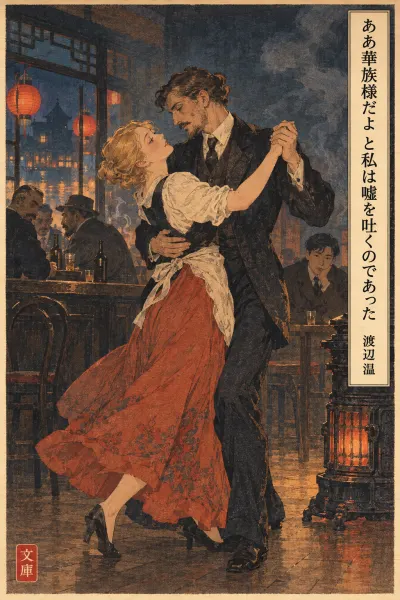
ああ華族様だよ と私は嘘を吐くのであった Aa Kazokusamada yo to Watakushi wa Uso o Haku Node Ata, part 1: A Night Out in Yokohama's Chinatown
In this part
The narrator goes out in Yokohama for the first time, guided by his neighbour Alexander, a handsome, penniless former dancer of the Russian imperial court who now plays the cello in a Ginza restaurant. They drink at the International bar in Chinatown, where Alexander teases the blonde waitress Marusha about her love for a Japanese novelist and dances with her. Then they wait until midnight at the Bungalow dance hall, where a very drunk, ageing dancer insists on teaching the narrator to dance.
AI translation · independently checked
居留地女の間ではAmong the Women of the Foreign Settlement
その晩、私は隣室のアレキサンダー君に案内されて、始めて横浜へ遊びに出かけた。That evening, guided by Alexander, who lived in the room next to mine, I went out to amuse myself in Yokohama for the first time.
アレキサンダー君は、そんな遊び場所に就いてなら、日本人の私なんぞよりも、遙かに詳かに心得ていた。When it came to places of that sort, Alexander knew them far more thoroughly than a mere Japanese like me.
アレキサンダー君は、その自ら名告るところに依れば、旧露国帝室付舞踏師で、革命後上海から日本へ渡って来たのだが、踊を以て生業とすることが出来なくなって、今では銀座裏の、西洋料理店某でセロを弾いていると云う、つまり街頭で、よく見かける羅紗売りより僅かばかり上等な類のコーカサス人である。By his own account, Alexander had once been a dancer attached to the imperial court of old Russia; after the revolution he had crossed over to Japan from Shanghai, but finding he could no longer make his living by dancing, he now played the cello at a certain Western restaurant in a back street of Ginza. In short, he was a Caucasian of a class only slightly better than the woollen-cloth peddlers one so often sees in the streets.
それでも、遉にコーカサス生れの故か、髪も眼も真黒で却々眉目秀麗な男だったので、貧乏なのにも拘らず、居留地女の間では、格別可愛がられているらしい。Even so, perhaps because he had been born in the Caucasus after all, his hair and eyes were jet black and he was quite a handsome fellow, so that, poor as he was, he seemed to be especially petted among the women of the foreign settlement.
――アレキサンダー君は、露西亜語の他に、拙い日本語と、同じ位拙い英語とを喋ることが出来る。Besides Russian, Alexander could speak clumsy Japanese and English that was just as clumsy.
桜木町の駅に降りたのが、かれこれ九時時分だったので、私達は、先ず暗い波止場の方を廻って、山下町の支那街へ行った。It was somewhere around nine o'clock when we got off at Sakuragichō Station, so we first went round by the dark waterfront and then on to the Chinese quarter of Yamashitachō.
そして、誰でも知っているインタアナショナル酒場でビールを飲んだ。There we drank beer at the International, the bar everyone knows.
ここの家はどう云う理由か、エビス・ビールを看板にしているが、私はずっと前に、矢張りその界隈にあるハムブルグ酒場で、大変美味しいピルゼンのビールを飲んだことがあった。For some reason this place advertised Yebisu Beer, but long before, at the Hamburg, a bar in the same neighbourhood, I had once drunk a wonderfully good Pilsen beer.
独逸へ行こうと思っていた頃で、そこの酒場に居合せた軍艦エムデン号の乗組員だったと称する変な独逸人に、ハイデルベルヒの大学へ入る第一の資格は、ビールを四打飲めることだと唆かされて、私はピルズナア・ビールを二打飲んだのであった。It was back when I was planning to go to Germany: a strange German who happened to be in the bar, and who claimed to have been a crewman on the warship Emden, egged me on by saying that the first qualification for entering the university at Heidelberg was being able to drink four dozen beers, and so I drank two dozen Pilsners.
『そのエムデンは店の人です、つまりサクラですね。――』"That Emden man, he is man of the shop. A shill, you see."
と、アレキサンダー君はハムブルクを斥けた。With that, Alexander dismissed the Hamburg.
『それに、あすこには、こんな別嬪さん一人もいませんです。つまらないですね。』"And also, over there is not even one beauty like this, no sir. Is very dull."
アレキサンダー君は、さう云いながら、私達の卓子を囲んで集まった、各自国籍の異るらしい四五人の女給の中で、一番器量良しの細い眼をした、金髪の少女の頤を指でつついたものだ。As he said this, Alexander poked with his finger at the chin of the prettiest of the four or five waitresses, apparently each of a different nationality, who had gathered round our table: a blonde girl with narrow eyes.
『マルウシャ! 日本人の小説を書く人に惚れています。――マルウシャ、云いなさい!』"Marusha! She is in love with Japanese man who writes novels. Marusha, you tell him!"
その少女の噂は、私も既に聞いていた。I had already heard the gossip about this girl.
彼女は私に、××氏から貰ったのだと云う手巾を見せたりした。She showed me, among other things, a handkerchief she said Mr. ×× had given her.
それから彼女は、アレキサンダー君と組んで踊った。Then she paired up with Alexander and danced.
ストーヴの傍にいた家族の者らしい老夫婦が、ヴァイオリンと竪琴とでそれに和した。An old couple by the stove, who seemed to be members of the family, accompanied them on violin and harp.
私はエビス・ビールが我慢出来なかったので、酒台のところに立って火酒を飲んだ。As I could not stand the Yebisu beer, I went and stood at the counter and drank vodka.
若い時分には、可なりの美人だったらしい面影を留めている女主人が、酒をつぎ乍ら私の話相手になってくれた。The proprietress, whose face kept traces suggesting she had been quite a beauty in her youth, poured my drinks and kept me company in conversation.
いいよ 君が死ねば僕だって死ぬよAll Right, If You Die, I'll Die Too
私達は予定通り、恰度一時間を費して、インタアナショナルを出た。Just as planned, we spent exactly one hour there and left the International.
真暗な河岸通りに青い街灯が惨めに凍えて、烈しい海の香りをふくんだ夜風が吹きまくっていた。Along the pitch-dark riverside street the blue street lamps froze miserably, and a night wind full of the sharp smell of the sea was blowing hard.
元町へ抜けて、バンガロオへ寄って、そこで十二時になるのを待った。We came out into Motomachi, dropped in at the Bungalow, and there waited for midnight to come.
アレキサンダー君が、このダンス場の看板時間まで踊り度いと云うので、踊の出来ない私は、ぼんやりウイスキーを舐めるばかりで、旺んなホールの光景を見物しながら待っていたわけである。Alexander said he wanted to dance until the hall closed for the night, so I, who could not dance, simply waited, absently sipping whisky and watching the lively scene on the floor.
へべれけに酔っぱらった大そう年をとり過ぎた踊子が、私の傍へ来て、ポートワインをねだるので、振舞ってやると、やがて彼女は、ダンス位出来なくては可哀相だから、教えてやると云って、私の両手を掴んで立ち上がるのであった。A dancer, roaring drunk and a great deal too old, came over beside me and begged for a glass of port, so I treated her; before long she announced that it was a pity for a man not to manage even a dance, that she would teach me, and she seized both my hands and stood up.
Vocabulary
| Word | Meaning | JLPT |
|---|---|---|
| 居留地きょりゅうち | foreign settlement (district where foreigners lived)Historical term for the treaty-port areas such as Yokohama's Yamate and Yamashitachō. | — |
| 心得てこころえる | to know well, to be familiar withdictionary form: 心得るImplies practical, experienced knowledge. | N2 |
| 名告るなのる | to call oneself, to give one's name asdictionary form: 名乗る名告る is an older spelling of 名乗る. | — |
| 生業せいぎょう | livelihood, occupationWritten style; also read なりわい. | — |
| 羅紗らしゃ | woollen clothFrom Portuguese raxa. Russian cloth peddlers were a familiar sight in prewar Japan. | — |
| 眉目秀麗びもくしゅうれい | handsome, good-looking (of a man)A four-character compound; here the author glosses it as ハンサム. | — |
| 拙いつたない | clumsy, unskilful | — |
| 波止場はとば | wharf, waterfront | — |
| 唆かされてそそのかす | to egg on, to temptdictionary form: 唆すHere in the passive: 'was egged on'. 唆かす is an old okurigana spelling. | — |
| サクラさくら | shill, planted customerSlang: someone who poses as a customer to draw others in. | N3 |
| 別嬪べっぴん | beautiful woman, a beautyColloquial and a little old-fashioned; さん adds a jokey politeness. | — |
| 器量良しきりょうよし | good-looking woman器量 means looks or features (of a woman). | — |
| 面影おもかげ | trace (of former looks), lingering image面影を留める: to still show traces of how one used to look. | — |
| へべれけへべれけ | dead drunkColloquial. | — |
Grammar
〜に依れば N3 according to ~
依れば is an older way of writing よれば. Combined with その自ら名告るところ ('what he himself claims'), it marks the following as Alexander's own claim, which the narrator does not vouch for.
その自ら名告るところに依れば、旧露国帝室付舞踏師で
by his own account, he had been a dancer attached to the court of old Russia
〜にも拘らず N2 in spite of ~, although
Attaches to a noun, or to a clause nominalised with の (here 貧乏なの + にも拘らず). Means 'despite' or 'in spite of'. It introduces a fact that would lead you to expect the opposite of what follows.
貧乏なのにも拘らず、居留地女の間では、格別可愛がられているらしい
poor as he was, he seemed to be especially petted among the women of the settlement
〜のであった N2 it was that ~ (literary explanatory past)
The past form of のだ, typical of written narration. It rounds off an episode, presenting the outcome with a slightly wry or reflective tone.
私はピルズナア・ビールを二打飲んだのであった
and so I drank two dozen Pilsners
〜度い (=〜たい) N5 want to ~
度い is an old way of writing the desire ending たい with a kanji. 踊り度い is simply 踊りたい, 'wants to dance'.
アレキサンダー君が、このダンス場の看板時間まで踊り度いと云うので
since Alexander said he wanted to dance until the hall closed
〜るばかり N3 do nothing but ~, only ~
Dictionary form plus ばかり means the person does only that one thing. Here it stresses the narrator's idle, passive waiting.
ぼんやりウイスキーを舐めるばかりで
doing nothing but absently sipping whisky
〜ませんです N5 (non-standard) polite negative
Standard Japanese uses ません on its own. Adding です makes it doubly polite, which marks Alexander's speech as a foreigner's broken Japanese.
こんな別嬪さん一人もいませんです
is not even one beauty like this, no sir