Upper intermediate · JLPT N2
愛撫Aibu — The Touch of a Paw
- JLPT N2
- 2,834 characters
- 2 parts
- about 24 minutes
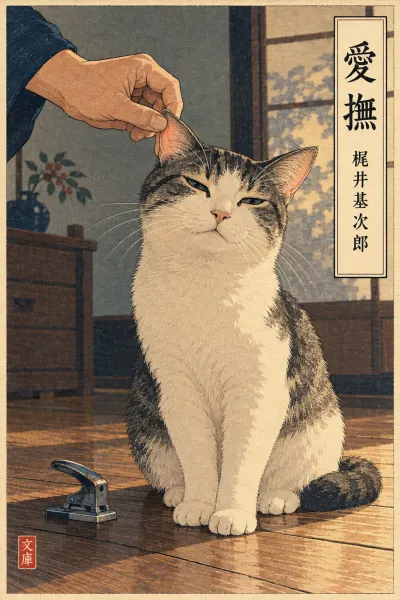
愛撫 is a short, essay-like piece in which a first-person narrator thinks closely, and a little obsessively, about cats. He starts with the odd feel of a cat's ear and moves on to its claws, then to a strange dream about a woman called X and her kitten Myuru. There is almost no plot in the usual sense. The interest lies in how the narrator's thoughts move from playful curiosity toward something unsettling, then back to tenderness. The tone is reflective, wry and slightly eerie. Small physical sensations are described with great care, and odd ideas are followed through to their logical end. For a learner, the text is short but dense. The narration uses the plain literary である style, with formal written phrases such as かくの如く and 〜たるを失わない. There are rhetorical questions, chains of hypotheses, and occasional loanwords like アンニュイ. The dream conversation is a welcome change: casual spoken Japanese, including feminine speech. Readers who are comfortable with N3 grammar and are moving toward N2 will find plenty of useful written-language patterns in a manageable length.
Contents
Before you read
- Learn the cat-body vocabulary first: 耳 (ear), 爪 (claw), 前足 (front paw), 肉球-like descriptions of the soft pads, and 瞼 (eyelid). Also learn 切符切り, the ticket punch the narrator wants to use on an ear. These words carry the whole piece.
- Much of the text is hypothetical reasoning: 'if the claws were cut, what then?' Watch for 〜たところで (even if), 〜ない限り (unless), 〜にちがいない (surely), and the rhetorical volitional 〜う / 〜があろうか ('could there be…?'). Read these as the narrator arguing with himself, not as statements of fact.
- Expect formal written expressions in the narration: かくの如く (in this way), 否 (no, rather), 〜たるを失わない (does not cease to be), and 〜や否や (as soon as). They are hard on first sight, but each appears in a clear context.
- Feelings are often expressed with 〜ずにはいられない (can't help doing) and 〜て堪らない (unbearably). The verb + 出す pattern marks something suddenly starting. Noticing these helps you follow the narrator's shifts in mood.
- In the dream scene, the register switches to casual speech. X uses feminine endings such as 〜じゃないの and 〜よ, and the narrator says things like 〜なくたっていいじゃないか ('you didn't have to…'). Read this part aloud to get a feel for natural spoken rhythm.
Words to know
The most useful words from the notes across the story.
| Word | Meaning | JLPT |
|---|---|---|
| 哀れなあわれ | pitiful, patheticdictionary form: 哀れA な-adjective with a literary tone of pity and sorrow. | N3 |
| 眼蓋まぶた | eyeliddictionary form: 瞼Now usually written 瞼 or まぶた. | N2 |
| 抓ってつねる | to pinch (skin between the fingers)dictionary form: 抓るThe kanji is rare; usually written in kana. | N1 |
| 曝露ばくろ | exposure, coming to lightToday usually written 暴露. | N1 |
| 悲鳴ひめい | scream, cry of painUsed with 悲鳴をあげる or 悲鳴を発する, 'to let out a cry'. | N1 |
| 研ごうとぐ | to sharpen, to whetdictionary form: 研ぐAlso used for washing rice (米を研ぐ). | N1 |
| 今更いまさら | anew; now, after all this time今更のように means 'as if for the first time'. | N1 |
| 可笑しなおかしな | curious, odd, funnyUsually written in kana; the kanji literally mean 'can laugh'. | — |
| 示唆力しさりょく | power of suggestion示唆 means 'suggestion, hint'; 力 as a suffix forms 'power of ~'. | — |
| 謹厳きんげん | solemn, strait-laced, seriousFormal word, used as a na-adjective here. | — |
| 執念深いしゅうねんぶかい | tenacious, persistent, unforgiving深い becomes ぶかい by rendaku in compounds. | — |
| 児戯じぎ | child's play, childish thingWritten-language word; 児戯に類する means 'akin to child's play'. | — |
| 分別ふんべつ | good sense, discretion, judgementRead ぶんべつ, it means 'sorting', as in sorting rubbish. | — |
| 痕跡こんせき | trace, mark, scar | — |
| 補片つぎ | patchThe author's own kanji for 継ぎ/接ぎ (a patch on cloth). | — |
Plot summary
Show the full summary (contains spoilers)
The narrator describes the strange texture of a cat's ear and admits a long-held wish to clip one with a ticket punch. Cats hardly react when their ears are pulled or pinched. Then one day he bites a cat's ear and discovers that this is what really hurts. His old fantasy ends there. He next imagines a cat with all its claws cut off. Such a cat, he thinks, would lose its confidence and die of despair, because its claws are its whole vitality. He then recounts a dream. In it, a woman, X, powders her face with a cosmetic puff made from the severed front paw of her kitten Myuru, prepared for her by a porter at a university medical school. Finally, lying on his back, the narrator places his own cat on his face. He presses its soft paws to his tired eyelids and begs it not to use its claws.
About the author
Kajii Motojirō was born in Ōsaka and studied at the Third Higher School in Kyōto before entering Tokyo Imperial University to study English literature, which he did not complete. With friends he helped found the coterie magazine Aozora (Blue Sky), where "Lemon" first appeared. His precise, sensuous style later won him a lasting place in modern Japanese literature.