Part 2 of 2 · JLPT N2
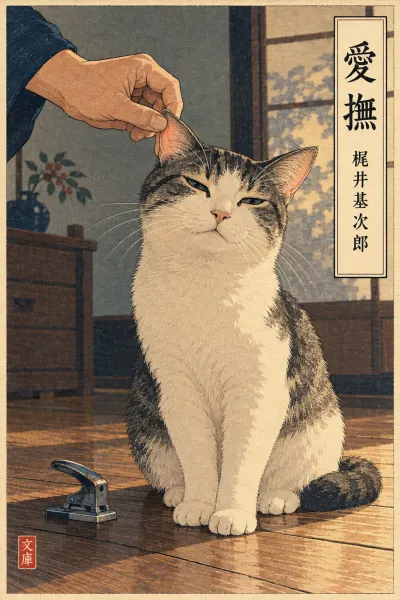
愛撫 Aibu, part 2: The Clawless Cat and a Dream
In this part
The narrator imagines a cat without claws as helpless and pitiful, convinced that the claws are the animal's whole vitality and essence. He then recounts a dream in which a woman, X, powders her face with a cosmetic tool made from the severed front paw of her kitten Myuru, made for her by a porter at the university medical school. Finally he lies on his back with his own cat on his face, presses its soft paws to his tired eyelids, and begs it not to dig in its claws.
AI translation · independently checked
爪のない猫!A cat without claws!
こんな、便りない、哀れな心持のものがあろうか!Could there be anything that feels so helpless and so pitiful?
空想を失ってしまった詩人、早発性痴呆に陥った天才にも似ている!It is like a poet who has lost his imagination, or a genius who has fallen into dementia praecox!
この空想はいつも私を悲しくする。This fancy always saddens me.
その全き悲しみのために、この結末の妥当であるかどうかということさえ、私にとっては問題ではなくなってしまう。Because of the sheer completeness of that sadness, even the question of whether this conclusion is sound ceases to matter to me.
しかし、はたして、爪を抜かれた猫はどうなるのだろう。But what, after all, would become of a cat whose claws had been pulled out?
眼を抜かれても、髭を抜かれても猫は生きているにちがいない。Even with its eyes put out, even with its whiskers plucked, a cat would surely go on living.
しかし、柔らかい蹠の、鞘のなかに隠された、鉤のように曲った、匕首のように鋭い爪!But the claws: hidden in sheaths in the soft soles of its feet, curved like hooks, sharp as daggers!
これがこの動物の活力であり、智慧であり、精霊であり、一切であることを私は信じて疑わないのである。That these are this creature's vitality, its wisdom, its spirit, its all in all, I believe without the slightest doubt.
ある日私は奇妙な夢を見た。One day I had a strange dream.
X――という女の人の私室である。It is the private room of a woman called X.
この女の人は平常可愛い猫を飼っていて、私が行くと、抱いていた胸から、いつもそいつを放して寄来すのであるが、いつも私はそれに辟易するのである。This woman keeps a sweet cat, and whenever I visit she always lets it go from her bosom, where she has been holding it, and sends it over to me, which always makes me shrink back.
抱きあげて見ると、その仔猫には、いつも微かな香料の匂いがしている。When I pick it up, the kitten always carries a faint scent of perfume.
夢のなかの彼女は、鏡の前で化粧していた。In the dream she was making herself up in front of the mirror.
私は新聞かなにかを見ながら、ちらちらその方を眺めていたのであるが、アッと驚きの小さな声をあげた。I had been glancing over at her now and then while looking at a newspaper or some such, when I let out a small cry of surprise.
彼女は、なんと!She was, of all things!
猫の手で顔へ白粉を塗っているのである。She was powdering her face with a cat's paw.
私はゾッとした。A shudder went through me.
しかし、なおよく見ていると、それは一種の化粧道具で、ただそれを猫と同じように使っているんだということがわかった。But as I kept watching more closely, I realised that it was a kind of cosmetic tool, and that she was simply using it the way a cat would.
しかしあまりそれが不思議なので、私はうしろから尋ねずにはいられなかった。Still, it was so strange that I could not help asking her from behind.
「それなんです? 顔をコスっているもの?」"What's that? The thing you're rubbing your face with?"
「これ?」"This?"
夫人は微笑とともに振り向いた。The lady turned around with a smile.
そしてそれを私の方へ抛って寄来した。And she tossed it over to me.
取りあげて見ると、やはり猫の手なのである。When I picked it up, it was a cat's paw after all.
「いったい、これ、どうしたの!」"What on earth is this?"
訊きながら私は、今日はいつもの仔猫がいないことや、その前足がどうやらその猫のものらしいことを、閃光のように了解した。Even as I asked, I understood in a flash that the usual kitten was not there today, and that the paw apparently belonged to it.
「わかっているじゃないの。これはミュルの前足よ」"You know perfectly well. This is Myuru's front paw."
彼女の答えは平然としていた。Her answer was perfectly calm.
そして、この頃外国でこんなのが流行るというので、ミュルで作って見たのだというのである。And she explained that these things were all the fashion abroad just now, so she had tried having one made from Myuru.
あなたが作ったのかと、内心私は彼女の残酷さに舌を巻きながら尋ねて見ると、それは大学の医科の小使が作ってくれたというのである。When I asked whether she had made it herself, inwardly astounded at her cruelty, she said that the porter at the university's medical school had made it for her.
私は医科の小使というものが、解剖のあとの死体の首を土に埋めて置いて髑髏を作り、学生と秘密の取引をするということを聞いていたので、非常に嫌な気になった。I had heard that medical-school porters bury the heads of corpses in the earth after dissection to make skulls, and then deal with the students in secret, so I felt thoroughly disgusted.
何もそんな奴に頼まなくたっていいじゃないか。Surely there was no need to ask a fellow like that!
そして女というものの、そんなことにかけての、無神経さや残酷さを、今更のように憎み出した。And I began to hate, as though I had only now discovered it, the insensitivity and cruelty of women in such matters.
しかしそれが外国で流行っているということについては、自分もなにかそんなことを、婦人雑誌か新聞かで読んでいたような気がした。Yet as for its being fashionable abroad, I had a feeling that I too had read something of the sort in a women's magazine or a newspaper.
――——
猫の手の化粧道具!A cosmetic tool made from a cat's paw!
私は猫の前足を引っ張って来て、いつも独り笑いをしながら、その毛並を撫でてやる。I draw my cat's forepaw toward me and, always laughing quietly to myself, stroke its fur.
彼が顔を洗う前足の横側には、毛脚の短い絨氈のような毛が密生していて、なるほど人間の化粧道具にもなりそうなのである。On the side of the forepaw he washes his face with grows a dense, short-piled fur like a carpet, and indeed it looks as if it could serve as a cosmetic tool for people.
しかし私にはそれが何の役に立とう?But what use would that be to me?
私はゴロッと仰向きに寝転んで、猫を顔の上へあげて来る。I flop down on my back and lift the cat up over my face.
二本の前足を掴んで来て、柔らかいその蹠を、一つずつ私の眼蓋にあてがう。Taking hold of its two front paws, I press its soft soles, one at a time, against my eyelids.
快い猫の重量。The pleasant weight of the cat.
温かいその蹠。The warmth of its soles.
私の疲れた眼球には、しみじみとした、この世のものでない休息が伝わって来る。Into my tired eyes there seeps a deep, quiet rest that is not of this world.
仔猫よ!Kitten!
後生だから、しばらく踏み外さないでいろよ。For pity's sake, don't slip off for a little while.
お前はすぐ爪を立てるのだから。Because you're so quick to dig your claws in.
Vocabulary
| Word | Meaning | JLPT |
|---|---|---|
| 便りないたよりない | helpless, forlorn, unreliableUsually written 頼りない today; literally 'nothing to rely on'. | — |
| 哀れなあわれ | pitiful, patheticdictionary form: 哀れA な-adjective with a literary tone of pity and sorrow. | N3 |
| 陥ったおちいる | to fall into (a bad state)dictionary form: 陥るUsed for illness, crisis, despair and similar conditions. | — |
| 鞘さや | sheath, scabbardHere the sheaths that a cat's retracted claws sit in. | — |
| 匕首あいくち | dagger (without a hand guard)A special reading; the kanji themselves would normally be read ひしゅ. | — |
| 辟易へきえき | to be daunted, to shrink back, to be put offdictionary form: 辟易する | — |
| 白粉おしろい | face powderTraditionally a white cosmetic powder. | — |
| 舌を巻きしたをまく | to be astoundeddictionary form: 舌を巻くAn idiom, literally 'to curl one's tongue'; usually admiring, but here closer to appalled amazement. | — |
| 小使こづかい | janitor, porter, odd-job man (at an institution)An old word, now replaced by 用務員. Not the same as 小遣い (pocket money). | — |
| 髑髏どくろ | skull | — |
| 今更いまさら | anew; now, after all this time今更のように means 'as if for the first time'. | N1 |
| 密生みっせい | to grow thickly, denselydictionary form: 密生する | — |
| 眼蓋まぶた | eyeliddictionary form: 瞼Now usually written 瞼 or まぶた. | N2 |
| 後生だからごしょう | for pity's sake, I beg youdictionary form: 後生後生 is the Buddhist 'next life'. Read こうせい, it means 'younger generation'. | — |
Grammar
〜があろうか N1 could there be ~? (rhetorical: surely not)
The volitional/conjectural form あろう plus か makes a rhetorical question that strongly implies 'no'. It is a literary way of saying nothing could be more pitiful.
こんな、便りない、哀れな心持のものがあろうか!
Could there be anything that feels so helpless and so pitiful?
〜にちがいない N3 must be ~, surely ~
This expresses the speaker's strong conviction. Here it sets up a contrast: the cat would surely survive losing its eyes or whiskers, but losing its claws is another matter.
眼を抜かれても、髭を抜かれても猫は生きているにちがいない。
Even with its eyes put out, even with its whiskers plucked, a cat would surely go on living.
〜ずにはいられない N2 cannot help doing ~
The negative ず plus にはいられない means the speaker cannot keep from doing something. 尋ねずにはいられなかった means he simply had to ask.
私はうしろから尋ねずにはいられなかった。
I could not help asking her from behind.
〜なくたっていいじゃないか N3 there's no need to ~, surely
なくたって is a casual form of なくてもいい ('it's fine not to'). 何も adds emphasis ('there's no need at all to go that far'), and じゃないか turns it into an indignant protest.
何もそんな奴に頼まなくたっていいじゃないか。
Surely there was no need to ask a fellow like that!
〜出す N4 to begin to ~
Attached to the verb stem, 出す marks the start of an action or feeling, often a sudden one. 憎み出した means he began to hate.
無神経さや残酷さを、今更のように憎み出した。
I began to hate, as though for the first time, their insensitivity and cruelty.
〜う (rhetorical volitional) N1 what ~ would ...? (implying nothing)
The volitional form 立とう is used here as literary conjecture inside a rhetorical question. It means 'what use could it possibly be?', in other words none.
しかし私にはそれが何の役に立とう?
But what use would that be to me?