Part 1 of 2 · JLPT N2
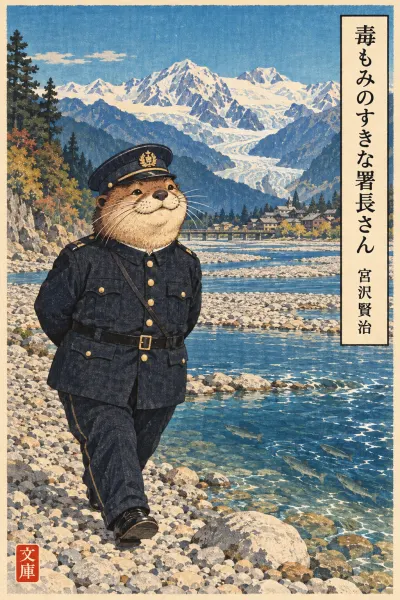
毒もみのすきな署長さん Dokumomi no Sukina Shochōsan, part 1: Poisoned Pools and a New Police Chief
In this part
Four icy rivers from Mount Karakon join at the town of Puhara, and the old pools on its wide riverbed teem with fish. The country's first law forbids fish-poisoning, which the barber Richiki describes in elaborate detail. A new, otter-like police chief arrives and patrols the town kindly, but soon the fish begin to vanish and the prickly ash trees are stripped of their bark, while the police seem unconcerned.
AI translation · independently checked
四つのつめたい谷川が、カラコン山の氷河から出て、ごうごう白い泡をはいて、プハラの国にはいるのでした。Four cold mountain rivers came down from the glaciers of Mount Karakon and, roaring and spitting white foam, flowed into the country of Puhara.
四つの川はプハラの町で集って一つの大きなしずかな川になりました。The four rivers gathered at the town of Puhara and became one great, quiet river.
その川はふだんは水もすきとおり、淵には雲や樹の影もうつるのでしたが、一ぺん洪水になると、幅十町もある楊の生えた広い河原が、恐ろしく咆える水で、いっぱいになってしまったのです。Usually the water of that river was clear, and the clouds and the shadows of the trees were reflected in its deep pools, but once a flood came, the wide riverbed, a full ten chō across and grown with willows, would be filled to the brim with dreadfully roaring water.
けれども水が退きますと、もとのきれいな、白い河原があらわれました。But when the water went down, the clean white riverbed appeared again just as before.
その河原のところどころには、蘆やがまなどの岸に生えた、ほそ長い沼のようなものがありました。Here and there on that riverbed were long, narrow things like marshes, with reeds and bulrushes growing along their banks.
それは昔の川の流れたあとで、洪水のたびにいくらか形も変るのでしたが、すっかり無くなるということもありませんでした。They were the old courses of the river, and their shapes changed a little with every flood, but they never disappeared altogether.
その中には魚がたくさんおりました。There were a great many fish in them.
殊にどじょうとなまずがたくさんおりました。There were especially many loaches and catfish.
けれどもプハラのひとたちは、どじょうやなまずは、みんなばかにして食べませんでしたから、それはいよいよ増えました。But the people of Puhara all looked down on loaches and catfish and would not eat them, so they multiplied more and more.
なまずのつぎに多いのはやっぱり鯉と鮒でした。After the catfish, the most plentiful fish were, as you might expect, carp and crucian carp.
それからはやもおりました。There were dace as well.
ある年などは、そこに恐ろしい大きなちょうざめが、海から遁げて入って来たという、評判などもありました。One year there was even a rumour that a terrifyingly huge sturgeon had escaped from the sea and come into those pools.
けれども大人や賢い子供らは、みんな本当にしないで、笑っていました。But the grown-ups and the clever children didn't believe it at all, and just laughed.
第一それを云いだしたのは、剃刀を二梃しかもっていない、下手な床屋のリチキで、すこしもあてにならないのでした。For one thing, the person who started the story was Richiki, the clumsy barber who owned only two razors, and nothing he said could be relied on in the least.
けれどもあんまり小さい子供らは、毎日ちょうざめを見ようとして、そこへ出かけて行きました。But the very small children went out there every day, hoping to see the sturgeon.
いくらまじめに眺めていても、そんな巨きなちょうざめは、泳ぎも浮びもしませんでしたから、しまいには、リチキは大へん軽べつされました。However earnestly they watched, no such enormous sturgeon ever swam by or rose to the surface, so in the end Richiki was held in great contempt.
さてこの国の第一条のNow, Article One of this country's laws reads:
「火薬を使って鳥をとってはなりません、"Birds shall not be taken by means of gunpowder.
毒もみをして魚をとってはなりません。」Fish shall not be taken by fish-poisoning."
というその毒もみというのは、何かと云いますと床屋のリチキはこう云う風に教えます。And if you ask what this fish-poisoning is, Richiki the barber will explain it like this.
山椒の皮を春の午の日の暗夜に剥いて土用を二回かけて乾かしうすでよくつく、その目方一貫匁を天気のいい日にもみじの木を焼いてこしらえた木灰七百匁とまぜる、それを袋に入れて水の中へ手でもみ出すことです。You strip the bark of the prickly ash on a dark night on a Day of the Horse in spring, dry it through two doyō periods, and pound it well in a mortar; you take one kan-me of it by weight and mix it with seven hundred monme of wood ash made by burning maple wood on a fine day, then put it in a bag and knead it out into the water with your hands.
そうすると、魚はみんな毒をのんで、口をあぶあぶやりながら、白い腹を上にして浮びあがるのです。Then all the fish swallow the poison and float up with their white bellies turned upward, their mouths gasping and gaping.
そんなふうにして、水の中で死ぬことは、この国の語ではエップカップと云いました。Dying in the water like that was called "eppukappu" in the language of this country.
これはずいぶんいい語です。It is a very good word indeed.
とにかくこの毒もみをするものを押えるということは警察のいちばん大事な仕事でした。At any rate, catching people who did this fish-poisoning was the most important job of the police.
ある夏、この町の警察へ、新らしい署長さんが来ました。One summer, a new police chief came to the police station of this town.
この人は、どこか河獺に似ていました。There was something about this man that looked like an otter.
赤ひげがぴんとはねて、歯はみんな銀の入歯でした。His red whiskers bristled out stiffly, and all his teeth were false ones made of silver.
署長さんは立派な金モールのついた、長い赤いマントを着て、毎日ていねいに町をみまわりました。The police chief wore a long red cape trimmed with splendid gold braid, and every day he made careful rounds of the town.
驢馬が頭を下げてると荷物があんまり重過ぎないかと驢馬追いにたずねましたし家の中で赤ん坊があんまり泣いていると疱瘡の呪いを早くしないといけないとお母さんに教えました。If a donkey was hanging its head, he would ask the donkey driver whether its load was not much too heavy, and if a baby was crying a great deal inside a house, he would tell the mother she had better hurry and perform the charm against smallpox.
ところがそのころどうも規則の第一条を用いないものができてきました。Around that time, however, it seemed that some people had begun to ignore Article One of the regulations.
あの河原のあちこちの大きな水たまりからいっこう魚が釣れなくなって時々は死んで腐ったものも浮いていました。No fish at all could be caught any more from the big pools here and there on the riverbed, and sometimes dead, rotting fish were floating in them.
また春の午の日の夜の間に町の中にたくさんある山椒の木がたびたびつるりと皮を剥かれておりました。Also, during the night of a Day of the Horse in spring, the many prickly ash trees in the town were again and again found stripped clean of their bark.
けれども署長さんも巡査もそんなことがあるかなあというふうでした。But the police chief and the constables merely looked as though they wondered whether such a thing could really be happening.
Vocabulary
| Word | Meaning | JLPT |
|---|---|---|
| 氷河ひょうが | glacier氷 (ice) + 河 (river): literally an 'ice river'. | — |
| 洪水こうずい | flood | N1 |
| 河原かわら | dry riverbed; gravelly river flatsIrregular reading; also written 川原. | — |
| 淵ふち | deep pool in a riverThe opposite of 瀬 (せ), a shallow rapid. | — |
| 評判ひょうばん | rumour; talk going aroundUsually means 'reputation'; here, what people are saying. | N3 |
| 床屋とこや | barber | N4 |
| あてにならないあてにならない | unreliable; not to be trusteddictionary form: 当てにならないFrom 当てにする 'to count on'. | — |
| 軽べつけいべつ | contempt, scorndictionary form: 軽蔑軽べつされる = to be despised. | N1 |
| 毒もみどくもみ | fish-poisoning (catching fish by kneading poison into water)毒 'poison' + もみ from 揉む 'to knead, rub'. | — |
| 署長しょちょう | police chief; head of a station署 = government office such as a police station (警察署). | — |
| みまわりましたみまわる | to patrol, make the roundsdictionary form: 見回る | — |
| 疱瘡ほうそう | smallpoxOld word; modern Japanese says 天然痘 (てんねんとう). | — |
| 規則きそく | rule, regulation | N4 |
| 巡査じゅんさ | police constableThe lowest police rank; somewhat old-fashioned. | N2 |
Grammar
〜てはなりません N3 must not; shall not
て-form + はならない expresses a firm prohibition, typical of laws and formal rules. It is stiffer than 〜てはいけません.
毒もみをして魚をとってはなりません。
Fish shall not be taken by fish-poisoning.
〜たびに N3 every time; whenever
Noun + の + たびに means that something happens each time the event occurs. Here the pools change shape with each flood.
洪水のたびにいくらか形も変るのでした
their shapes changed a little with every flood
〜ようとして N3 trying to; in order to
The volitional form + として shows the purpose or attempt behind an action. The children go out each day trying to see the sturgeon.
毎日ちょうざめを見ようとして、そこへ出かけて行きました。
went out there every day, hoping to see the sturgeon.
〜も〜もしない N2 neither … nor …
Two verb stems, each followed by も, then しない, deny both actions together. The sturgeon neither swam nor surfaced.
そんな巨きなちょうざめは、泳ぎも浮びもしませんでした
no such enormous sturgeon ever swam by or rose to the surface
〜のでした N3 it was that …; narrative explanation
The past form of のです gives a storyteller's explanatory tone, describing how things usually were. It adds a gentle, fairy-tale feel to the narration.
淵には雲や樹の影もうつるのでしたが
and the clouds and the shadows of the trees were reflected in its deep pools, but