Upper intermediate · JLPT N2
毒もみのすきな署長さんDokumomi no Sukina Shochōsan — The Police Chief and His Favourite Pastime
- JLPT N2
- 3,025 characters
- 2 parts
- about 25 minutes
- 3 easier versions
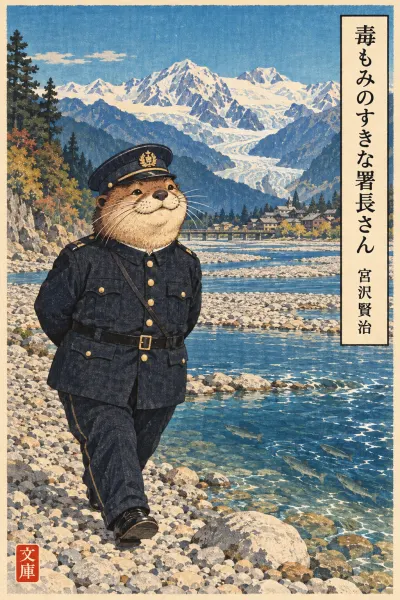
This is a short comic fable by Miyazawa Kenji. It is set in Puhara, an imaginary country where four icy rivers from the glaciers of Mount Karakon meet. The pools on its wide gravel riverbed are full of fish, and the country's very first law forbids fish-poisoning, a practice the idle town barber, Richiki, is only too happy to describe at length. A new police chief arrives and makes his kindly rounds. Soon the fish start to disappear and the prickly ash trees lose their bark, yet the police seem strangely unbothered. The narrator tells the tale in a polite です/ます storyteller's voice with a deadpan, gently ironic edge. The dialogue is lively and colloquial: the children chatter casually, the mayor speaks politely, and the chief switches between 僕 and a rough おれ. This contrast is a useful lesson in register. The main challenges are the descriptive passages, the invented names, and old-fashioned units of weight and money such as kan-me, monme and ryō. Still, the text is short, and its dry humour rewards careful reading.
Contents
Easier versions
This story is also retold in simpler Japanese. Reading an easier version first makes the original much more approachable.
Before you read
- The narration often closes scenes with 〜のでした, a storyteller's past tense that explains or rounds off a situation. Read it as 'and so it was that…' rather than as a plain past tense.
- Watch the contrast between rules and talk. The law is phrased with the formal prohibition 〜てはなりません ('must not'), while characters use the casual 〜なくちゃいかん ('have to'). Spotting the two forms helps you see the gap between the official tone and everyday speech.
- Notice when the chief says 僕 and when he says おれ. His shift into the rough おれ marks changes in his mood and in how he presents himself, which is central to the story's humour.
- In the colloquial dialogue, learn 〜もんですから (giving a reason, often as an excuse), 〜癖に ('even though…', usually critical) and the surprised 〜というではありませんか ('and what do you know, they say…'). These carry much of the characters' attitude.
- Treat the units and money (kan-me, monme, kin, ryō, sen, chō) and the coined word 'eppukappu' as glossed labels. You don't need exact conversions to follow the story, so don't let them slow you down.
Words to know
The most useful words from the notes across the story.
| Word | Meaning | JLPT |
|---|---|---|
| 巡査じゅんさ | police constableThe lowest police rank; somewhat old-fashioned. | N2 |
| 床屋とこや | barber | N4 |
| 規則きそく | rule, regulation | N4 |
| 評判ひょうばん | rumour; talk going aroundUsually means 'reputation'; here, what people are saying. | N3 |
| 灰はい | ash (from burnt wood) | N3 |
| 勘定かんじょう | calculation, working out the accountsAlso means 'the bill' in a shop or restaurant: お勘定お願いします. | N3 |
| 押えようおさえる | to catch, to seize (a culprit)dictionary form: 押さえるLiterally 'to hold down'. Older spelling without さ. | N2 |
| 洪水こうずい | flood | N1 |
| 軽べつけいべつ | contempt, scorndictionary form: 軽蔑軽べつされる = to be despised. | N1 |
| 交る交るかわるがわる | by turns, one after the otherdictionary form: 代わる代わるUsually written 代わる代わる today; 交る交る is an older spelling. | N1 |
| 証拠しょうこ | proof, evidence | N1 |
| 収支しゅうし | income and expenditure収 = take in, 支 = pay out. | N1 |
| 名誉めいよ | honour, good name | N1 |
| 死刑しけい | death penalty | N1 |
| 氷河ひょうが | glacier氷 (ice) + 河 (river): literally an 'ice river'. | — |
Plot summary
Show the full summary (contains spoilers)
Four glacial rivers from Mount Karakon meet at the town of Puhara, whose riverbed pools teem with fish. The country's first law bans fish-poisoning, as the barber Richiki explains in elaborate detail. A new, otter-like police chief arrives and patrols the town kindly. Soon, though, the fish vanish and the prickly ash trees are stripped of their bark, while the police seem unconcerned. The town's children begin to suspect the chief himself, and Richiki even works out how much profit the chief must be making. When the troubled mayor visits the station, the chief cheerfully admits he is the culprit and has himself arrested. Sentenced to death, he goes to the executioner laughing and says that next he will poison fish in Hell. Everyone is deeply impressed.
About the author
Miyazawa Kenji was a poet and writer of children's stories from Hanamaki in Iwate Prefecture. He studied agricultural science in Morioka and later taught at an agricultural school. He devoted much of his life to helping local farmers improve their methods and their cultural lives. He was a devout Buddhist, and his faith, love of nature and interest in science run through his writing. His fame came after his death, with works such as 銀河鉄道の夜, 風の又三郎 and the poem 雨ニモマケズ.