Part 2 of 2 · JLPT N2
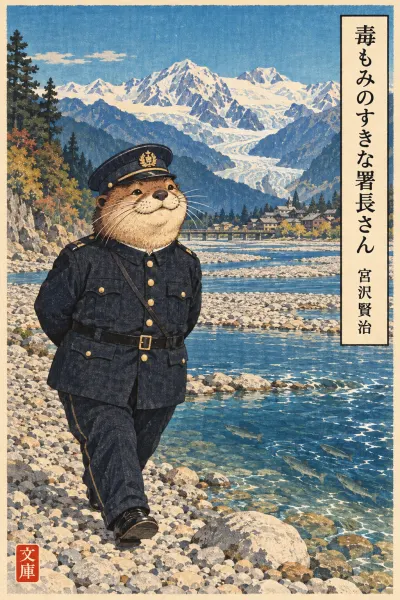
毒もみのすきな署長さん Dokumomi no Sukina Shochōsan, part 2: The Culprit Confesses with a Smile
In this part
The town's children begin to suspect the police chief himself of fish-poisoning, and the barber Richiki even works out how much profit he must be making. When the troubled mayor visits the station, the chief cheerfully admits he is the culprit and has himself arrested. Sentenced to death, he goes to the executioner laughing, saying he will poison fish in Hell next, and everyone is deeply impressed.
AI translation · independently checked
ところがある朝手習の先生のうちの前の草原で二人の子供がみんなに囲まれて交る交る話していました。But then one morning, in the grassy field in front of the writing teacher's house, two children stood surrounded by everyone, taking turns to talk.
「署長さんにうんと叱られたぞ」"We got a real telling-off from the Chief!"
「署長さんに叱られたかい。」少し大きなこどもがききました。"The Chief told you off?" asked a slightly bigger child.
「叱られたよ。署長さんの居るのを知らないで石をなげたんだよ。するとあの沼の岸に署長さんが誰か三四人とかくれて毒もみをするものを押えようとしていたんだ。」"He sure did. We were throwing stones without knowing he was there. And it turned out the Chief was hiding on the bank of that pond with three or four others, trying to catch anyone who came to poison the fish."
「なんと云って叱られた。」"What did he say when he told you off?"
「誰だ。石を投げるものは。おれたちは第一条の犯人を押えようと思って一日ここに居るんだぞ。早く黙って帰れ。って云った。」"He said, 'Who's that? Who's throwing stones? We've been here all day trying to catch whoever's breaking Article One. Now be quiet and get off home, quick.'"
「じゃきっと間もなくつかまるねえ。」"Then they're sure to catch him soon, aren't they?"
ところがそれから半年ばかりたちますとまたこどもらが大さわぎです。But about half a year after that, the children were in a great uproar again.
「そいつはもうたしかなんだよ。僕の証拠というのはね、ゆうべお月さまの出るころ、署長さんが黒い衣だけ着て、頭巾をかぶってね、変な人と話してたんだよ。"It's certain now, I tell you. Here's my proof: last night, around the time the moon came up, the Chief was wearing nothing but a black robe, with a hood over his head, and he was talking with a strange man.
ね、そら、あの鉄砲打ちの小さな変な人ね、そしてね、『おい、こんどはも少しよく、粉にして来なくちゃいかんぞ。You know, that strange little man who goes about shooting, and the Chief says, 'Look here, next time you'd better grind it a bit finer before you bring it.
』なんて云ってるだろう。それから鉄砲打ちが何か云ったら、『なんだ、柏の木の皮もまぜておいた癖に、一俵二両だなんて、あんまり無法なことを云うな。' That's what he was saying, see. Then the shooting man said something, and the Chief goes, 'What? You mixed in oak bark as well, and you still ask two ryō a bale? Don't talk such outrageous nonsense.
』なんて云ってるだろう。きっと山椒の皮の粉のことだよ。」' That's what he was saying, see. It must be about powdered prickly ash bark."
するとも一人が叫びました。Then another child cried out.
「あっ、そうだ。あのね、署長さんがね、僕のうちから、灰を二俵買ったよ。僕、持って行ったんだ。ね、そら、山椒の粉へまぜるのだろう。」"Oh, that's right! Listen, the Chief bought two bales of ash from our house. I carried them over myself. See, he must be mixing it into the prickly ash powder."
「そうだ。そうだ。きっとそうだ。」みんなは手を叩いたり、こぶしを握ったりしました。"That's it! That's it! That must be it!" Everyone clapped their hands or clenched their fists.
床屋のリチキは、商売がはやらないで、ひまなもんですから、あとでこの話をきいて、すぐ勘定しました。Richiki the barber, whose business was slow and who therefore had plenty of time on his hands, heard this story afterwards and at once worked out the accounts.
毒もみ収支計算Fish-Poisoning: Statement of Income and Expenditure
費用の部Expenses
一、金 二両 山椒皮 一俵Item: the sum of two ryō — prickly ash bark, one bale
一、金 三十銭 灰 一俵Item: the sum of thirty sen — ash, one bale
計 二両三十銭也Total: two ryō thirty sen exactly
収入の部Income
一、金 十三両 鰻 十三斤Item: the sum of thirteen ryō — eels, thirteen kin
一、金 十両 その他見積りItem: the sum of ten ryō — other, estimated
計 二十三両也Total: twenty-three ryō exactly
差引勘定Balance
二十両七十銭 署長利益Twenty ryō seventy sen — the Chief's profit
あんまりこんな話がさかんになって、とうとう小さな子供らまでが、巡査を見ると、わざと遠くへ遁げて行って、This kind of talk spread so far that in the end even the little children, whenever they saw a policeman, would deliberately run off to a safe distance,
「毒もみ巡査、"Fish-poisoning copper,
なまずはよこせ。」hand over the catfish!"
なんて、力いっぱいからだまで曲げて叫んだりするもんですから、これではとてもいかんというので、プハラの町長さんも仕方なく、家来を六人連れて警察に行って、署長さんに会いました。and shout something like that, bending their whole bodies with the effort. As this really would not do, the mayor of Puhara had no choice but to go to the police station with six of his attendants, and there he met the Chief.
二人が一緒に応接室の椅子にこしかけたとき、署長さんの黄金いろの眼は、どこかずうっと遠くの方を見ていました。When the two of them sat down together on the chairs in the reception room, the Chief's golden eyes were gazing somewhere far, far away.
「署長さん、ご存じでしょうか、近頃、林野取締法の第一条をやぶるものが大変あるそうですが、どうしたのでしょう。」"Chief, perhaps you are aware of it: they say that lately a great many people are breaking Article One of the Forest and Field Control Law. Whatever can be going on?"
「はあ、そんなことがありますかな。」"Oh? Is that so, now?"
「どうもあるそうですよ。わたしの家の山椒の皮もはがれましたし、それに魚が、たびたび死んでうかびあがるというではありませんか。」"It certainly seems so. The prickly ash bark at my own house has been stripped, and besides, don't they say that fish keep dying and floating to the surface?"
すると署長さんがなんだか変にわらいました。At this the Chief gave a rather odd laugh.
けれどもそれも気のせいかしらと、町長さんは思いました。But the mayor thought he might only have imagined it.
「はあ、そんな評判がありますかな。」"Oh? Is there such talk, now?"
「ありますとも。どうもそしてその、子供らが、あなたのしわざだと云いますが、困ったもんですな。」"There most certainly is. And, well, the thing is, the children are saying it's your doing. Most awkward, isn't it?"
署長さんは椅子から飛びあがりました。The Chief leapt up from his chair.
「そいつは大へんだ。僕の名誉にも関係します。早速犯人をつかまえます。」"That's terrible! My honour is at stake as well. I'll catch the culprit at once."
「何かおてがかりがありますか。」"Do you have any leads?"
「さあ、そうそう、ありますとも。ちゃんと証拠があがっています。」"Well now... oh yes, of course I have. The evidence is all in hand."
「もうおわかりですか。」"You know who it is already?"
「よくわかってます。実は毒もみは私ですがね。」"I know very well. The truth is, the fish-poisoner is me."
署長さんは町長さんの前へ顔をつき出してこの顔を見ろというようにしました。The Chief thrust his face out in front of the mayor, as if to say, "Take a good look at this face."
町長さんも愕きました。The mayor was astonished too.
「あなた? やっぱりそうでしたか。」"You? So it was you after all?"
「そうです。」"It was."
「そんならもうたしかですね。」"Then there's no doubt about it?"
「たしかですとも。」"None whatsoever."
署長さんは落ち着いて、卓子の上の鐘を一つカーンと叩いて、赤ひげのもじゃもじゃ生えた、第一等の探偵を呼びました。Quite calmly, the Chief struck the bell on the table once, clang, and called in his first-class detective, the one with the bushy red beard.
さて署長さんは縛られて、裁判にかかり死刑ということにきまりました。And so the Chief was tied up and put on trial, and it was decided that he would be put to death.
いよいよ巨きな曲った刀で、首を落されるとき、署長さんは笑って云いました。At last, just as his head was about to be cut off with a huge curved sword, the Chief laughed and said:
「ああ、面白かった。おれはもう、毒もみのことときたら、全く夢中なんだ。いよいよこんどは、地獄で毒もみをやるかな。」"Ah, that was fun! When it comes to fish-poisoning, I'm simply crazy about it. Well, next time I suppose I'll do my fish-poisoning in Hell."
みんなはすっかり感服しました。Everyone was filled with admiration.
Vocabulary
| Word | Meaning | JLPT |
|---|---|---|
| 交る交るかわるがわる | by turns, one after the otherdictionary form: 代わる代わるUsually written 代わる代わる today; 交る交る is an older spelling. | N1 |
| 押えようおさえる | to catch, to seize (a culprit)dictionary form: 押さえるLiterally 'to hold down'. Older spelling without さ. | N2 |
| 証拠しょうこ | proof, evidence | N1 |
| 頭巾ずきん | hood, cloth head coveringFamiliar from 赤頭巾 (Little Red Riding Hood). | — |
| 無法むほう | outrageous, unreasonableLiterally 'lawless'; here it means an unfair price. | — |
| 山椒さんしょう | Japanese prickly ash (sansho pepper)Its powdered bark was used to stun fish, which is why the trees were being stripped. | — |
| 灰はい | ash (from burnt wood) | N3 |
| 勘定かんじょう | calculation, working out the accountsAlso means 'the bill' in a shop or restaurant: お勘定お願いします. | N3 |
| 収支しゅうし | income and expenditure収 = take in, 支 = pay out. | N1 |
| 巡査じゅんさ | police officer, constableOld-fashioned word; today お巡りさん or 警察官 is more common. | N2 |
| しわざしわざ | (someone's) doing, actdictionary form: 仕業Almost always used for bad deeds: 誰の仕業だ? 'Who did this?' | — |
| 名誉めいよ | honour, good name | N1 |
| 死刑しけい | death penalty | N1 |
| 感服かんぷく | admiration, being deeply impressedFormal; 服 here means 'to submit', so it suggests bowing to someone's spirit. | — |
Grammar
〜なくちゃいかん N4 must, have to
なくちゃ is the casual contraction of なくては, and いかん is a rough, older form of いけない. The chief uses it to order the man to bring the powder ground finer.
粉にして来なくちゃいかんぞ
you'd better grind it into powder before you bring it
〜癖に N3 even though, despite (with criticism)
くせに joins two facts and blames the subject for the contradiction between them. Here the chief complains that the man mixed in cheap oak bark and still asks a high price.
柏の木の皮もまぜておいた癖に、一俵二両だなんて
you mixed in oak bark too, and you still say two ryō a bale
〜もんですから N3 because, since (giving a reason)
もんですから is a colloquial form of ものですから. It gives a reason, often with a slightly apologetic or explanatory tone. Here it explains why Richiki had time to do the sums.
商売がはやらないで、ひまなもんですから
since his business was slow and he had time on his hands
〜というではありませんか N3 don't they say that...?, isn't it said that...?
ではありませんか turns a statement into a rhetorical question that asks for agreement. With という, the mayor politely presses the point that people are talking about the dead fish.
魚が、たびたび死んでうかびあがるというではありませんか
don't they say that fish keep dying and floating to the surface?
〜とも N2 of course, certainly
When とも follows a plain or polite sentence ending, it strongly affirms the statement. The mayor and the chief both use it, which makes their exchange sound comically emphatic.
ありますとも。
There most certainly is.
〜ときたら N1 when it comes to..., as for...
ときたら singles out a topic, usually before an extreme comment about it. Here the chief uses it to admit his hopeless passion for fish-poisoning.
毒もみのことときたら、全く夢中なんだ
when it comes to fish-poisoning, I'm simply crazy about it