Part 1 of 2 · JLPT N2
花咲かじじい Hanasakajijii, part 1: Shiro Finds Gold, the Greedy Neighbour Strikes
In this part
An honest, kind old couple love their dog Shiro like a child. Shiro leads the old man to a spot under a hackberry tree where he digs up a pile of gold coins, but when the greedy neighbour borrows Shiro and forces him to dig, only filth comes up, and the angry neighbour kills the dog. The grieving couple bury Shiro and plant a pine tree on the grave; it quickly grows into a magnificent tree, and the old man makes a mortar from it and begins pounding rice for cakes in Shiro's memory.
AI translation · independently checked
一One
むかし、むかし、あるところに、おじいさんとおばあさんがありました。Long, long ago, in a certain place, there lived an old man and an old woman.
正直な、人のいいおじいさんとおばあさんどうしでしたけれど、子どもがないので、飼犬の白を、ほんとうの子どものようにかわいがっていました。They were an honest, good-hearted old man and old woman, but they had no children, so they loved their pet dog Shiro as if he were their very own child.
白も、おじいさんとおばあさんに、それはよくなついていました。And Shiro, for his part, was ever so fond of the old man and the old woman.
すると、おとなりにも、おじいさんとおばあさんがありました。Now, next door there lived another old man and old woman.
このほうは、いけない、欲ばりのおじいさんとおばあさんでした。These two were a wicked, greedy old man and old woman.
ですから、おとなりの白をにくらしがって、きたならしがって、いつもいじのわるいことばかりしていました。And so they hated the dog Shiro next door, thought him filthy, and were forever doing nasty, spiteful things to him.
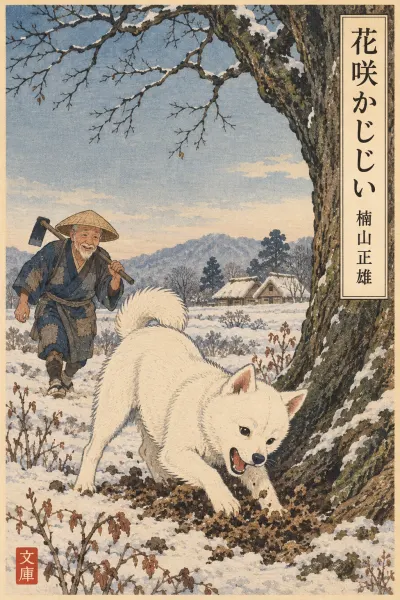
ある日、正直おじいさんが、いつものようにくわをかついで、畑をほりかえしていますと、白も一緒についてきて、そこらをくんくんかぎまわっていましたが、ふと、おじいさんのすそをくわえて、畑のすみの、大きなえのきの木の下までつれて行って、前足で土をかき立てながら、One day, as the honest old man was digging up his field, a hoe over his shoulder as usual, Shiro came along with him and went sniffing about here and there, sniff, sniff, when all of a sudden he took the hem of the old man's clothes in his mouth and led him to the foot of a big hackberry tree in the corner of the field, and, scratching up the earth with his front paws,
「ここほれ、ワン、ワン。"Dig here, bow-wow!
ここほれ、ワン、ワン」Dig here, bow-wow!"
となきました。he barked.
「なんだな、なんだな」"What is it, then? What is it?"
と、おじいさんはいいながら、くわを入れてみますと、かちりと音がして、穴のそこできらきら光るものがありました。said the old man, and when he tried putting his hoe into the ground, there was a clink, and at the bottom of the hole something was glittering and sparkling.
ずんずんほって行くと、小判がたくさん、出てきました。As he dug deeper and deeper, out came heaps of gold coins.
おじいさんはびっくりして、大きな声でおばあさんをよびたてて、えんやら、えんやら、小判をうちのなかへはこび込みました。The old man was astonished; he called loudly for the old woman, and heave-ho, heave-ho, they carried the gold coins into the house.
正直なおじいさんとおばあさんは、きゅうにお金持ちになりました。The honest old man and old woman had suddenly become rich.
二Two
すると、おとなりの欲ばりおじいさんが、それをきいてたいへんうらやましがって、さっそく白をかりにきました。Then the greedy old man next door heard about it, grew terribly envious, and came straight away to borrow Shiro.
正直おじいさんは、人がいいものですから、うっかり白をかしてやりますと、欲ばりおじいさんは、いやがる白の首になわをつけて、ぐんぐん、畑のほうへひっぱって行きました。The honest old man, being so good-natured, carelessly lent him Shiro, and the greedy old man tied a rope around the neck of the unwilling dog and dragged him off, tug, tug, towards his field.
「おれの畑にも小判がうまっているはずだ。さあ、どこだ、どこだ」"There must be gold coins buried in my field too. Come on, where is it? Where is it?"
といいながら、よけいつよくひっぱりますと、白は苦しがって、やたらに、そこらの土をひっかきました。he said, pulling all the harder, until Shiro, in pain, scratched wildly at the earth around him.
欲ばりおじいさんは、The greedy old man
「うん、ここか。しめたぞ、しめたぞ」said, "Aha, here, is it? Splendid, splendid!"
といいながら、ほりはじめましたが、ほっても、ほっても出てくるものは、石ころやかわらのかけらばかりでした。and began to dig, but however much he dug and dug, all that came up was pebbles and bits of broken roof tile.
それでもかまわず、やたらにほって行きますと、ぷんとくさいにおいがして、きたないものが、うじゃうじゃ、出てきました。Not minding that, he went on digging wildly, until there came a sudden foul stink, and out swarmed a heap of filthy things.
欲ばりおじいさんは、「くさい」とさけんで、鼻をおさえました。The greedy old man cried "It stinks!" and held his nose.
そうして、腹立ちまぎれに、いきなりくわをふり上げて、白のあたまから打ちおろしますと、かわいそうに、白はひと声、「きゃん」とないたなり、死んでしまいました。Then, in a fit of rage, he suddenly swung up his hoe and brought it down on Shiro's head, and poor Shiro gave a single yelp, "Kyan!", and died.
正直おじいさんとおばあさんは、あとでどんなにかなしがったでしょう。How sad the honest old man and old woman must have been afterwards!
けれども死んでしまったものはしかたがありませんから、涙をこぼしながら、白の死骸を引きとって、お庭のすみに穴をほって、ていねいにうずめてやって、お墓の代りにちいさいまつの木を一本、その上にうえました。But nothing can be done about one who has died, so with tears falling they took Shiro's body home, dug a hole in a corner of the garden, buried him with loving care, and in place of a gravestone they planted a single little pine tree on top.
するとそのまつが、みるみるそだって行って、やがてりっぱな大木になりました。And then that pine grew and grew before their very eyes, and soon became a magnificent great tree.
「これは白の形見だ」"This is something to remember Shiro by."
こうおじいさんはいって、そのまつを切って、うすをこしらえました。So saying, the old man cut down the pine and made a mortar from it.
そうして、And then,
「白はおもちがすきだったから」"Shiro loved rice cakes, after all,"
といって、うすのなかにお米を入れて、おばあさんとふたりで、he said, and he put rice into the mortar, and together with the old woman,
「ぺんたらこっこ、ぺんたらこっこ」"Pentara-kokko, pentara-kokko!"
Vocabulary
| Word | Meaning | JLPT |
|---|---|---|
| 正直しょうじき | honestUsed here almost as a title: 正直おじいさん 'the honest old man', contrasted with 欲ばりおじいさん. | N3 |
| かわいがっていましたかわいがる | to dote on, to treat with lovedictionary form: 可愛がる〜がる verb from かわいい: to show affection towards someone or something. | N2 |
| なついていましたなつく | to become attached to, be fond of (a person)dictionary form: 懐くTypically used of children or animals taking to someone. | N1 |
| 欲ばりよくばり | greedy; a greedy persondictionary form: 欲張り | N2 |
| いじのわるいいじがわるい | spiteful, nasty, meandictionary form: 意地が悪いAlso said as 意地悪 (いじわる). | — |
| くわくわ | hoedictionary form: 鍬 | — |
| すそすそ | hem (of a robe or kimono)dictionary form: 裾 | N1 |
| えのきえのき | Chinese hackberry treedictionary form: 榎A large shade tree often found in old Japanese villages. | — |
| 小判こばん | oval gold coinGold coins of the Edo period; a classic symbol of treasure in folktales. | — |
| うらやましがってうらやましがる | to be envious, to show envydictionary form: 羨ましがる | — |
| かわらかわら | roof tiledictionary form: 瓦 | N2 |
| 腹立ちまぎれはらだちまぎれ | in a fit of angerdictionary form: 腹立ち紛れ〜まぎれ: doing something driven by, and distracted by, a strong feeling. | — |
| 形見かたみ | keepsake, memento of the dead | — |
| うすうす | mortar (for pounding rice into mochi)dictionary form: 臼 | — |
Grammar
〜のように N4 like, as if
Noun + のように compares an action to something else. Here the couple treat Shiro the way one treats a real child.
ほんとうの子どものようにかわいがっていました
they loved him as if he were their very own child
〜ばかり N4 nothing but, only
ばかり after a noun stresses that it is the only thing. With いつも it paints the neighbours as constantly doing spiteful things.
いつもいじのわるいことばかりしていました
were forever doing nothing but nasty things
〜はずだ N4 should be, must be (expectation)
はずだ expresses the speaker's confident expectation based on reasoning. The greedy man assumes that since gold was found next door, his field must have some too.
おれの畑にも小判がうまっているはずだ
There must be gold coins buried in my field too
〜ても、〜ても N4 no matter how much ~
Repeating the て-form + も of the same verb emphasises continued effort with no result.
ほっても、ほっても出てくるものは、石ころやかわらのかけらばかりでした
however much he dug and dug, all that came up was pebbles and bits of broken tile
〜たなり N1 and then (nothing more); just as ~
〜たなり (≈ 〜たきり): after doing X, the situation stays just as it is, with nothing further happening. Here Shiro gave a single yelp, 「きゃん」, and then died without another sound. (Do not confuse this with dictionary form + なり, e.g. 見るなり, meaning 'as soon as'.)
白はひと声、「きゃん」とないたなり、死んでしまいました
Shiro gave a single yelp, "Kyan!", and died
どんなに〜でしょう N3 how very ~ (they must have been)!
どんなに with でしょう is an exclamatory guess about the degree of a feeling. The narrator invites the listener to imagine the couple's grief.
正直おじいさんとおばあさんは、あとでどんなにかなしがったでしょう
How sad the honest old man and old woman must have been afterwards!