Upper intermediate · JLPT N2
花咲かじじいHanasakajijii — Grandpa Blossom
- JLPT N2
- 3,012 characters
- 2 parts
- about 25 minutes
- 3 easier versions
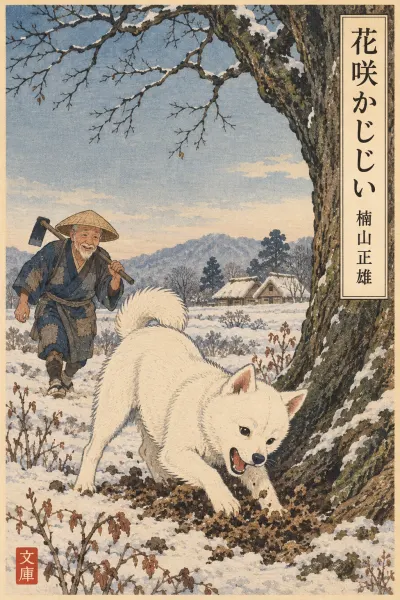
花咲かじじい is one of Japan's best-known folktales, retold by Kusuyama Masao in the gentle, polite voice of a storyteller reading aloud to children. An honest, kind old couple live next door to a greedy pair. When the honest couple's beloved dog Shiro starts barking 「ここほれ、わんわん」 ('dig here, woof woof'), a chain of events begins in which kindness and envy keep meeting the same magical things, with very different results. The story follows a clear repeating pattern: something good happens to the honest old man, the neighbour borrows it, and things go badly. This makes the plot easy to follow even when individual sentences are hard. The narration uses です・ます throughout, but it is full of onomatopoeia and chants, and it draws on vocabulary from old rural life, such as mortars, pounding rice cakes, withered trees and a lord's hunting party. The lord's brusque, old-fashioned commands and the neighbour's rough おれ add contrasting voices. At about 3,000 characters in two parts, it can be finished in one or two sittings. Much of the challenge comes from sound words and period vocabulary rather than from complicated sentence structure.
Contents
Easier versions
This story is also retold in simpler Japanese. Reading an easier version first makes the original much more approachable.
Before you read
- Learn the key nouns before you start: 榎 (えのき, hackberry tree), 臼 (うす, mortar), 餅 (もち, rice cake), 灰 (はい, ash), 枯れ木 (かれき, withered tree), 殿様 (とのさま, lord) and 家来 (けらい, retainer). The whole plot turns on these objects.
- Treat the onomatopoeia and chants as vocabulary. かちり, きらきら, ぷん and うじゃうじゃ tell you whether the result is treasure or filth. Chants such as 「ここほれ、わんわん」 and 「ぺんたらこっこ」 repeat, so read them aloud and enjoy the rhythm.
- Use the repeating structure. Each scene in Part 2 mirrors a scene in Part 1: the honest man succeeds, the neighbour copies him and fails. When a sentence is difficult, you can often guess its meaning from the parallel scene.
- Watch for the grammar that recurs in the notes. 〜だらけ ('covered in') and 〜ばかり ('nothing but') describe the neighbour's disasters. どんなに〜でしょう expresses strong feeling. 〜たなり means 'and stayed that way', and 〜どころか means 'far from…'. 〜やら〜やら lists a jumble of things.
- Notice the three different voices. The narrator is polite and gentle, and the greedy man uses rough おれ. The lord gives old-fashioned commands like 見せてみよ and calls someone ふとどきなやつ. Imperatives ending in 〜よ, such as 〜て見せよ, are classical-style commands, not the modern sentence-ending particle.
Words to know
The most useful words from the notes across the story.
| Word | Meaning | JLPT |
|---|---|---|
| うすうす | mortar (for pounding rice into mochi)dictionary form: 臼 | — |
| 正直しょうじき | honestUsed here almost as a title: 正直おじいさん 'the honest old man', contrasted with 欲ばりおじいさん. | N3 |
| さなかさなか | the very middle (of a season or event)dictionary form: 最中Literary; also read さいちゅう in everyday use. | N3 |
| かわいがっていましたかわいがる | to dote on, to treat with lovedictionary form: 可愛がる〜がる verb from かわいい: to show affection towards someone or something. | N2 |
| 欲ばりよくばり | greedy; a greedy persondictionary form: 欲張り | N2 |
| かわらかわら | roof tiledictionary form: 瓦 | N2 |
| ずうずうしくずうずうしい | shameless, cheeky, brazendictionary form: 図々しいAdverbial ~く form here: 'shamelessly came to borrow'. | N2 |
| うっかりうっかり | carelessly, without thinkingOften used when someone makes a naive mistake. | N2 |
| もしてもす | to burndictionary form: 燃すColloquial variant of 燃やす (もやす). | N2 |
| なついていましたなつく | to become attached to, be fond of (a person)dictionary form: 懐くTypically used of children or animals taking to someone. | N1 |
| すそすそ | hem (of a robe or kimono)dictionary form: 裾 | N1 |
| 家来けらい | retainer, vassal, follower | N1 |
| いじのわるいいじがわるい | spiteful, nasty, meandictionary form: 意地が悪いAlso said as 意地悪 (いじわる). | — |
| くわくわ | hoedictionary form: 鍬 | — |
| えのきえのき | Chinese hackberry treedictionary form: 榎A large shade tree often found in old Japanese villages. | — |
Plot summary
Show the full summary (contains spoilers)
An honest old couple love their dog Shiro like a child. Shiro leads the old man to a hackberry tree, where he digs up a pile of gold coins. The greedy neighbour borrows Shiro and forces him to dig, but finds only filth, and he kills the dog in anger. The grieving couple bury Shiro and plant a pine tree on the grave. It quickly grows into a magnificent tree, and the old man makes a mortar from its wood. When he pounds rice in it, rice pours out and fills the kitchen. The neighbour borrows the mortar, gets only filth, and burns it. The honest old man scatters its ashes, and withered trees burst into blossom, so a lord rewards him richly. The greedy man tries the same trick, but the ashes blow into the lord's face. He is tied up and taken to prison.
About the author
Kusuyama Masao (1884–1950) was a Japanese writer, editor and translator who did much to shape children's literature in modern Japan. He studied at Waseda University and was also active in theatre, working as a critic and translator of Western drama. He is best remembered for his retellings of Japanese folk tales and legends for young readers. His retellings are written in clear, rhythmic Japanese meant to be read aloud.