Part 1 of 2 · JLPT N3
いちょうの実 Ichō no Jitsu, part 1: The Ginkgo Children Wake at Dawn
In this part
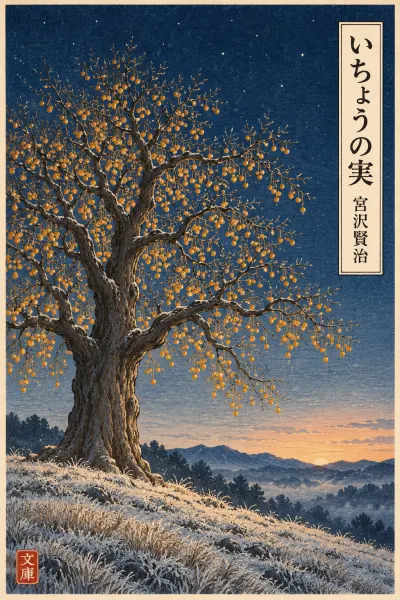
On a freezing, starry morning just before sunrise, the thousand golden nuts of a lone ginkgo tree on a hill wake up and realise that today they must leave their mother tree. Some nuts talk nervously about the fall, their flasks and peppermint water. The girls say they do not want to go and ask each other's forgiveness, while the boys dream of becoming stars or of being carried into the sky by the crow. The mother tree has already dropped all her golden leaves out of grief.
AI translation · independently checked
そらのてっぺんなんかつめたくてつめたくてまるでカチカチのやきをかけた鋼です。Up at the very top of the sky it was cold, so very cold, just like steel that has been tempered hard as stone.
そして星がいっぱいです。And the sky was full of stars.
けれども東の空はもうやさしいききょうの花びらのようにあやしい底光りをはじめました。But the eastern sky had already begun to glow with a strange light from deep within, like the soft petals of a bellflower.
その明け方の空の下、ひるの鳥でもゆかない高いところをするどい霜のかけらが風に流されてサラサラサラサラ南のほうへとんでゆきました。Beneath that dawn sky, high up where not even the birds of daytime go, sharp splinters of frost were swept along by the wind, flying off southward with a swish-swish, swish-swish.
じつにそのかすかな音が丘の上の一本いちょうの木に聞こえるくらいすみきった明け方です。It was a dawn so truly clear that even that faint sound could be heard by the lone ginkgo tree on top of the hill.
いちょうの実はみんないちどに目をさましました。The ginkgo nuts all woke up at once.
そしてドキッとしたのです。And their hearts gave a jump.
きょうこそはたしかに旅だちの日でした。Today, for certain, was the day of their departure.
みんなも前からそう思っていましたし、きのうの夕方やってきた二わのカラスもそういいました。They had all been thinking so for a long while, and the two crows who had come by yesterday evening had said so too.
「ぼくなんか落ちるとちゅうで目がまわらないだろうか。」一つの実がいいました。"I wonder if someone like me will get dizzy on the way down," said one of the nuts.
「よく目をつぶっていけばいいさ。」も一つが答えました。"You'll be fine if you just keep your eyes shut tight," answered another.
「そうだ。わすれていた。ぼく水とうに水をつめておくんだった。」"That's right. I forgot. I should have filled my flask with water."
「ぼくはね、水とうのほかにはっか水を用意したよ。すこしやろうか。旅へ出てあんまり心持ちのわるいときはちょっと飲むといいっておっかさんがいったぜ。」"Well, besides my flask, I've got some peppermint water ready. Shall I give you a little? Mother said that if you feel really poorly on a journey, you should take a sip of it."
「なぜおっかさんはぼくへはくれないんだろう。」"Why didn't Mother give any to me, I wonder?"
「だから、ぼくあげるよ。おっかさんをわるく思っちゃすまないよ。」"That's why I'm giving you some. You mustn't think badly of Mother."
そうです。Yes, indeed.
このいちょうの木はおかあさんでした。This ginkgo tree was their mother.
ことしは千人の黄金色の子どもが生まれたのです。This year a thousand golden children had been born to her.
そしてきょうこそ子どもらがみんないっしょに旅にたつのです。And today, at last, the children were all setting off on their journey together.
おかあさんはそれをあんまり悲しんでおうぎ形の黄金の髪の毛をきのうまでにみんな落としてしまいました。Their mother grieved so much over this that by yesterday she had let all her fan-shaped golden hair fall away.
「ね、あたしどんなとこへいくのかしら。」ひとりのいちょうの女の子が空を見あげてつぶやくようにいいました。"Say, I wonder what sort of place I'll be going to," one little ginkgo girl murmured, gazing up at the sky.
「あたしだってわからないわ、どこへもいきたくないわね。」もひとりがいいました。"I don't know either. I don't want to go anywhere at all, do you?" said another.
「あたしどんなめにあってもいいから、おっかさんとこにいたいわ。」"I don't care what happens to me, I just want to stay with Mother."
「だっていけないんですって。風が毎日そういったわ。」"But they say we're not allowed to. The wind told us so every day."
「いやだわね。」"Isn't it horrid?"
「そしてあたしたちもみんなばらばらにわかれてしまうんでしょう。」"And we'll all be scattered and parted from each other, won't we?"
「ええ、そうよ。もうあたしなんにもいらないわ。」"Yes, we will. I don't want anything anymore."
「あたしもよ。今までいろいろわがままばっかしいってゆるしてくださいね。」"Nor do I. Please forgive me for always being so selfish and saying so many willful things till now."
「あら、あたしこそ。あたしこそだわ。ゆるしてちょうだい。」"Oh, no, it's me. It's me who should say that. Please forgive me."
東の空のききょうの花びらはもういつかしぼんだように力なくなり、朝の白光りがあらわれはじめました。The bellflower petals of the eastern sky had somehow already lost their strength, as if they had withered, and the white light of morning began to appear.
星が一つずつきえてゆきます。One by one the stars went out.
木のいちばんいちばん高いところにいたふたりのいちょうの男の子がいいました。Two little ginkgo boys who were at the very, very top of the tree spoke up.
「そら、もう明るくなったぞ。うれしいなあ。ぼくはきっと黄金色のお星さまになるんだよ。」"Look, it's light already! Oh, I'm so happy. I'm sure I'm going to become a golden star."
「ぼくもなるよ。きっとここから落ちればすぐ北風が空へつれてってくれるだろうね。」"So am I. I bet as soon as we drop from here, the North Wind will carry us straight up into the sky."
「ぼくは北風じゃないと思うんだよ。北風はしんせつじゃないんだよ。ぼくはきっとからすさんだろうと思うね。」"I don't think it'll be the North Wind. The North Wind isn't kind. I think it's sure to be Mr. Crow."
「そうだ。きっとからすさんだ。からすさんはえらいんだよ。ここから遠くてまるで見えなくなるまでひと息に飛んでゆくんだからね。たのんだら、ぼくらふたりぐらいきっといっぺんに青ぞらまでつれていってくれるぜ。」"That's it. It's sure to be Mr. Crow. Mr. Crow is wonderful. He flies off in one breath until he's so far from here you can't see him at all. If we ask him, I bet he'll take the two of us up to the blue sky in one go."
「たのんでみようか。はやく来るといいな。」"Shall we try asking him? I hope he comes soon."
そのすこし下でもうふたりがいいました。A little lower down, two more were talking.
「ぼくはいちばんはじめにあんずの王様のお城をたずねるよ。そしておひめ様をさらっていったばけものを退治するんだ。そんなばけものがきっとどこかにあるね。」"The very first thing I'll do is visit the castle of the Apricot King. And then I'll slay the monster that carried off the princess. There's sure to be a monster like that somewhere."
Vocabulary
| Word | Meaning | JLPT |
|---|---|---|
| 鋼はがね | steelやきをかける means to temper (harden) metal by heating and quenching. | — |
| 底光りそこびかり | a deep, inner glow; light shining from beneath the surface | — |
| 霜しも | frost | N3 |
| かけらかけら | fragment, splinter, shard | — |
| すみきったすみきる | to be perfectly cleardictionary form: 澄み切る〜きる adds the sense of 'completely'. | — |
| 旅だちたびだち | departure on a journeydictionary form: 旅立ちVerb form: 旅立つ / 旅にたつ, to set off on a journey. | — |
| 目がまわらないめがまわる | to feel dizzydictionary form: 目が回るAlso used figuratively for being extremely busy. | — |
| はっか水はっかすい | peppermint water (an old home remedy)dictionary form: 薄荷水 | — |
| 心持ちこころもち | how one feels; mood, physical feelingSomewhat old-fashioned; today 気持ち is more common. | — |
| おっかさんおっかさん | Mother, MumOld-fashioned, colloquial form of お母さん. | — |
| つぶやくつぶやく | to murmur, mutter to oneselfdictionary form: 呟く | N1 |
| わがままわがまま | selfishness, willfulnessdictionary form: 我が儘 | N3 |
| しぼんだしぼむ | to wither, wilt, shriveldictionary form: 萎む | N2 |
| 退治たいじ | slaying, getting rid of (monsters, pests)Classic folktale word, e.g. 鬼退治 'demon slaying'. | N1 |
Grammar
〜こそ N3 emphasis: 'this very', 'it is precisely'
こそ singles out a word with strong emphasis. きょうこそ means 'today of all days', and in あたしこそ the girl insists that she, not her friend, is the one who should apologise.
きょうこそはたしかに旅だちの日でした。
Today, for certain, was the day of their departure.
〜ておくんだった N3 I should have done (something) in advance
〜ておく means doing something in preparation; adding んだった expresses regret about not having done it.
ぼく水とうに水をつめておくんだった。
I should have filled my flask with water.
〜ちゃすまない N3 it won't do to…; you mustn't…
〜ちゃ is the casual contraction of 〜ては. Combined with すまない ('it's not right / inexcusable'), it gently warns against doing something.
おっかさんをわるく思っちゃすまないよ。
You mustn't think badly of Mother.
〜かしら N3 I wonder…
A sentence-final particle for wondering aloud, traditionally used in feminine speech, much like 〜かな.
あたしどんなとこへいくのかしら。
I wonder what sort of place I'll be going to.
〜んですって N3 they say that…; I hear that…
って after a clause reports what someone else said; んですって is a soft, feminine way to pass on hearsay.
だっていけないんですって。
But they say we're not allowed to.
〜ば…てくれる N4 if…, (someone) will do…for us
The conditional 〜ば sets the condition, and 〜てくれる shows the action is done as a favour to the speaker; だろう adds a hopeful guess.
きっとここから落ちればすぐ北風が空へつれてってくれるだろうね。
I bet as soon as we drop from here, the North Wind will carry us straight up into the sky.