Intermediate · JLPT N3
いちょうの実Ichō no Jitsu — Departure Morning on the Ginkgo Tree
- JLPT N3
- 2,629 characters
- 2 parts
- about 22 minutes
- 2 easier versions
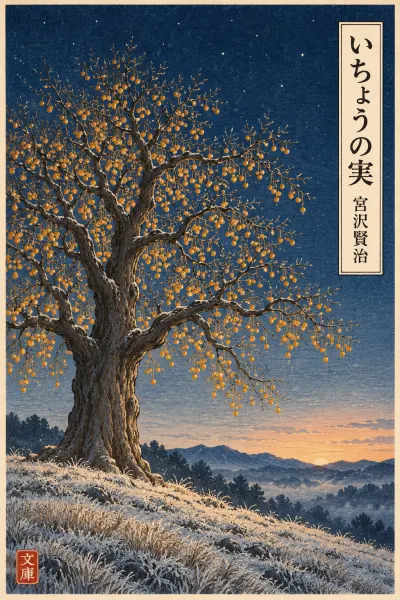
This is a short children's tale by Miyazawa Kenji, told almost entirely from the point of view of ginkgo nuts. On a freezing, star-filled morning just before sunrise, the thousand golden nuts of a lone ginkgo tree on a hill wake up knowing that today they must leave their mother. What follows is mostly their chatter as they get ready. Some are nervous about the fall, some cry and say they don't want to go, and some boast about the adventures waiting for them. Above them stands the mother tree, already bare. The narration is gentle and polite (です・ます), written largely in hiragana, and full of sound words. Even the sunrise is described with honorific language. The story is both playful and quietly sad, a picture of children leaving home seen through nature. For learners, the plain grammar of the narration is very approachable. The challenge is the dialogue. Dozens of small voices speak without names, each marked only by gendered and childlike speech (ぼく…ぜ, あたし…かしら, ってよ), with a few old-fashioned words mixed in.
Contents
Easier versions
This story is also retold in simpler Japanese. Reading an easier version first makes the original much more approachable.
Before you read
- Use speech style to tell the speakers apart, since none of the nuts has a name. ぼく with ぜ or さ marks a boy. あたし/わたし with わ, かしら, 〜てよ/〜なくってよ, 〜ですもの or ちょうだい marks a girl. Pairs of lines are often a short exchange between two nuts.
- Learn the casual contractions before you start. 〜ちまう = 〜てしまう. 〜ちゃすまない = 〜ては済まない ('it wouldn't be right to…'). 〜んだって / 〜んですって = 'I hear that…'. 〜ておくんだった expresses regret: 'I should have…'.
- Because most of the text is in hiragana, read slowly and look for word boundaries at particles. If a line seems confusing, try writing the likely kanji for each word.
- Notice the honorific language used for the sun: おでましになる ('makes an appearance') and おやりなさいました. The narrator treats the sun like a respected figure, much as one would a noble person in an old tale.
- A few older words are worth knowing in advance. おっかさん means 'Mother'. くだすった is an older form of くださった. 外套 (がいとう) means 'overcoat'. Also note the sound words (サラサラ, ゴーッ, ユラリユラリ), which describe the wind and the swaying tree.
Words to know
The most useful words from the notes across the story.
| Word | Meaning | JLPT |
|---|---|---|
| くだすったくださる | to give (to me, respectfully)dictionary form: くださるくだすった is an old colloquial form of くださった. | N4 |
| 出発しゅっぱつ | departure, setting off | N4 |
| 霜しも | frost | N3 |
| わがままわがまま | selfishness, willfulnessdictionary form: 我が儘 | N3 |
| 宝石ほうせき | jewel, gem | N3 |
| しぼんだしぼむ | to wither, wilt, shriveldictionary form: 萎む | N2 |
| こごえたらこごえる | to freeze (of a living body), go numb with colddictionary form: 凍える | N2 |
| つぶやくつぶやく | to murmur, mutter to oneselfdictionary form: 呟く | N1 |
| 退治たいじ | slaying, getting rid of (monsters, pests)Classic folktale word, e.g. 鬼退治 'demon slaying'. | N1 |
| 鋼はがね | steelやきをかける means to temper (harden) metal by heating and quenching. | — |
| 底光りそこびかり | a deep, inner glow; light shining from beneath the surface | — |
| かけらかけら | fragment, splinter, shard | — |
| すみきったすみきる | to be perfectly cleardictionary form: 澄み切る〜きる adds the sense of 'completely'. | — |
| 旅だちたびだち | departure on a journeydictionary form: 旅立ちVerb form: 旅立つ / 旅にたつ, to set off on a journey. | — |
| 目がまわらないめがまわる | to feel dizzydictionary form: 目が回るAlso used figuratively for being extremely busy. | — |
Plot summary
Show the full summary (contains spoilers)
Before dawn on a frosty morning, the golden nuts of a single ginkgo tree on a hill wake and realise that today is the day they must leave their mother tree. They talk over their worries: whether the fall will hurt, and whether they have filled their flasks with peppermint water. Some girls say they don't want to go and ask each other's forgiveness. Some boys dream of becoming stars or of being carried off by a crow. One brave little nut plans to use a net made from Mother's hair to defeat a monster and rescue the apricot princess. As the sky brightens, the children hurry to get ready. They swap shoes, share bread, and offer to share a coat with a friend who has lost hers. Then the sun's rays strike and the cold north wind roars. The nuts call goodbye to their mother and leap from the branches together to begin their journey.
About the author
Miyazawa Kenji was a poet and writer of children's stories from Hanamaki in Iwate Prefecture. He studied agricultural science in Morioka and later taught at an agricultural school. He devoted much of his life to helping local farmers improve their methods and their cultural lives. He was a devout Buddhist, and his faith, love of nature and interest in science run through his writing. His fame came after his death, with works such as 銀河鉄道の夜, 風の又三郎 and the poem 雨ニモマケズ.