Part 1 of 1 · JLPT N3
待つ Matsu, part 1: Waiting on a Cold Station Bench
In this part
A twenty-year-old woman stops at a small station every day on her way home from shopping and sits on a cold bench, waiting for someone or something she cannot name. She fears people, and since the great war began she has felt unable to stay quietly at home. She wonders whether her wish to be useful is only an excuse for reckless fancies, lists and rejects possible answers, and finally asks to be remembered, saying the reader will someday see her.
AI translation · independently checked
省線のその小さい駅に、私は毎日、人をお迎えにまいります。Every day I go to that little station on the government line to meet someone.
誰とも、わからぬ人を迎えに。To meet someone, though I could not say who.
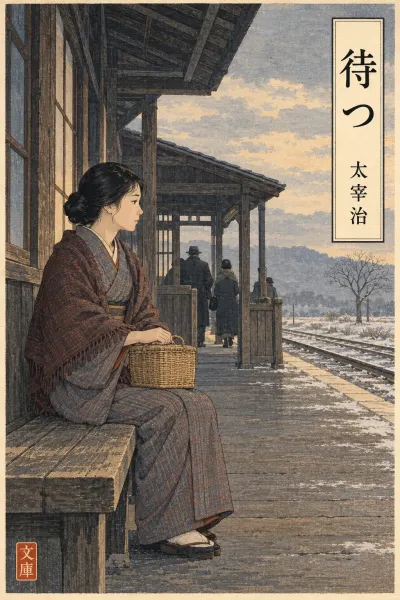
市場で買い物をして、その帰りには、かならず駅に立ち寄って駅の冷いベンチに腰をおろし、買い物籠を膝に乗せ、ぼんやり改札口を見ているのです。After my shopping at the market, I always stop at the station on the way home. I sit down on its cold bench with my shopping basket on my lap and gaze absently at the ticket gate.
上り下りの電車がホームに到着するごとに、たくさんの人が電車の戸口から吐き出され、どやどや改札口にやって来て、一様に怒っているような顔をして、パスを出したり、切符を手渡したり、それから、そそくさと脇目も振らず歩いて、私の坐っているベンチの前を通り駅前の広場に出て、そうして思い思いの方向に散って行く。Each time a train pulls in at the platform, going up the line or down, crowds of people are spat out of the carriage doors and come surging toward the gate, every one of them wearing the same angry-looking face. They show their passes or hand over their tickets, then hurry off without a glance to either side. They pass in front of the bench where I sit, come out into the square before the station, and scatter, each in a different direction.
私は、ぼんやり坐っています。I sit there absently.
誰か、ひとり、笑って私に声を掛ける。Someone, just one person, smiles and calls out to me.
おお、こわい。Oh, how frightening.
ああ、困る。Ah, what would I do?
胸が、どきどきする。My heart is pounding.
考えただけでも、背中に冷水をかけられたように、ぞっとして、息がつまる。Just thinking of it makes me shudder, as though cold water had been poured down my back, and I can hardly breathe.
けれども私は、やっぱり誰かを待っているのです。And yet I am waiting for someone, after all.
いったい私は、毎日ここに坐って、誰を待っているのでしょう。Whom on earth am I waiting for, sitting here every day?
どんな人を?What sort of person?
いいえ、私の待っているものは、人間でないかも知れない。No. Perhaps what I am waiting for is not a human being at all.
私は、人間をきらいです。I dislike people.
いいえ、こわいのです。No, I am afraid of them.
人と顔を合せて、お変りありませんか、寒くなりました、などと言いたくもない挨拶を、いい加減に言っていると、なんだか、自分ほどの嘘つきが世界中にいないような苦しい気持になって、死にたくなります。When I meet someone face to face and carelessly say greetings I do not even want to say, such as "Are you keeping well?" or "It has turned cold, hasn't it?", I somehow come to feel so wretched that I want to die. It is as though there were no greater liar than me in all the world.
そうしてまた、相手の人も、むやみに私を警戒して、当らずさわらずのお世辞やら、もったいぶった嘘の感想などを述べて、私はそれを聞いて、相手の人のけちな用心深さが悲しく、いよいよ世の中がいやでいやでたまらなくなります。And the other person, too, is needlessly on guard against me. They offer safe, noncommittal compliments or pompous, insincere opinions. Listening to them, I am saddened by their petty caution, and the world grows more and more hateful to me, until I can hardly bear it.
世の中の人というものは、お互い、こわばった挨拶をして、用心して、そうしてお互いに疲れて、一生を送るものなのでしょうか。Is it the way of people in this world to exchange stiff greetings, to stay on guard, and so to wear each other out until their whole lives have passed?
私は、人に逢うのが、いやなのです。I hate meeting people.
だから私は、よほどの事でもない限り、私のほうからお友達の所へ遊びに行く事などは致しませんでした。That is why, unless it was something truly important, I never went out of my own accord to visit friends.
家にいて、母と二人きりで黙って縫物をしていると、一ばん楽な気持でした。I felt most at ease staying at home and sewing in silence, just Mother and me.
けれども、いよいよ大戦争がはじまって、周囲がひどく緊張してまいりましてからは、私だけが家で毎日ぼんやりしているのが大変わるい事のような気がして来て、何だか不安で、ちっとも落ちつかなくなりました。But once the great war had at last begun and everything around me grew so very tense, I came to feel it was terribly wrong for me alone to sit idly at home day after day. Somehow I grew uneasy, and I could not settle at all.
身を粉にして働いて、直接に、お役に立ちたい気持なのです。I want to work myself to the bone and be of use directly.
私は、私の今までの生活に、自信を失ってしまったのです。I have lost all confidence in the life I have led until now.
家に黙って坐って居られない思いで、けれども、外に出てみたところで、私には行くところが、どこにもありません。I feel I cannot sit quietly at home, and yet even if I go out, there is nowhere at all for me to go.
買い物をして、その帰りには、駅に立ち寄って、ぼんやり駅の冷いベンチに腰かけているのです。I do my shopping, and on the way home I stop at the station and sit absently on its cold bench.
どなたか、ひょいと現われたら!If only someone would suddenly appear!
という期待と、ああ、現われたら困る、どうしようという恐怖と、でも現われた時には仕方が無い、その人に私のいのちを差し上げよう、私の運がその時きまってしまうのだというような、あきらめに似た覚悟と、その他さまざまのけしからぬ空想などが、異様にからみ合って、胸が一ぱいになり窒息するほどくるしくなります。Several feelings tangle together strangely inside me. There is that hope. There is the dread: oh, if someone did appear, what would I do? There is a resolve close to resignation: if they do appear, it cannot be helped, I will give my life to that person, and my fate will be settled then and there. And there are all sorts of other improper fancies besides. My heart grows so full that it hurts, as if I were suffocating.
生きているのか、死んでいるのか、わからぬような、白昼の夢を見ているような、なんだか頼りない気持になって、駅前の、人の往来の有様も、望遠鏡を逆に覗いたみたいに、小さく遠く思われて、世界がシンとなってしまうのです。I feel so unsteady, as if I could not tell whether I were alive or dead, as if I were dreaming in broad daylight. Even the comings and goings of people in front of the station seem small and far away, as though seen through the wrong end of a telescope, and the whole world falls silent.
ああ、私はいったい、何を待っているのでしょう。Oh, what on earth am I waiting for?
ひょっとしたら、私は大変みだらな女なのかも知れない。Perhaps I am a very wanton woman.
大戦争がはじまって、何だか不安で、身を粉にして働いて、お役に立ちたいというのは嘘で、本当は、そんな立派そうな口実を設けて、自身の軽はずみな空想を実現しようと、何かしら、よい機会をねらっているのかも知れない。Perhaps it is a lie that the great war has made me uneasy and that I want to work myself to the bone and be of use. Perhaps the truth is that I have set up this fine-sounding excuse and am watching for some chance or other to make my reckless fancies come true.
ここに、こうして坐って、ぼんやりした顔をしているけれども、胸の中では、不埒な計画がちろちろ燃えているような気もする。I sit here like this with a vacant look on my face, yet I also feel as if some wicked scheme were flickering away in my heart.
いったい、私は、誰を待っているのだろう。Whom on earth am I waiting for?
はっきりした形のものは何もない。There is nothing with a clear shape.
ただ、もやもやしている。It is only a haze.
けれども、私は待っている。And yet I am waiting.
大戦争がはじまってからは、毎日、毎日、お買い物の帰りには駅に立ち寄り、この冷いベンチに腰をかけて、待っている。Since the great war began, every day, every single day, I stop at the station on my way home from shopping, sit down on this cold bench, and wait.
誰か、ひとり、笑って私に声を掛ける。Someone, one person, smiles and speaks to me.
おお、こわい。Oh, how frightening.
ああ、困る。Ah, what would I do?
私の待っているのは、あなたでない。The one I am waiting for is not you.
それではいったい、私は誰を待っているのだろう。Then whom on earth am I waiting for?
旦那さま。A husband.
ちがう。No.
恋人。A lover.
ちがいます。No, not that.
お友達。A friend.
いやだ。Oh, no.
お金。Money.
まさか。Surely not.
亡霊。A ghost.
おお、いやだ。Oh, how horrid.
もっとなごやかな、ぱっと明るい、素晴らしいもの。Something gentler, something suddenly bright, something wonderful.
なんだか、わからない。I do not quite know.
たとえば、春のようなもの。Something like spring, perhaps.
いや、ちがう。No, that is not it.
青葉。Fresh green leaves.
五月。May.
麦畑を流れる清水。Clear water running through a field of wheat.
やっぱり、ちがう。No, still not it.
ああ、けれども私は待っているのです。Ah, and yet I am waiting.
胸を躍らせて待っているのだ。I am waiting with my heart leaping.
眼の前を、ぞろぞろ人が通って行く。People stream past before my eyes.
あれでもない、これでもない。Not that one, not this one.
私は買い物籠をかかえて、こまかく震えながら一心に一心に待っているのだ。Clutching my shopping basket and trembling slightly, I wait with all my heart, with all my heart.
私を忘れないで下さいませ。Please do not forget me.
毎日、毎日、駅へお迎えに行っては、むなしく家へ帰って来る二十の娘を笑わずに、どうか覚えて置いて下さいませ。Every single day a girl of twenty goes to the station to meet someone, and every day she comes home again for nothing. Please do not laugh at her; please, I beg you, remember her.
その小さい駅の名は、わざとお教え申しません。I will not tell you the name of that little station. I keep it from you on purpose.
お教えせずとも、あなたは、いつか私を見掛ける。Even if I do not tell you, someday you will catch sight of me.
Vocabulary
| Word | Meaning | JLPT |
|---|---|---|
| お迎えむかえ | going to meet someone (on arrival)dictionary form: 迎えお迎えに行く / まいる means 'go to meet'. まいります is the humble form of 行く. | N3 |
| 立ち寄ってたちよる | to stop by, to drop in on the waydictionary form: 立ち寄る | N1 |
| 改札口かいさつぐち | ticket gate, ticket barrier口 becomes ぐち in this compound. | — |
| 脇目も振らずわきめもふらず | without looking aside; single-mindedlyA set phrase. 脇目 means a sideways glance. | — |
| ぞっとしてぞっとする | to shudder, to get chills (from fear)dictionary form: ぞっとする | — |
| 警戒けいかい | wariness, being on guard | N1 |
| お世辞せじ | flattery, complimentsdictionary form: 世辞Almost always used with お: お世辞を言う. | N1 |
| 身を粉にしてみをこにする | to work oneself to the bonedictionary form: 身を粉にする粉 is read こ in this idiom, not こな. | — |
| 覚悟かくご | resolve; being prepared for the worst | N3 |
| みだらみだら | wanton, lewd, immoraldictionary form: 淫ら | — |
| 口実こうじつ | pretext, excuse口実を設ける means 'to make up an excuse'. | N2 |
| 不埒ふらち | outrageous, wicked, improperA somewhat old-fashioned word. | — |
| もやもやもやもや | hazy, vague; a cloudy, unclear feelingOnomatopoeia from 靄 (mist). | — |
| 亡霊ぼうれい | ghost, spirit of the dead | — |
Grammar
〜ぬ N2 not (literary negative)
ぬ is an older, literary form of the negative ない, attached to the same verb stem. わからぬ人 means 'a person I don't know'.
誰とも、わからぬ人を迎えに。
To meet someone, though I could not say who.
〜ごとに N3 every time; each
Added to a dictionary-form verb, ごとに means that something happens every single time the action occurs. Here it describes each train's arrival.
上り下りの電車がホームに到着するごとに
Each time a train pulls in at the platform, going up the line or down
〜てたまらない N3 unbearably; can't stand how ~
This pattern expresses a feeling too strong to bear. Repeating the adjective (いやでいやで) intensifies it further, and なります shows the feeling growing.
いよいよ世の中がいやでいやでたまらなくなります。
the world grows more and more hateful to me, until I can hardly bear it.
〜ない限り N2 unless
This pattern sets a condition: unless the condition is met, the main statement holds. よほどの事 means 'something truly serious or out of the ordinary'.
よほどの事でもない限り
unless it was something truly important
〜たところで N2 even if (it would be pointless)
Following a past-form verb, たところで means that even if the action is done, the result will be useless or disappointing. Here, going out does not help because she has nowhere to go.
外に出てみたところで、私には行くところが、どこにもありません。
even if I go out, there is nowhere at all for me to go.
〜ずとも N1 even without ~ing
This is a literary form combining ず (negative) and とも (even if). It means 'even without doing'. お教えせず is the humble form of 'without telling you'.
お教えせずとも、あなたは、いつか私を見掛ける。
Even if I do not tell you, someday you will catch sight of me.