Intermediate · JLPT N3
待つMatsu — Every Day at the Little Station
- JLPT N3
- 2,064 characters
- 1 part
- about 17 minutes
- 2 easier versions
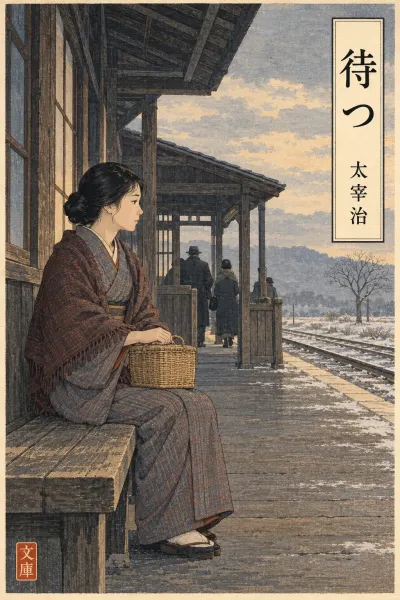
待つ is a very short first-person monologue by Dazai Osamu. A young woman of twenty describes her daily habit of stopping at a small, unnamed railway station and sitting on a bench to wait. She cannot say whom or what she is waiting for. The story is set in the days after a 'great war' has begun. Almost nothing happens outwardly. The interest lies in the voice: polite, hesitant and self-doubting, she questions her own motives, accuses herself, and then takes the accusation back. For a learner, the text is short enough to read in one or two sittings, and the vocabulary is mostly everyday. The challenge is the style. She speaks in soft, rather old-fashioned feminine humble Japanese, full of forms like まいります and 致しませんでした. When she grows agitated, this breaks into plain-form fragments and exclamations. Following her logic means noticing these shifts in register, the many negatives, and the conditional patterns that carry her reasoning. Read it slowly. Each sentence rewards attention to how she qualifies what she has just said.
Contents
Easier versions
This story is also retold in simpler Japanese. Reading an easier version first makes the original much more approachable.
Before you read
- Learn the humble and polite feminine forms before you start: まいります (行く/来る), 致します (する), 申します (言う), and the request ending 〜下さいませ. They appear throughout, and recognising them quickly keeps the sentences from feeling longer than they are.
- Watch for the classical negative 〜ぬ and the related 〜ずとも ('even without ~'). The narrator often defines her feelings by what they are not, so it matters to keep track of what is being negated.
- Her self-questioning relies on a few patterns: 〜ない限り ('unless/as long as not'), 〜たところで ('even if ~, it would be no use') and 〜てたまらない ('unbearably ~'). Mark them as you read. They signal where she is arguing with herself.
- Notice the shifts in register. When the polite desu/masu flow breaks into short plain-form fragments or exclamations, she is becoming agitated. Read these as raw thoughts rather than as statements addressed to anyone.
- Two words to know in advance: 省線, the government railway lines of the period, and あなた in the final lines. There, あなた means the reader, whom she addresses directly.
Words to know
The most useful words from the notes across the story.
| Word | Meaning | JLPT |
|---|---|---|
| お迎えむかえ | going to meet someone (on arrival)dictionary form: 迎えお迎えに行く / まいる means 'go to meet'. まいります is the humble form of 行く. | N3 |
| 覚悟かくご | resolve; being prepared for the worst | N3 |
| 口実こうじつ | pretext, excuse口実を設ける means 'to make up an excuse'. | N2 |
| 立ち寄ってたちよる | to stop by, to drop in on the waydictionary form: 立ち寄る | N1 |
| 警戒けいかい | wariness, being on guard | N1 |
| お世辞せじ | flattery, complimentsdictionary form: 世辞Almost always used with お: お世辞を言う. | N1 |
| 改札口かいさつぐち | ticket gate, ticket barrier口 becomes ぐち in this compound. | — |
| 脇目も振らずわきめもふらず | without looking aside; single-mindedlyA set phrase. 脇目 means a sideways glance. | — |
| ぞっとしてぞっとする | to shudder, to get chills (from fear)dictionary form: ぞっとする | — |
| 身を粉にしてみをこにする | to work oneself to the bonedictionary form: 身を粉にする粉 is read こ in this idiom, not こな. | — |
| みだらみだら | wanton, lewd, immoraldictionary form: 淫ら | — |
| 不埒ふらち | outrageous, wicked, improperA somewhat old-fashioned word. | — |
| もやもやもやもや | hazy, vague; a cloudy, unclear feelingOnomatopoeia from 靄 (mist). | — |
| 亡霊ぼうれい | ghost, spirit of the dead | — |
Plot summary
Show the full summary (contains spoilers)
A twenty-year-old woman stops at a small station every day on her way home from shopping. She sits on a cold bench and watches the passengers come through the ticket gate, waiting for someone or something she cannot name. She admits that she is afraid of people and dreads having to talk to them. Yet since the great war began, she has felt unable to stay quietly at home. She wonders whether her wish to be of use is sincere, or only an excuse for reckless fancies. She runs through possible answers about what she is waiting for, and she rejects each one. The story ends with her speaking directly to the reader. She asks to be remembered, and she says that the reader will someday see her at that little station.
About the author
Dazai Osamu (太宰治) was the pen name of Tsushima Shūji, born into a wealthy landowning family in Aomori Prefecture in northern Japan. He studied French literature at Tokyo Imperial University but did not graduate, devoting himself instead to writing. He is best known for the novels The Setting Sun (斜陽) and No Longer Human (人間失格), which draw heavily on his own troubled life. Much of his work is dark and confessional. Keep Running, Melos shows a brighter, more straightforwardly heroic side of his writing. He died by suicide in 1948.