Advanced · JLPT N1
蜜柑Mikan — Tangerines Thrown at Dusk
- JLPT N1
- 3,151 characters
- 2 parts
- about 26 minutes
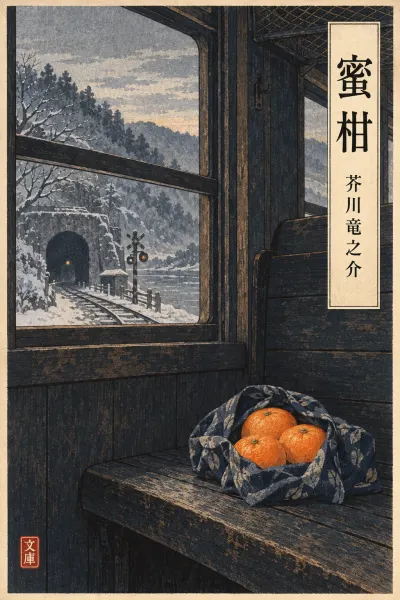
"Mikan" is a very short first-person sketch by Akutagawa Ryūnosuke, set on a single train journey. On a cloudy winter evening, a tired and gloomy narrator sits in a second-class carriage leaving Yokosuka. A shabby country girl carrying a third-class ticket sits down opposite him, and he watches her with open irritation. Almost nothing happens beyond the train moving through a series of tunnels toward the edge of a poor town, but the story turns on one small moment near the end. That moment briefly changes how the narrator sees the girl and his own weariness. The prose is restrained, precise and inward-looking. It records soot, grime, dim light and the narrator's fastidious distaste in close detail, which makes the brief brightness at the end stand out. For learners, the story's length is its main appeal: it can be read in one or two sittings. It is still demanding, at roughly N1 level. There is no real dialogue to lean on. Sentences are long and descriptive, and the text uses older Taishō-era vocabulary, kanji and katakana spellings you will not find in modern textbooks.
Contents
Before you read
- Learn the train vocabulary first, since the whole story is built on it: 汽車 (steam train), 二等 and 三等 (second and third class), 切符 (ticket), 隧道 or トンネル (tunnel), 踏切 (level crossing), 硝子戸 or 窓 (glass window) and 煤煙 (soot and smoke).
- Expect older spellings. 云う is the older kanji for 言う, and loanwords appear in period forms such as プラットフォオム (platform) and ポッケット (pocket). Read these aloud and they usually resolve into words you already know.
- The narration is in plain written style with である and た, and many sentences chain clauses with the te-form or the conjunctive stem (〜し、〜て). Find the final verb of each long sentence first, then work backward to see what each clause attaches to.
- Watch how the narrator describes the girl. Nearly every adjective and simile (〜ような, 〜らしい) is a judgement, not a neutral observation. Noticing how his word choices shift near the end is the key to understanding the story.
- Words for colour, light and darkness (薄暗い, 曇った, 暖かな日の色) carry the story's mood. It is worth marking them as you read.
Words to know
The most useful words from the notes across the story.
| Word | Meaning | JLPT |
|---|---|---|
| 小娘こむすめ | young girl, slip of a girlSlightly dismissive, matching the narrator's disdain. | — |
| 霜焼けしもやけ | chilblainsLiterally 'frost burn'. | — |
| 隧道ずいどう | tunnelArchaic kanji word, often glossed トンネル; also read すいどう, as in this text. | — |
| 夕刊ゆうかん | evening newspaperContrasts with 朝刊 (ちょうかん, morning edition). | N2 |
| 車掌しゃしょう | (train) conductor | N2 |
| 踏切りふみきり | level crossing, railway crossingdictionary form: 踏切Today usually written 踏切. | N2 |
| 気まぐれきまぐれ | whim, caprice | N1 |
| 日暮ひぐれ | dusk, nightfalldictionary form: 日暮れHere written without the okurigana れ, as is common in older texts. | — |
| 倦怠けんたい | weariness, ennuiA literary word for listless boredom; often paired with 疲労 (fatigue). | — |
| 外套がいとう | overcoatOld-fashioned; modern Japanese usually says コート. | — |
| 赤帽あかぼう | station porterLiterally 'red cap', from the red caps porters wore. | — |
| 祝儀しゅうぎ | tip, gratuityAlso means a celebration or a congratulatory gift. | — |
| 未練がましくみれんがましい | reluctantly, clinging (as if unable to let go)dictionary form: 未練がましい未練 is lingering attachment; 〜がましい means 'suggestive of'. | — |
| 一瞥いちべつ | a glanceUsed as 一瞥する, 'to glance at'. | — |
| 田舎者いなかもの | country person, rusticOften condescending, as here. | — |
Plot summary
Show the full summary (contains spoilers)
On a grey winter evening, the narrator boards an up train at Yokosuka and sinks into a second-class seat, weighed down by boredom and fatigue. Just before departure, a thirteen- or fourteen-year-old country girl rushes in and sits opposite him. She has chapped cheeks and a large bundle, and clutches a third-class ticket. He finds her vulgar and dull. As the train enters a tunnel, she struggles to open the heavy window, and soot-laden smoke pours in and makes him cough. When the train emerges near a level crossing on the outskirts of a poor town, three small boys stand cheering. The girl leans out and throws them several warm-coloured tangerines. The narrator understands that she is going away to work and is thanking her brothers for seeing her off. For a moment, he forgets his weariness.
About the author
Akutagawa Ryūnosuke (1892–1927) was one of the most important writers of modern Japanese short fiction. Born in Tokyo, he studied English literature at Tokyo Imperial University, and his early story 鼻 (The Nose) won praise from Natsume Sōseki. Many of his works retell older Japanese and Chinese tales with modern psychological insight, including 羅生門 (Rashōmon) and 藪の中 (In a Grove), which later inspired Kurosawa Akira's film Rashomon. He died by suicide at the age of 35. The Akutagawa Prize was named in his honour by his friend Kikuchi Kan.