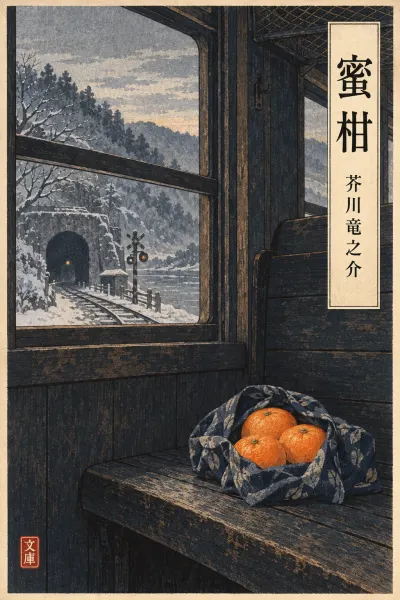
Part 2 of 2 · JLPT N1
蜜柑 Mikan, part 2: Tangerines Over the Level Crossing
In this part
The country girl moves beside the narrator and struggles to open the window just as the train enters a tunnel, filling the carriage with choking smoke and deepening his irritation. As the train emerges near a poor town's level crossing, three small boys cheer, and she throws them a handful of bright tangerines. In that moment the narrator understands she is leaving home to go into service and is thanking her brothers, and for a little while his weariness with life lifts.
AI translation · independently checked
それから幾分か過ぎた後であった。It was some while after that.
ふと何かに脅されたような心もちがして、思わずあたりを見まわすと、何時の間にか例の小娘が、向う側から席を私の隣へ移して、頻に窓を開けようとしている。Suddenly I had the feeling that something was threatening me, and when I glanced around without thinking, I found that the girl I have mentioned had at some point moved from the seat opposite to the one beside me and was persistently trying to open the window.
が、重い硝子戸は中々思うようにあがらないらしい。But the heavy glass pane would not, it seemed, go up as she wanted.
あの皸だらけの頬は愈赤くなって、時々鼻洟をすすりこむ音が、小さな息の切れる声と一しょに、せわしなく耳へはいって来る。Her chapped cheeks grew redder still, and the sound of her sniffling now and then, along with small, breathless gasps, came hurriedly to my ears.
これは勿論私にも、幾分ながら同情を惹くに足るものには相違なかった。Of course, this was undoubtedly enough to draw some small measure of sympathy, even from me.
しかし汽車が今将に隧道の口へさしかかろうとしている事は、暮色の中に枯草ばかり明い両側の山腹が、間近く窓側に迫って来たのでも、すぐに合点の行く事であった。Yet it was plain at once that the train was at that very moment about to enter the mouth of a tunnel, if only from the way the hillsides on either side, their withered grass alone still bright in the dusk, had pressed in close to the windows.
にも関らずこの小娘は、わざわざしめてある窓の戸を下そうとする、――その理由が私には呑みこめなかった。Nonetheless the girl was trying to bring down a window that had been shut on purpose, and why she should do so I could not comprehend.
いや、それが私には、単にこの小娘の気まぐれだとしか考えられなかった。No, I could think of it only as a mere whim on the girl's part.
だから私は腹の底に依然として険しい感情を蓄えながら、あの霜焼けの手が硝子戸を擡げようとして悪戦苦闘する容子を、まるでそれが永久に成功しない事でも祈るような冷酷な眼で眺めていた。And so, still nursing a harsh feeling deep inside me, I watched those chilblained hands struggling desperately to raise the glass pane, with cold eyes that seemed almost to pray it would never succeed.
すると間もなく凄じい音をはためかせて、汽車が隧道へなだれこむと同時に、小娘の開けようとした硝子戸は、とうとうばたりと下へ落ちた。Then, a moment later, as the train plunged into the tunnel with a fearful roar, the pane she had been trying to open finally dropped down with a thud.
そうしてその四角な穴の中から、煤を溶したようなどす黒い空気が、俄に息苦しい煙になって、濛々と車内へ漲り出した。And through that square opening, air as black as if soot had been dissolved in it suddenly turned into choking smoke and came billowing into the carriage.
元来咽喉を害していた私は、手巾を顔に当てる暇さえなく、この煙を満面に浴びせられたおかげで、殆息もつけない程咳きこまなければならなかった。My throat had been poor to begin with, and since the smoke struck me full in the face before I had time even to raise my handkerchief, I was forced to cough until I could scarcely breathe.
が、小娘は私に頓着する気色も見えず、窓から外へ首をのばして、闇を吹く風に銀杏返しの鬢の毛を戦がせながら、じっと汽車の進む方向を見やっている。The girl, however, showed no sign of caring about me at all; she stretched her head out of the window and, with the side locks of her ginkgo-leaf chignon stirring in the wind that blew through the darkness, gazed steadily in the direction the train was travelling.
その姿を煤煙と電燈の光との中に眺めた時、もう窓の外が見る見る明くなって、そこから土の匂や枯草の匂や水の匂が冷かに流れこんで来なかったなら、漸咳きやんだ私は、この見知らない小娘を頭ごなしに叱りつけてでも、又元の通り窓の戸をしめさせたのに相違なかったのである。As I watched her figure there amid the soot and the electric light, had the outside not been growing lighter before my eyes, and had the smells of earth and dry grass and water not come flowing coolly in, I, having at last stopped coughing, would certainly have made this girl I did not know shut the window again as before, even if it meant scolding her roundly without hearing her out.
しかし汽車はその時分には、もう安々と隧道を辷りぬけて、枯草の山と山との間に挟まれた、或貧しい町はずれの踏切りに通りかかっていた。But by then the train had already slipped easily out of the tunnel and was passing a level crossing on the outskirts of a poor town, hemmed in between hills of withered grass.
踏切りの近くには、いずれも見すぼらしい藁屋根や瓦屋根がごみごみと狭苦しく建てこんで、踏切り番が振るのであろう、唯一旒のうす白い旗が懶げに暮色を揺っていた。Near the crossing, shabby thatched roofs and tiled roofs alike stood huddled together in a cramped jumble, and a single pale white flag, waved no doubt by the crossing keeper, swayed listlessly in the dusk.
やっと隧道を出たと思う――その時その蕭索とした踏切りの柵の向うに、私は頬の赤い三人の男の子が、目白押しに並んで立っているのを見た。Just as I thought we had at last come out of the tunnel, I saw, beyond the fence of that bleak crossing, three red-cheeked boys standing in a row, pressed close together.
彼等は皆、この曇天に押しすくめられたかと思う程、揃って背が低かった。They were all equally short, as if the overcast sky had pressed them down.
そうして又この町はずれの陰惨たる風物と同じような色の着物を着ていた。And they wore clothes of the same colour as the gloomy scenery of the town's outskirts.
それが汽車の通るのを仰ぎ見ながら、一斉に手を挙げるが早いか、いたいけな喉を高く反らせて、何とも意味の分らない喊声を一生懸命に迸らせた。Looking up at the passing train, they all raised their hands at once, and the next moment, tilting back their small, tender throats, they sent up with all their might a shout whose meaning could not be made out at all.
するとその瞬間である。It was at that instant.
窓から半身を乗り出していた例の娘が、あの霜焼けの手をつとのばして、勢よく左右に振ったと思うと、忽ち心を躍らすばかり暖な日の色に染まっている蜜柑が凡そ五つ六つ、汽車を見送った子供たちの上へばらばらと空から降って来た。The girl, who had been leaning half out of the window, suddenly stretched out those chilblained hands and waved them vigorously from side to side, and at once some five or six tangerines, glowing with the warm colour of sunlight that set the heart leaping, came tumbling down from the sky onto the children who were seeing the train off.
私は思わず息を呑んだ。I caught my breath.
そうして刹那に一切を了解した。And in that instant I understood everything.
小娘は、恐らくはこれから奉公先へ赴こうとしている小娘は、その懐に蔵していた幾顆の蜜柑を窓から投げて、わざわざ踏切りまで見送りに来た弟たちの労に報いたのである。The girl, the girl who was probably now on her way to a place where she would go into service, had thrown from the window the few tangerines she had kept tucked in the front of her kimono, to reward her little brothers for taking the trouble to come all the way to the crossing to see her off.
暮色を帯びた町はずれの踏切りと、小鳥のように声を挙げた三人の子供たちと、そうしてその上に乱落する鮮な蜜柑の色と――すべては汽車の窓の外に、瞬く暇もなく通り過ぎた。The level crossing on the edge of town, tinged with dusk; the three children who had cried out like little birds; and the vivid colour of the tangerines scattering down upon them: all of it passed by outside the train window quicker than the blink of an eye.
が、私の心の上には、切ない程はっきりと、この光景が焼きつけられた。But the scene was burned into my heart with a clarity that was almost painful.
そうしてそこから、或得体の知れない朗な心もちが湧き上って来るのを意識した。And I became aware of a strange, cheerful feeling I could not account for welling up from it.
私は昂然と頭を挙げて、まるで別人を見るようにあの小娘を注視した。I raised my head high and gazed at the girl as though she were someone else entirely.
小娘は何時かもう私の前の席に返って、相不変皸だらけの頬を萌黄色の毛糸の襟巻に埋めながら、大きな風呂敷包みを抱えた手に、しっかりと三等切符を握っている。She had already returned at some point to the seat in front of me, and with her chapped cheeks buried as before in her pale-green woollen scarf, she held a third-class ticket tightly in the hand that clasped her large cloth-wrapped bundle.
……………………
私はこの時始めて、云いようのない疲労と倦怠とを、そうして又不可解な、下等な、退屈な人生を僅に忘れる事が出来たのである。Only then, for the first time, was I able to forget, if only a little, my unspeakable fatigue and weariness, and this incomprehensible, vulgar, tedious life.
Vocabulary
| Word | Meaning | JLPT |
|---|---|---|
| 小娘こむすめ | young girl, slip of a girlOften a little dismissive, which suits the narrator's early contempt for her. | — |
| 皸ひび | chaps, cracks in the skin from coldUsually written in kana today. 皸だらけ means 'covered in chaps'. | — |
| 隧道すいどう | tunnelOld-fashioned word. Modern Japanese uses トンネル. | — |
| 暮色ぼしょく | dusk, the colours of eveningLiterary. 暮 means 'evening', as in 夕暮れ. | — |
| 合点がてん | understanding, grasping合点が行く means 'to make sense, to understand'. Also read がってん. | — |
| 気まぐれきまぐれ | whim, caprice | N1 |
| 霜焼けしもやけ | chilblainsLiterally 'frost burn'. A sign of hard outdoor work in the cold. | — |
| 悪戦苦闘あくせんくとう | desperate struggleFour-character idiom: 'bad battle, bitter fight'. | — |
| 頓着とんじゃく | concern, paying attention (to)Usually in the negative, meaning 'not caring about'. Also read とんちゃく. | — |
| 銀杏返しいちょうがえし | ginkgo-leaf chignonA traditional hairstyle with the topknot looped into two parts like a ginkgo leaf. It was common among young working women of the time. | — |
| 踏切りふみきり | level crossing, railway crossingdictionary form: 踏切Today usually written 踏切. | N2 |
| 刹那せつな | instant, momentA Buddhist term for the smallest unit of time. | — |
| 奉公ほうこう | domestic service, working in another household奉公先 is the household where one goes to serve, often as a live-in maid. | — |
| 懐ふところ | the fold at the front of a kimonoUsed like a pocket. It can also mean 'bosom' or 'one's finances'. | — |
Grammar
〜に足る N1 enough to ~, worthy of ~
A dictionary-form verb plus に足る means the thing is sufficient to cause or deserve that action. Here the girl's struggle is 'enough to draw sympathy'.
同情を惹くに足るものには相違なかった
it was certainly something enough to draw sympathy
〜としか考えられない N3 can only think that ~
しか plus a negative potential verb means that no other interpretation is possible. The narrator can see her action as nothing but a whim.
単にこの小娘の気まぐれだとしか考えられなかった
I could only think it was simply this girl's whim
〜が早いか N1 no sooner ~ than, the moment ~
A dictionary-form verb plus が早いか shows that the second action follows immediately after the first. It is literary in tone.
一斉に手を挙げるが早いか、いたいけな喉を高く反らせて
no sooner had they all raised their hands than they tilted back their tender throats
〜ばかり N1 so much that ~, as if to ~
After a verb, ばかり expresses degree: the colour is warm enough almost to make the heart leap. This literary use differs from ばかり meaning 'only'.
心を躍らすばかり暖な日の色に染まっている蜜柑
tangerines tinged with the warm colour of sunlight, enough to make the heart leap