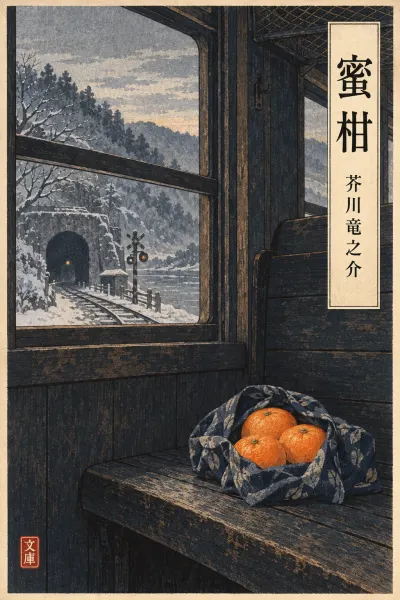
Part 1 of 2 · JLPT N1
蜜柑 Mikan, part 1: A Weary Traveller and an Unwelcome Girl
In this part
On a cloudy winter evening, the exhausted and gloomy narrator sits alone in a second-class carriage leaving Yokosuka. Just as the train departs, a shabby country girl holding a third-class ticket rushes into his compartment, and he finds her coarse and irritating. As the train enters the first tunnel, he skims the dull evening paper, sees the girl, the train and the news together as symbols of a dreary life, and drifts off to sleep.
AI translation · independently checked
或曇った冬の日暮である。It was the dusk of a cloudy winter's day.
私は横須賀発上り二等客車の隅に腰を下して、ぼんやり発車の笛を待っていた。I had settled into a corner of a second-class carriage on the up train from Yokosuka and sat there, vacantly waiting for the whistle that would send us off.
とうに電燈のついた客車の中には、珍らしく私の外に一人も乗客はいなかった。The lamps in the carriage had long since been lit, and for once there was not a single passenger inside besides me.
外を覗くと、うす暗いプラットフォオムにも、今日は珍しく見送りの人影さえ跡を絶って、唯、檻に入れられた小犬が一匹、時々悲しそうに、吠え立てていた。When I peered out, even the dim platform was, unusually for that day, empty of anyone come to see a traveller off; only a puppy shut in a cage now and then broke into mournful barking.
これらはその時の私の心もちと、不思議な位似つかわしい景色だった。It was a scene that suited my frame of mind at the time to a strange degree.
私の頭の中には云いようのない疲労と倦怠とが、まるで雪曇りの空のようなどんよりした影を落していた。Inside my head an indescribable fatigue and weariness cast a dull, heavy shadow, like a sky clouded over before snow.
私は外套のポッケットへじっと両手をつっこんだまま、そこにはいっている夕刊を出して見ようと云う元気さえ起らなかった。I sat with both hands thrust deep into the pockets of my overcoat, unable to summon even the energy to take out the evening paper that lay in one of them and look at it.
が、やがて発車の笛が鳴った。Presently, however, the whistle sounded.
私はかすかな心の寛ぎを感じながら、後の窓枠へ頭をもたせて、眼の前の停車場がずるずると後ずさりを始めるのを待つともなく待ちかまえていた。Feeling a faint easing of my spirits, I leaned my head back against the window frame and waited, without quite waiting, for the station before my eyes to begin slipping slowly backwards.
ところがそれよりも先にけたたましい日和下駄の音が、改札口の方から聞え出したと思うと、間もなく車掌の何か云い罵る声と共に、私の乗っている二等室の戸ががらりと開いて、十三四の小娘が一人、慌しく中へはいって来た、と同時に一つずしりと揺れて、徐に汽車は動き出した。But before that could happen, a shrill clatter of fair-weather clogs rang out from the direction of the ticket gate, and almost at once, amid the voice of a conductor shouting some abuse, the door of the second-class compartment I was in was flung open with a clatter, and a girl of thirteen or fourteen hurried in; at the same moment the carriage gave one heavy lurch, and the train slowly began to move.
一本ずつ眼をくぎって行くプラットフォオムの柱、置き忘れたような運水車、それから車内の誰かに祝儀の礼を云っている赤帽――そう云うすべては、窓へ吹きつける煤煙の中に、未練がましく後へ倒れて行った。The platform pillars cutting across my view one after another, a water cart that seemed to have been left behind and forgotten, a red-cap porter thanking someone in the train for a tip: all of it fell away behind us, reluctantly, into the smoke that blew against the window.
私は漸くほっとした心もちになって、巻煙草に火をつけながら、始めて懶い睚をあげて、前の席に腰を下していた小娘の顔を一瞥した。At last I felt at ease, and as I lit a cigarette I raised my heavy eyelids for the first time and glanced at the face of the girl who had sat down in the seat opposite me.
それは油気のない髪をひっつめの銀杏返しに結って、横なでの痕のある皸だらけの両頬を気持の悪い程赤く火照らせた、如何にも田舎者らしい娘だった。She was a girl who looked every inch a country bumpkin: her dry, unoiled hair was pulled tightly back into a ginkgo-leaf bun, and both her chapped cheeks, marked where they had been wiped sideways, were flushed an unpleasantly vivid red.
しかも垢じみた萌黄色の毛糸の襟巻がだらりと垂れ下った膝の上には、大きな風呂敷包みがあった。What was more, on her lap, over which a grimy yellow-green woollen scarf hung limply, lay a large bundle wrapped in cloth.
その又包みを抱いた霜焼けの手の中には、三等の赤切符が大事そうにしっかり握られていた。And in the chilblained hands that held that bundle, a red third-class ticket was gripped tightly, as though it were something precious.
私はこの小娘の下品な顔だちを好まなかった。I did not like the girl's coarse features.
それから彼女の服装が不潔なのもやはり不快だった。Then, too, I found the dirtiness of her clothes distasteful.
最後にその二等と三等との区別さえも弁えない愚鈍な心が腹立たしかった。Last of all, I was irritated by the dull mind that could not even tell second class from third.
だから巻煙草に火をつけた私は、一つにはこの小娘の存在を忘れたいと云う心もちもあって、今度はポッケットの夕刊を漫然と膝の上へひろげて見た。So, having lit my cigarette, and partly out of a wish to forget that the girl was there at all, I now spread the evening paper from my pocket listlessly across my knees.
するとその時夕刊の紙面に落ちていた外光が、突然電燈の光に変って、刷の悪い何欄かの活字が意外な位鮮に私の眼の前へ浮んで来た。Just then the daylight falling on the page suddenly changed to electric light, and the badly printed type of some column or other rose up before my eyes with surprising clarity.
云うまでもなく汽車は今、横須賀線に多い隧道の最初のそれへはいったのである。Needless to say, the train had just entered the first of the many tunnels on the Yokosuka Line.
しかしその電燈の光に照らされた夕刊の紙面を見渡しても、やはり私の憂鬱を慰むべく、世間は余りに平凡な出来事ばかりで持ち切っていた。Yet even when I looked over the lamplit pages, the world was taken up entirely with events far too commonplace to console my gloom.
講和問題、新婦新郎、涜職事件、死亡広告――私は隧道へはいった一瞬間、汽車の走っている方向が逆になったような錯覚を感じながら、それらの索漠とした記事から記事へ殆機械的に眼を通した。Peace negotiations, brides and bridegrooms, a bribery scandal, death notices: with the illusion, in the instant we entered the tunnel, that the train had reversed direction, I ran my eyes almost mechanically from one bleak article to the next.
が、その間も勿論あの小娘が、あたかも卑俗な現実を人間にしたような面持ちで、私の前に坐っている事を絶えず意識せずにはいられなかった。And all the while, of course, I could not stop being aware that the girl was sitting in front of me, wearing the look of vulgar reality itself made human.
この隧道の中の汽車と、この田舎者の小娘と、そうして又この平凡な記事に埋っている夕刊と、――これが象徴でなくて何であろう。This train in the tunnel, this country girl, and this evening paper buried in commonplace news: what could they be, if not a symbol?
不可解な、下等な、退屈な人生の象徴でなくて何であろう。What could they be, if not a symbol of an incomprehensible, base and tedious life?
私は一切がくだらなくなって、読みかけた夕刊を抛り出すと、又窓枠に頭を靠せながら、死んだように眼をつぶって、うつらうつらし始めた。Everything had become worthless to me; I tossed aside the paper I had begun to read, leaned my head against the window frame once more, closed my eyes as if I were dead, and began to doze.
Vocabulary
| Word | Meaning | JLPT |
|---|---|---|
| 日暮ひぐれ | dusk, nightfalldictionary form: 日暮れHere written without the okurigana れ, as is common in older texts. | — |
| 倦怠けんたい | weariness, ennuiA literary word for listless boredom; often paired with 疲労 (fatigue). | — |
| 外套がいとう | overcoatOld-fashioned; modern Japanese usually says コート. | — |
| 夕刊ゆうかん | evening newspaperContrasts with 朝刊 (ちょうかん, morning edition). | N2 |
| 小娘こむすめ | young girl, slip of a girlSlightly dismissive, matching the narrator's disdain. | — |
| 車掌しゃしょう | (train) conductor | N2 |
| 赤帽あかぼう | station porterLiterally 'red cap', from the red caps porters wore. | — |
| 祝儀しゅうぎ | tip, gratuityAlso means a celebration or a congratulatory gift. | — |
| 未練がましくみれんがましい | reluctantly, clinging (as if unable to let go)dictionary form: 未練がましい未練 is lingering attachment; 〜がましい means 'suggestive of'. | — |
| 一瞥いちべつ | a glanceUsed as 一瞥する, 'to glance at'. | — |
| 田舎者いなかもの | country person, rusticOften condescending, as here. | — |
| 霜焼けしもやけ | chilblainsLiterally 'frost burn'. | — |
| 愚鈍ぐどん | dull-witted, stupid | — |
| 隧道ずいどう | tunnelArchaic kanji word, often glossed トンネル; also read すいどう, as in this text. | — |
Grammar
〜ともなく N1 without really intending to ~
Placed between two forms of the same verb, it describes an action done half-consciously. The narrator is 'waiting without quite waiting' for the train to move.
眼の前の停車場がずるずると後ずさりを始めるのを待つともなく待ちかまえていた
waited, without quite waiting, for the station before my eyes to begin slipping slowly backwards
〜まま N4 while remaining in a state; as it is
After a past-tense verb, まま shows that a state continues unchanged. His hands stay thrust in his pockets the whole time.
外套のポッケットへじっと両手をつっこんだまま
with both hands thrust deep into the pockets of my overcoat
〜さえ N3 even ~
Marks an extreme case: not even something as small as this happened. He lacks even the energy to take out the paper.
夕刊を出して見ようと云う元気さえ起らなかった
could not summon even the energy to take out the evening paper and look at it
〜たと思うと N2 no sooner had ~ than
Links two events in quick succession: as soon as one thing is noticed, the next follows. The clatter of clogs is immediately followed by the door opening.
改札口の方から聞え出したと思うと、間もなく車掌の何か云い罵る声と共に
no sooner rang out from the ticket gate than, almost at once, amid a conductor's shouted abuse
〜ずにはいられない N2 cannot help doing ~
ず is a classical negative, so this literally means 'cannot remain without doing'. Here it expresses that he cannot stop being aware of the girl.
私の前に坐っている事を絶えず意識せずにはいられなかった
I could not stop being constantly aware that she was sitting in front of me
〜でなくて何であろう N1 what else could it be but ~? (it is surely ~)
A literary rhetorical question that makes a strong assertion. であろう is the formal conjectural form of だ.
これが象徴でなくて何であろう
what could they be, if not a symbol?