Part 1 of 4 · JLPT N2
桃太郎(一) Momotarō, part 1: A Giant Peach Floats Down the River
In this part
An old woman washing clothes at the river sees a huge peach floating toward her, sings to draw it close, and carries it home. When the old man returns and admires it, the peach splits open and a lively baby boy jumps out. The overjoyed couple believe the gods have sent them a child and name him Momotarō.
AI translation · independently checked
むかし、むかし、あるところに、おじいさんとおばあさんがありました。Long, long ago, in a certain place, there lived an old man and an old woman.
まいにち、おじいさんは山へしば刈りに、おばあさんは川へ洗濯に行きました。Every day the old man went to the mountain to cut firewood, and the old woman went to the river to do the washing.
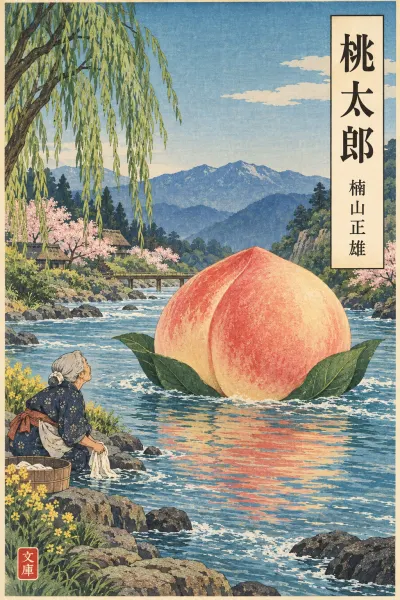
ある日、おばあさんが、川のそばで、せっせと洗濯をしていますと、川上から、大きな桃が一つ、One day, as the old woman was busily washing by the river, from upstream a single big peach,
「ドンブラコッコ、スッコッコ。"Donburakokko, sukkokko.
ドンブラコッコ、スッコッコ。」Donburakokko, sukkokko."
と流れて来ました。came bobbing along down the stream.
「おやおや、これはみごとな桃だこと。おじいさんへのおみやげに、どれどれ、うちへ持って帰りましょう。」"My, my, what a splendid peach this is! Well now, let me take it home as a present for the old man."
おばあさんは、そう言いながら、腰をかがめて桃を取ろうとしましたが、遠くって手がとどきません。Saying this, the old woman bent down and tried to take the peach, but it was too far away and her hand could not reach it.
おばあさんはそこで、So the old woman
「あっちの水は、かあらいぞ。"The water over there is sa-alty!
こっちの水は、ああまいぞ。The water over here is swe-eet!
かあらい水は、よけて来い。Keep away from the salty water,
ああまい水に、よって来い。Come along to the sweet water!"
と歌いながら、手をたたきました。sang, clapping her hands.
すると桃はまた、Then the peach once again,
「ドンブラコッコ、スッコッコ。"Donburakokko, sukkokko.
ドンブラコッコ、スッコッコ。」Donburakokko, sukkokko."
といいながら、おばあさんの前へ流れて来ました。went, as it floated down right in front of the old woman.
おばあさんはにこにこしながら、Smiling happily, the old woman
「早くおじいさんと二人で分けて食べましょう。」"Let's hurry and split it with the old man so the two of us can eat it."
と言って、桃をひろい上げて、洗濯物といっしょにたらいの中に入れて、えっちら、おっちら、かかえておうちへ帰りました。said, and she picked up the peach, put it in her washtub along with the laundry, and, puffing and panting, carried it home in her arms.
夕方になってやっと、おじいさんは山からしばを背負って帰って来ました。At last, when evening came, the old man returned from the mountain with firewood on his back.
「おばあさん、今帰ったよ。」"Old woman, I'm home."
「おや、おじいさん、おかいんなさい。待っていましたよ。さあ、早くお上がんなさい。いいものを上げますから。」"Oh, old man, welcome back. I've been waiting for you. Come, hurry on in. I have something nice to give you."
「それはありがたいな。何だね、そのいいものというのは。」"Well, that's kind of you. What is it, this nice thing?"
こういいながら、おじいさんはわらじをぬいで、上に上がりました。Saying this, the old man took off his straw sandals and stepped up into the house.
その間に、おばあさんは戸棚の中からさっきの桃を重そうにかかえて来て、Meanwhile, the old woman brought the peach from before out of the cupboard, hugging it as if it were heavy,
「ほら、ごらんなさいこの桃を。」"Here, take a look at this peach."
と言いました。she said.
「ほほう、これはこれは。どこからこんなみごとな桃を買って来た。」"Well, well, my goodness! Where did you buy such a splendid peach?"
「いいえ、買って来たのではありません。今日川で拾って来たのですよ。」"No, I didn't buy it. I picked it up in the river today."
「え、なに、川で拾って来た。それはいよいよめずらしい。」"What, you picked it up in the river? That's even more remarkable."
こうおじいさんは言いながら、桃を両手にのせて、ためつ、すがめつ、ながめていますと、だしぬけに、桃はぽんと中から二つに割れて、As the old man said this, he held the peach in both hands, turning it this way and that and gazing at it, when all of a sudden, the peach split in two from the inside with a pop,
「おぎゃあ、おぎゃあ。」"Waah, waah!"
と勇ましいうぶ声を上げながら、かわいらしい赤さんが元気よくとび出しました。and, giving a brave first cry, a lovely baby leapt out, full of life.
「おやおや、まあ。」"Oh my, oh my!"
おじいさんも、おばあさんも、びっくりして、二人いっしょに声を立てました。The old man and the old woman were both astonished and cried out together.
「まあまあ、わたしたちが、へいぜい、どうかして子供が一人ほしい、ほしいと言っていたものだから、きっと神さまがこの子をさずけて下さったにちがいない。」"Well, well! We were always saying how we wanted a child somehow, just one, how we wanted one, so the gods must surely have given us this child."
おじいさんも、おばあさんも、うれしがって、こう言いました。The old man and the old woman said this, full of joy.
そこであわてておじいさんがお湯をわかすやら、おばあさんがむつきをそろえるやら、大さわぎをして、赤さんを抱き上げて、うぶ湯をつかわせました。So, in a great bustle, the old man hurried to boil water while the old woman got the swaddling cloths ready, and they lifted the baby up and gave him his first bath.
するといきなり、Then all at once,
「うん。」"Hmph!"
と言いながら、赤さんは抱いているおばあさんの手をはねのけました。went the baby, pushing away the hands of the old woman who was holding him.
「おやおや、何という元気のいい子だろう。」"My, my, what a lively child he is!"
おじいさんとおばあさんは、こう言って顔を見合わせながら、「あッは、あッは。」とおもしろそうに笑いました。Saying this, the old man and the old woman looked at each other and laughed merrily, "Ha ha, ha ha!"
そして桃の中から生まれた子だというので、この子に桃太郎という名をつけました。And since he was a child born from inside a peach, they gave him the name Momotarō.
Vocabulary
| Word | Meaning | JLPT |
|---|---|---|
| しば刈りしばかり | gathering brushwood / firewooddictionary form: 柴刈り柴 is small brushwood used as fuel; a classic job for old men in folk tales. | — |
| せっせとせっせと | busily, diligentlyDescribes steady, hard-working effort. | N2 |
| 川上かわかみ | upstreamOpposite: 川下 (かわしも), downstream. | — |
| みごとなみごと | splendid, magnificentdictionary form: 見事な-adjective; often written 見事. | N3 |
| かがめてかがめる | to bend (the body), stoopdictionary form: かがめる腰をかがめる = to bend at the waist. | — |
| よけてよける | to avoid, keep away fromdictionary form: 避けるSame kanji as さける; よける is more physical and colloquial. | N3 |
| たらいたらい | washtubdictionary form: 盥A wide, shallow wooden tub for washing clothes. | — |
| えっちら、おっちらえっちらおっちら | (carrying) with great effort, huffing and puffingdictionary form: えっちらおっちらSound-symbolic word for slow, laborious movement. | — |
| わらじわらじ | straw sandalsdictionary form: 草鞋Traditional footwear, removed before stepping up into a house. | — |
| ためつ、すがめつためつすがめつ | examining closely from every angledictionary form: 矯めつ眇めつOld literary set phrase; つ…つ marks alternating actions. | — |
| だしぬけにだしぬけ | suddenly, without warningdictionary form: 出し抜け | — |
| うぶ声うぶごえ | a newborn's first crydictionary form: 産声うぶ湯 (うぶゆ) is a newborn's first bath. | — |
| へいぜいへいぜい | usually, alwaysdictionary form: 平生Somewhat old-fashioned; similar to ふだん. | — |
| さずけてさずける | to grant, bestow (a child, a gift)dictionary form: 授けるUsed of gods or superiors giving something. | N1 |
| むつきむつき | swaddling cloths, nappiesdictionary form: 襁褓Old word; modern Japanese uses おむつ, which comes from it. | — |
Grammar
〜に行く (purpose) N5 go (somewhere) to do …
A verb stem or an action noun plus に before 行く shows the purpose of going. Here the nouns しば刈り and 洗濯 give each person's reason for going out.
おじいさんは山へしば刈りに、おばあさんは川へ洗濯に行きました。
The old man went to the mountain to cut firewood, and the old woman went to the river to do the washing.
〜(よ)うとする N4 try to …; be about to …
The volitional form plus とする describes an attempt. Followed by が, it sets up an attempt that fails.
腰をかがめて桃を取ろうとしましたが、遠くって手がとどきません。
She bent down and tried to take the peach, but it was too far and her hand could not reach it.
〜ていますと (…when) N4 while/when …, (something happened)
Conditional と after a polite ongoing action sets the scene, and an unexpected event follows. The polite ます before と is typical of storytelling narration.
ためつ、すがめつ、ながめていますと、だしぬけに、桃はぽんと中から二つに割れて
As he was turning it this way and that and gazing at it, all of a sudden the peach split in two with a pop
〜ものだから / 〜にちがいない N2 because (explaining a reason) / must surely be
ものだから gives a reason, often as a personal explanation of circumstances. にちがいない expresses a strong conviction about the conclusion.
子供が一人ほしい、ほしいと言っていたものだから、きっと神さまがこの子をさずけて下さったにちがいない。
Because we kept saying we wanted a child, the gods must surely have given us this one.
〜やら〜やら N2 what with … and …
やら lists several actions happening at once, suggesting confusion or a busy scene. It is often followed by a word like 大さわぎ.
おじいさんがお湯をわかすやら、おばあさんがむつきをそろえるやら、大さわぎをして
In a great bustle, with the old man boiling water and the old woman getting the swaddling cloths ready
〜そうに (appearance) N4 as if …, looking …
An adjective stem plus そうに works as an adverb describing how something looks from outside. Here it shows the peach looked heavy to carry.
さっきの桃を重そうにかかえて来て
brought the peach from before, hugging it as if it were heavy