 N5 · easy
Simplified retelling · JLPT N5
桃太郎 Momotarō in easy Japanese (N5)
This is our own simplified retelling of The Boy Who Came from a Peach, written for N5 learners and checked word by word against the N5 vocabulary list. A few story words and grammar patterns go beyond N5; the notes below give each one's level. It keeps the characters, events and ending of the original. When it feels easy, move on to the N4 version or the original text.
The story in brief
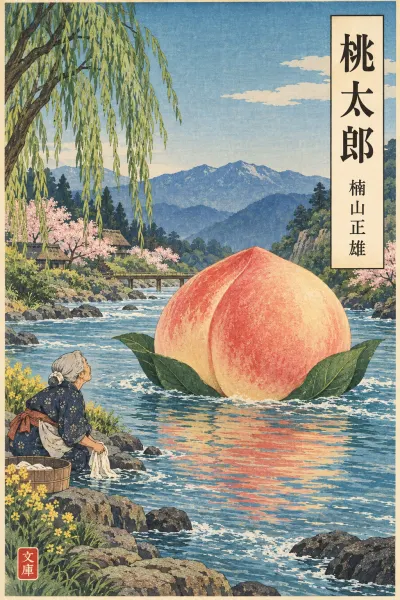
An old woman finds a big peach floating down the river, and a baby boy comes out of it. The couple name him Momotarō, and when he is fifteen he sets off with millet dumplings to fight the ogres of Onigashima, gaining a dog, a monkey and a pheasant along the way. They defeat the ogres, bring the treasure back to Japan, and the old couple, who have been waiting, welcome them.
AI translation · independently checked
むかし、ある村に、おじいさんとおばあさんがいました。Long, long ago, in a certain village, there lived an old man and an old woman.
毎日、おじいさんは山へ行きました。Every day, the old man went to the mountain.
おばあさんは川へせんたくに行きました。The old woman went to the river to do the washing.
ある日、おばあさんが川でせんたくをしていました。One day, the old woman was doing the washing at the river.
すると、川の上の方から、大きなももが一つ流れて来ました。Then, from upstream, one big peach came floating down.
「まあ、りっぱなももですね。おじいさんと食べましょう。」My, what a splendid peach! Let's eat it together with the old man.
おばあさんは、ももをとって、いえへかえりました。The old woman picked up the peach and went home.
夕方、おじいさんが山からかえりました。In the evening, the old man came home from the mountain.
おばあさんはももを見せました。The old woman showed him the peach.
二人がももを見ていると、ももが二つになりました。While the two of them were looking at the peach, it split in two.
中から、元気な男の赤ちゃんが出て来ました。Out from inside came a healthy baby boy.
「あっ!」"Oh!"
二人は大きな声を出しました。The two of them cried out loudly.
二人はずっと、こどもがほしかったのです。For a long time, the two of them had wanted a child.
「ももから生まれたから、名前はももたろうにしましょう。」"He was born from a peach, so let's call him Momotarō."
ももたろうはだんだん大きくなりました。Little by little, Momotarō grew bigger.
とてもつよい子でした。He was a very strong boy.
でも、やさしい子で、おじいさんとおばあさんを大切にしました。But he was also a kind boy, and he took good care of the old man and the old woman.
ももたろうが十五さいの時、ある人が話しました。When Momotarō was fifteen years old, a certain person told him something.
「とおいうみの向こうに、おにがしまがあります。わるいおにがすんでいます。おには人のたからものをとりました。」"Far across the sea, there is Onigashima. Wicked ogres live there. The ogres took people's treasures."
ももたろうはいいました。Momotarō said,
「わたしはおにがしまへ行って、おにとたたかいます。」"I will go to Onigashima and fight the ogres."
おばあさんはきびだんごをつくりました。The old woman made millet dumplings.
「行ってきます。」I'm off!
ももたろうは元気に出かけました。Momotarō set out in high spirits.
二人は、もんの外で、いつまでも見ていました。The two of them stood outside the gate and watched him for a long, long time.
ももたろうが山を歩いていると、いぬが来ました。As Momotarō was walking through the mountains, a dog came along.
「ももたろうさん、どこへ行きますか。」"Momotarō, sir, where are you going?"
「おにがしまへ行きます。」"I'm going to Onigashima."
「それは何ですか。」What is that?
「日本一のきびだんごです。」"The best millet dumplings in Japan."
「一つください。いっしょに行きます。」"Please give me one. I will go with you."
ももたろうは、いぬにきびだんごを一つあげました。Momotarō gave the dog one millet dumpling.
それから、木の上からさるが来ました。After that, a monkey came down from a tree.
空からきじもとんで来ました。A pheasant, too, came flying from the sky.
二人もきびだんごを一つずつもらって、いっしょに行きました。The two of them each received one millet dumpling too, and went along with him.
うみに、ふねがありました。At the sea, there was a boat.
みんなはふねにのりました。Everyone got into the boat.
ふねはとてもはやく走りました。The boat sped along very fast.
きじが空をとんで、いいました。The pheasant flew up into the sky and said,
「おにがしまが見えます!」"I can see Onigashima!"
おにがしまのもんは、しまっていました。The gate of Onigashima was shut.
さるが高い所へのぼって、中からもんをあけました。The monkey climbed up to a high place and opened the gate from the inside.
いぬも、さるも、きじも、よくたたかいました。The dog, the monkey and the pheasant all fought well.
おにたちは「いたい、いたい」となきました。The ogres cried, "Ouch, ouch!"
いちばん大きいおにも、ももたろうにまけました。Even the biggest ogre of all was beaten by Momotarō.
「ごめんなさい。もうわるいことはしません。たからものをぜんぶあげます。」"I'm sorry. We will never do bad things again. We will give you all the treasure."
ももたろうたちは、たからものを車に入れて、ふねで日本へかえりました。Momotarō and his companions put the treasure in a cart and went back to Japan by boat.
いぬとさるが車を引いて、さるが後ろからおしました。The dog and the monkey pulled the cart, and the monkey pushed from behind.
おじいさんとおばあさんは、ずっとまっていました。The old man and the old woman had been waiting all along.
「日本一だ!」"The best in Japan!"
「元気でよかったね。」"We're so glad you're safe and well."
ももたろうはいいました。Momotarō said,
「おにとのたたかいは、おもしろかったね。」"The fight with the ogres was fun, wasn't it?"
いぬはワンワン、さるはキャッキャッ、きじはケンケンと鳴きました。The dog went woof-woof, the monkey went kya-kya, and the pheasant went ken-ken.
空はあおくはれて、にわにはきれいなはながたくさんさいていました。The sky was clear and blue, and in the garden many pretty flowers were in bloom.
Vocabulary
| Word | Meaning | JLPT |
|---|---|---|
| せんたくせんたく | washing clothes, laundrydictionary form: 洗濯In old stories, washing was done by hand in the river. せんたくをする = to do the washing. | N5 |
| 流れてながれる | to flow; to float along (on water)dictionary form: 流れる流れて来る = to come floating toward the speaker. | N3 |
| りっぱりっぱ | splendid, fine, magnificentdictionary form: 立派A な-adjective: りっぱなもも. | N5 |
| 大切にしましたたいせつにする | to take good care of, to treasuredictionary form: 大切にする大切 means 'important'; 〜を大切にする means to treat someone or something with care. | — |
| おにおに | ogre, demondictionary form: 鬼A horned monster of Japanese folklore; おにがしま means 'Ogre Island'. | N3 |
| たからものたからもの | treasuredictionary form: 宝物 | — |
| たたかいますたたかう | to fightdictionary form: 戦うUsed with と: おにとたたかう = to fight (against) the ogres. | N3 |
| きびだんごきびだんご | millet dumplingdictionary form: 黍団子A small round dumpling made from millet flour, famous from this story. | — |
| 出かけましたでかける | to go out, to set outdictionary form: 出かける | N5 |
| 見えますみえる | can be seen, to be visibledictionary form: 見えるThe thing seen takes が: おにがしまが見えます. | N4 |
| まけましたまける | to lose, to be beatendictionary form: 負ける〜にまける = to lose to someone. | N4 |
| おしましたおす | to pushdictionary form: 押すThe opposite of 引く (to pull). | N5 |
| さいていましたさく | to bloom (of flowers)dictionary form: 咲くさいている = to be in bloom. | N5 |
Grammar
〜へ〜に行く N5 go (somewhere) to do something
A noun of action or a verb stem followed by に shows the purpose of going. Here せんたくに means 'to do the washing'.
おばあさんは川へせんたくに行きました。
The old woman went to the river to do the washing.
〜ていました N5 was doing (ongoing action in the past)
The て-form plus いました describes an action that was in progress at a past moment. It sets the scene before something happens.
おばあさんが川でせんたくをしていました。
The old woman was doing the washing at the river.
〜ていると N4 while (someone) was doing ~, (something happened)
Verb て-form + いると describes an ongoing action, and the next clause tells what happened unexpectedly during it.
二人がももを見ていると、ももが二つになりました。
While the two of them were looking at the peach, it split in two.
〜がほしい N5 want (something)
ほしい is an い-adjective meaning 'wanted'; the thing wanted is marked with が. The past form ほしかった shows the old couple's long-held wish.
二人はずっと、こどもがほしかったのです。
For a long time, the two of them had wanted a child.
〜にしましょう N5 let's make it ~ / let's decide on ~
Noun + にする means 'to decide on' or 'choose'. With ましょう it becomes a suggestion: 'let's call him ~'.
名前はももたろうにしましょう。
Let's call him Momotarō.
〜ずつ N4 ~ each
ずつ after a number or quantity shows that the same amount goes to each one. 一つずつ means 'one each' – here the monkey and the pheasant each receive one millet dumpling.
二人もきびだんごを一つずつもらって、いっしょに行きました。
The two of them each received one millet dumpling too, and went along with him.