 N4 · easy
Simplified retelling · JLPT N4
ねずみの嫁入り Nezumi no Yomeiri in easy Japanese (N4)
This is our own simplified retelling of The Finest Match in All the Land, written for N4 learners and checked word by word against the N4 vocabulary list. A few story words and grammar patterns go beyond N4; the notes below give each one's level. It keeps the characters, events and ending of the original. When it feels easy, move on to the original text.
The story in brief
A rich mouse couple living in a storehouse finally have a daughter, and she grows into the most beautiful mouse in the land. Her father sets out to marry her to the greatest being in the world, but the Sun, the Cloud, the Wind and a Wall each say that someone else is greater. The Wall admits that mice are stronger than it is, so the father happily marries his daughter to Chūsuke, the young mouse next door, and the family lives on in happiness.
AI translation · independently checked
むかし、ある家のくらの中に、ねずみの家族が住んでいました。Once upon a time, a family of mice lived inside the storehouse of a certain house.
くらの中には、こめなどの食べ物がたくさんありました。Inside the storehouse there was plenty to eat, such as rice.
ねずみのお父さんとお母さんは、お金持ちでした。The mouse father and mother were rich.
でも、二人には子どもがいませんでした。But the two of them had no children.
それで、かみさまにたのみました。So they prayed to the gods for one.
すると、やっと女の子が生まれました。And then, at long last, a little girl was born.
女の子はどんどん大きくなりました。The little girl grew bigger and bigger.
そして、とてもきれいなむすめになりました。And she became a very beautiful daughter.
ねずみの国で、いちばんきれいなむすめでした。She was the most beautiful daughter in all the land of mice.
お父さんとお母さんは考えました。The father and mother thought it over.
「うちのむすめは日本一のむすめだ。だから、日本一のむこをさがさなければならない。」"Our daughter is the finest daughter in Japan. So we must find the finest husband in Japan for her."
世界でいちばんえらいのはだれでしょう。Now, who is the greatest in the world?
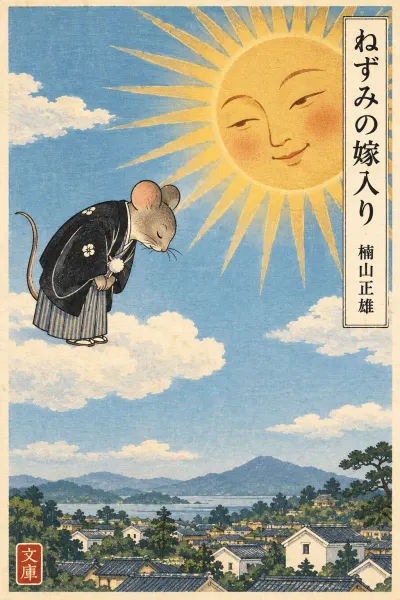
それは、高い空から世界を見ているお日さまです。Why, it is the Sun, who looks down on the world from high in the sky.
そこで、お父さんはお母さんとむすめをつれて、空へのぼっていきました。So the father took the mother and their daughter with him and climbed up to the sky.
「お日さま、お日さま、あなたは世界でいちばんえらい方です。どうぞ、わたくしのむすめをおよめさんにもらってください。」"Honourable Sun, honourable Sun, you are the greatest one in all the world. I beg you, please take my daughter as your bride."
お父さんは、ていねいにあたまを下げました。The father bowed his head politely.
お日さまはわらいながら答えました。The Sun laughed as it answered.
「それはうれしいが、わたしよりもっとえらいものがいるよ。」"That makes me very happy, but there is someone greater than me."
お父さんはびっくりしました。The father was astonished.
「あなたよりえらい方がいるのですか。それはどなたですか。」"There is someone greater than you? And who might that be?"
「それはくもだよ。くもが出ると、わたしはもう何もできないからね。」"Why, it's the Cloud. When the Cloud comes out, I can't do a thing, you see."
「なるほど。」"I see."
お父さんは、今度はくものところへ出かけました。This time, the father set off to see the Cloud.
「くもさん、くもさん、あなたは世界でいちばんえらい方です。どうぞ、わたくしのむすめをおよめさんにもらってください。」"Honourable Cloud, honourable Cloud, you are the greatest one in all the world. I beg you, please take my daughter as your bride."
「それはうれしいが、わたしよりもっとえらいものがいるよ。」"That makes me very happy, but there is someone greater than me."
お父さんはびっくりしました。The father was astonished.
「あなたよりえらい方がいるのですか。それはどなたですか。」"There is someone greater than you? And who might that be?"
「それは風だよ。風が強くふくと、わたしはとおくへ行ってしまうからね。」"Why, it's the Wind. When the Wind blows hard, I get blown far away, you see."
「なるほど。」"I see."
お父さんは、今度は風のところへ出かけました。This time, the father set off to see the Wind.
「風さん、風さん、あなたは世界でいちばんえらい方です。どうぞ、わたくしのむすめをおよめさんにもらってください。」"Honourable Wind, honourable Wind, you are the greatest one in all the world. I beg you, please take my daughter as your bride."
「それはうれしいが、わたしよりもっとえらいものがいるよ。」"That makes me very happy, but there is someone greater than me."
お父さんはびっくりしました。The father was astonished.
「あなたよりえらい方がいるのですか。それはどなたですか。」"There is someone greater than you? And who might that be?"
「それはかべだよ。わたしが強くふいても、かべはぜんぜん動かないからね。」"Why, it's the Wall. Even when I blow hard, the Wall doesn't move one bit, you see."
「なるほど。」"I see."
お父さんは、また、かべのところへ出かけました。Once again, the father set off, this time to see the Wall.
「かべさん、かべさん、あなたは世界でいちばんえらい方です。どうぞ、うちのむすめをおよめさんにもらってください。」"Honourable Wall, honourable Wall, you are the greatest one in all the world. I beg you, please take our daughter as your bride."
「それはうれしいが、わたしよりもっとえらいものがいるよ。」"That makes me very happy, but there is someone greater than me."
お父さんはびっくりしました。The father was astonished.
「あなたよりえらい方がいるのですか。それはどなたですか。」"There is someone greater than you? And who might that be?"
「それは、ねずみさんだよ。わたしはとてもかたいです。でも、ねずみさんは、わたしの体をかんで、あなをあけます。そして、そこを通っていくじゃないか。わたしは、ねずみさんにはかてないよ。」"Why, it's you mice. I am very hard. But you mice gnaw at my body and make holes in it. And then you go right on through, don't you? I just can't beat you mice."
「なるほど。」"I see."
ねずみのお父さんは、ぽんと手をうちました。The mouse father clapped his hands together with a pop.
「これは知らなかった。わたしたちが、世界でいちばんえらいのですね。」"Well, I never knew that. So it is we who are the greatest in the world!"
お父さんはわらいながら、うれしそうに家へ帰りました。Laughing, the father went home looking very pleased.
帰ると、お父さんはすぐに、となりのちゅうすけというねずみを、むすめのむこにしました。As soon as he got home, the father married his daughter to the mouse next door, who was called Chūsuke.
わかい二人は、けんかをしないで、毎日楽しくせいかつしました。The young couple never quarrelled and lived happily every day.
そして、お父さんとお母さんを大切にしました。And they took good care of the father and mother.
子どももたくさん生まれて、くらのねずみの家族は、どんどん大きくなりました。Many children were born to them too, and the mouse family in the storehouse grew bigger and bigger.
Vocabulary
| Word | Meaning | JLPT |
|---|---|---|
| くらくら | storehousedictionary form: 蔵A thick-walled building for keeping rice and valuables, the kind of place mice love. | N1 |
| お金持ちおかねもち | rich; a rich personLiterally 'money-holder' (金 money + 持つ to hold). | N4 |
| たのみましたたのむ | to ask; to beg; here, to pray fordictionary form: 頼むThe object of the request goes with に: かみさまにたのむ. | N5 |
| むすめむすめ | daughter; young womandictionary form: 娘Used for one's own daughter; お嬢さん is the polite word for someone else's. | N4 |
| むこむこ | husband for a daughter; son-in-lawdictionary form: 婿The key word of the story: the father is looking for the right むこ. | N1 |
| えらいえらい | great; important; mightydictionary form: 偉いDescribes someone of high rank or great power, not simply 'strong'. | N2 |
| のぼってのぼる | to go up; to ascenddictionary form: 登るDirection is marked with へ or に: 空へのぼる. | N5 |
| およめさんおよめさん | bride; wifedictionary form: お嫁さんよめにもらう means 'to take someone as one's bride'. | — |
| ていねいにていねい | politely; carefullydictionary form: 丁寧な-adjective; add に to use it as an adverb. | N4 |
| かべかべ | walldictionary form: 壁 | N4 |
| かんでかむ | to bite; to gnawdictionary form: 噛む | N4 |
| かてないかつ | to win; to beatdictionary form: 勝つThe person you beat takes に: ねずみさんにかてない 'can't beat the mice'. | N4 |
| 手をうちましたてをうつ | to clap one's handsdictionary form: 手を打つHere a gesture of sudden understanding, like 'Aha!'. | — |
| 大切にたいせつ | treating with care; cherishingdictionary form: 大切〜を大切にする means 'to take good care of / treasure someone'. | N5 |
Grammar
〜なければならない N4 must; have to
Attached to the ない-stem of a verb (さがさ-), it expresses obligation. The father feels he has no choice but to find the very best husband.
日本一のむこをさがさなければならない。
We must find the finest husband in Japan.
〜ながら N4 while doing ~
Verb ます-stem + ながら shows two actions done at the same time by the same person. The Sun is laughing as it answers.
お日さまはわらいながら答えました。
The Sun laughed as it answered.
AよりBのほうが / Aより〜 N5 more ~ than A
より marks the thing being compared against. わたしよりもっとえらい means 'even greater than me'; もっと strengthens the comparison.
わたしよりもっとえらいものがいるよ。
There is someone greater than me.
〜と (conditional) N4 when ~ / whenever ~
Plain form + と shows that one thing always happens as a natural result of another. The Sun and the Cloud use it to explain why someone else is greater: when the Cloud comes out or the Wind blows hard, they are powerless.
くもが出ると、わたしはもう何もできないからね。
When the Cloud comes out, I can't do a thing, you see.
〜てしまう N4 end up ~ (often unwillingly)
Verb て-form + しまう shows that something happens completely, often with a feeling that it can't be helped. The Cloud can't stop itself from being blown away.
風が強くふくと、わたしはとおくへ行ってしまうからね。
When the Wind blows hard, I get blown far away, you see.
〜そうに N4 looking ~; in a ~ way
Adjective stem + そう means 'seems ~'; with に it describes how someone does something. うれしそうに means the father looked happy as he went home.
お父さんはわらいながら、うれしそうに家へ帰りました。
Laughing, the father went home looking very pleased.