Part 2 of 2 · JLPT N3
野ばら Nobara, part 2: War, a Dream, and a Fading Rose
In this part
In spring the two countries go to war, and the young soldier refuses to kill his old friend. He leaves to fight in the north, and the old man stays alone at the border, worrying about him. A traveller says the small country lost and all its soldiers died. The old man then dreams that the young man rides past at the head of a silent column, bows, and smells the roses. Soon afterwards the roses wither, and in autumn the old man goes home to the south.
AI translation · independently checked
やがて冬が去って、また春となりました。Before long the winter passed, and spring came once again.
ちょうどそのころ、この二つの国は、なにかの利益問題から、戦争を始めました。Just around that time, the two countries went to war over some question of their interests.
そうしますと、これまで毎日、仲むつまじく、暮らしていた二人は、敵、味方の間柄になったのです。And so the two, who until then had lived every day on such friendly terms, found themselves on opposite sides, as enemies.
それがいかにも、不思議なことに思われました。That seemed a very strange thing indeed.
「さあ、おまえさんと私は今日から敵どうしになったのだ。私はこんなに老いぼれていても少佐だから、私の首を持ってゆけば、あなたは出世ができる。だから殺してください。」と、老人はいいました。"Well now, from today you and I have become enemies. Old and worn-out as I am, I'm still a major, so if you take my head back with you, you'll earn yourself a promotion. So go on, kill me," said the old man.
これを聞くと、青年は、あきれた顔をして、When he heard this, the young man looked at him in astonishment,
「なにをいわれますか。どうして私とあなたとが敵どうしでしょう。私の敵は、ほかになければなりません。戦争はずっと北の方で開かれています。私は、そこへいって戦います。」と、青年はいい残して、去ってしまいました。"What are you saying? How could you and I be enemies? My enemy must be somewhere else. The war is being fought far away to the north. I will go there and fight." With those parting words, the young man went away.
国境には、ただ一人老人だけが残されました。Only the old man was left at the border, all alone.
青年のいなくなった日から、老人は、茫然として日を送りました。From the day the young man was gone, the old man passed his days in a daze.
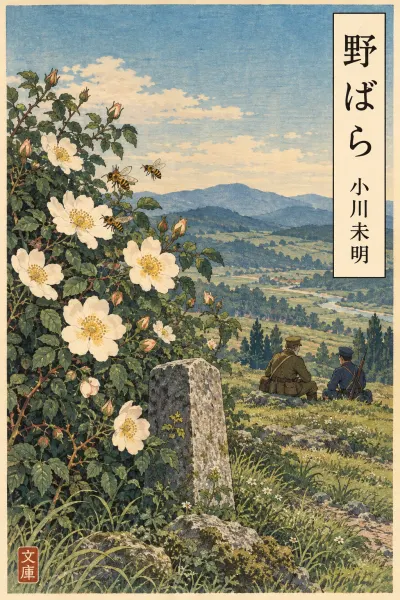
野ばらの花が咲いて、みつばちは、日が上がると、暮れるころまで群がっています。The wild roses bloomed, and the honeybees swarmed around them from the time the sun rose until it grew dark.
いま戦争は、ずっと遠くでしているので、たとえ耳を澄ましても、空をながめても、鉄砲の音も聞こえなければ、黒い煙の影すら見られなかったのであります。Now the war was being fought far, far away, so even if he strained his ears or gazed up at the sky, he could not hear the sound of guns, nor could he see so much as a trace of black smoke.
老人はその日から、青年の身の上を案じていました。From that day on, the old man worried about what had become of the young man.
日はこうしてたちました。And so the days went by.
ある日のこと、そこを旅人が通りました。One day, a traveller passed that way.
老人は戦争について、どうなったかとたずねました。The old man asked him how the war had turned out.
すると、旅人は、小さな国が負けて、その国の兵士はみなごろしになって、戦争は終わったということを告げました。The traveller told him that the small country had lost, that its soldiers had been killed to the last man, and that the war was over.
老人は、そんなら青年も死んだのではないかと思いました。The old man wondered whether, in that case, the young man had died too.
そんなことを気にかけながら石碑の礎に腰をかけて、うつむいていますと、いつか知らず、うとうとと居眠りをしました。As he sat on the base of the stone marker with his head bowed, troubled by such thoughts, he dozed off before he knew it.
かなたから、おおぜいの人のくるけはいがしました。From far away came the feeling of many people approaching.
見ると、一列の軍隊でありました。When he looked, he saw a column of soldiers.
そして馬に乗ってそれを指揮するのは、かの青年でありました。And the one riding on horseback at their head, commanding them, was that same young man.
その軍隊はきわめて静粛で声ひとつたてません。The troops were perfectly silent and did not make a single sound.
やがて老人の前を通るときに、青年は黙礼をして、ばらの花をかいだのでありました。Then, as they passed in front of the old man, the young man bowed in silence and breathed in the scent of the roses.
老人は、なにかものをいおうとすると目がさめました。Just as the old man was about to say something, he woke up.
それはまったく夢であったのです。It had been nothing but a dream.
それから一月ばかりしますと、野ばらが枯れてしまいました。About a month after that, the wild roses withered away.
その年の秋、老人は南の方へ暇をもらって帰りました。That autumn, the old man was granted leave and went home to the south.
Vocabulary
| Word | Meaning | JLPT |
|---|---|---|
| 仲むつまじくなかむつまじい | on close, affectionate terms; harmoniousdictionary form: 仲睦まじいOften used for couples or families. Here it describes the two soldiers' friendship. | — |
| 間柄あいだがら | relationship (between people)敵、味方の間柄 means a relationship of enemy and ally, so the two men are now on opposite sides. | N1 |
| 敵どうしかたきどうし | enemies of each otherdictionary form: 敵同士〜同士 means 'fellow ~' or 'mutual ~'. 敵 is read かたき here, an older and more personal word for 'foe'. | — |
| 老いぼれておいぼれる | to grow old and feeble; to be decrepitdictionary form: 老いぼれるSelf-deprecating when a speaker uses it about himself, as here. | — |
| 出世しゅっせ | promotion; rising in the world出世ができる / 出世する = to get ahead in one's career. | N1 |
| 茫然ぼうぜん | dazed; absent-minded; at a lossUsed as 茫然として or 茫然と. Also written 呆然. | N1 |
| 身の上みのうえ | one's circumstances or fate〜の身の上を案じる = to worry about how someone is faring. | — |
| 案じてあんじる | to worry about; to be anxious overdictionary form: 案じるA more literary word than 心配する. | N1 |
| みなごろしみなごろし | killing everyone; annihilationdictionary form: 皆殺し皆 (all) + 殺す (kill), with rendaku: ころし becomes ごろし. | — |
| 居眠りいねむり | dozing off (while sitting)Paired with the mimetic うとうと, which suggests drowsily nodding off. | N3 |
| けはいけはい | sign, sense or feeling (of something present)dictionary form: 気配〜のけはいがする = to sense that something is happening. | N2 |
| 静粛せいしゅく | silent; hushed and orderlyA formal word. It gives the dream soldiers a solemn, ghostly air. | — |
| 黙礼もくれい | a silent bow黙 (silent) + 礼 (bow, courtesy). | — |
| 暇ひま | leave; discharge from service暇をもらう is an older expression meaning to be given leave from one's post, not just 'free time'. | N5 |
Grammar
たとえ〜ても N3 even if ~
たとえ signals a concession, and the て-form + も completes it. Here two conditions are listed: straining his ears and gazing at the sky. Neither one helps.
たとえ耳を澄ましても、空をながめても
even if he strained his ears or gazed at the sky
〜も〜なければ、〜すら〜ない N2 neither ~ nor even ~
The ば-form of a negative verb (聞こえなければ) links two negated statements, like 'neither… nor'. すら means 'even' and stresses how little there is: not so much as a trace of smoke.
鉄砲の音も聞こえなければ、黒い煙の影すら見られなかったのであります
he could not hear the sound of guns, nor see so much as a trace of black smoke
〜なければなりません N4 must ~; has to ~
A negative condition plus 'will not do' expresses obligation or certainty. Here the young man insists that his real enemy must be somewhere else.
私の敵は、ほかになければなりません。
My enemy must be somewhere else.
〜のではないか(と思う) N3 I wonder if ~; perhaps ~
This pattern expresses a fearful or tentative guess. The old man suspects the young man is dead but cannot be sure.
そんなら青年も死んだのではないかと思いました。
He wondered whether, in that case, the young man had died too.
〜ようとすると N3 just as one tries / is about to ~
The volitional form + とする means 'try to' or 'be about to'. Adding と shows that something else happens at that moment: he wakes before he can speak.
老人は、なにかものをいおうとすると目がさめました。
Just as the old man was about to say something, he woke up.
〜と (sequence/discovery) N4 when ~; upon ~
Clause + と links an event to what follows from it. そうしますと is a polite, storytelling way of saying 'and so' or 'thereupon'.
そうしますと、これまで毎日、仲むつまじく、暮らしていた二人は、敵、味方の間柄になったのです。
And so the two men, who until then had lived together every day on friendly terms, found themselves on opposite sides.