Intermediate · JLPT N3
野ばらNobara — A Wild Rose on the Border
- JLPT N3
- 2,304 characters
- 2 parts
- about 19 minutes
- 2 easier versions
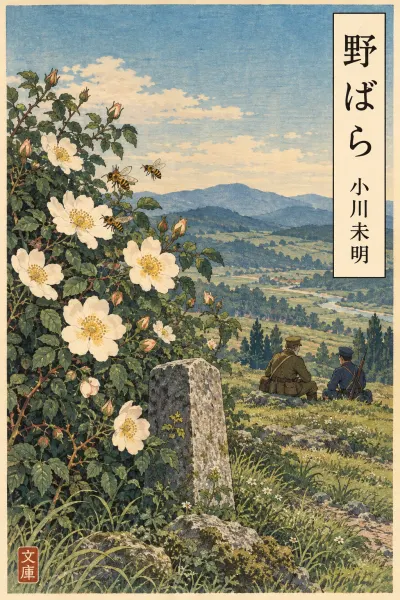
野ばら is a short fairy tale (童話) by Ogawa Mimei. On a quiet mountain border between a large country and its smaller neighbour, one soldier from each side is posted to guard the boundary stone. One is an old man and the other is young. They start as strangers with nothing to say to each other. Over the long, empty days a friendship grows between them, and a wild rose blooms on the border line itself. Then something happens far away, beyond their control, and it puts that friendship to the test. The tone is gentle and quiet, and the story says a lot about war and friendship without ever preaching. For a learner, the sentences are mostly short and the vocabulary is concrete: seasons, bees, flowers, a game board. The narration uses polite です/ます and the slightly formal であります, a clear model of classic storybook Japanese. The main challenge is the dialogue. The old soldier talks in a relaxed, old-fashioned, slightly dialectal way, and the young soldier uses careful honorific speech. The contrast is worth studying closely.
Contents
Easier versions
This story is also retold in simpler Japanese. Reading an easier version first makes the original much more approachable.
Before you read
- Learn a few key words before you start: 国境(こっきょう, border), 石碑(せきひ, stone marker), 兵隊・兵士(soldier), 将棋(しょうぎ, Japanese chess), 戦争(war), 蜂(はち, bee), and 野ばら itself. They recur throughout.
- The narrator often ends sentences with であります and でありました instead of です/でした. Read them as the same meaning in a more formal, storytelling voice.
- Compare the two voices in the dialogue. The old man uses casual, old-fashioned endings such as 〜でございますな, 〜かいな and しれん (for しれない). The young man uses respectful forms such as お帰りになれば and いわれますか. Asking why each speaks the way he does tells you a lot about their relationship.
- Track the seasons as the story moves from spring through winter to a second spring and then autumn. Time words (春, 冬, 秋, 毎日, ある日) mark each shift, and the rose changes with them.
- Much of the emotion is left unsaid, especially near the end. Read the final scenes slowly and pay attention to what the old man sees and does, not just what he says.
Words to know
The most useful words from the notes across the story.
| Word | Meaning | JLPT |
|---|---|---|
| 暇ひま | leave; discharge from service暇をもらう is an older expression meaning to be given leave from one's post, not just 'free time'. | N5 |
| 国境こっきょう | national border国 (country) + 境 (boundary); also read くにざかい in older texts. | N3 |
| 番ばん | watch, guard duty番をする = to keep watch; compare 交番 (police box). | N3 |
| 敵てき | enemyPaired with 味方 (ally) as a key theme of the story. | N3 |
| 味方みかた | ally, one's own side | N3 |
| 退屈たいくつ | bored; boredom | N3 |
| 居眠りいねむり | dozing off (while sitting)Paired with the mimetic うとうと, which suggests drowsily nodding off. | N3 |
| しげってしげる | to grow thickly, be lushdictionary form: 茂るUsually written 茂る. | N2 |
| 将棋しょうぎ | shogi, Japanese chessThe verb used for playing it is 差す (指す). | N2 |
| けはいけはい | sign, sense or feeling (of something present)dictionary form: 気配〜のけはいがする = to sense that something is happening. | N2 |
| 派遣はけん | dispatch, sending (someone) on dutyHere used in the passive: 派遣される 'to be sent'. | N1 |
| せがれせがれ | (my) sondictionary form: 倅Old-fashioned, humble way to refer to one's own son. | N1 |
| 間柄あいだがら | relationship (between people)敵、味方の間柄 means a relationship of enemy and ally, so the two men are now on opposite sides. | N1 |
| 出世しゅっせ | promotion; rising in the world出世ができる / 出世する = to get ahead in one's career. | N1 |
| 茫然ぼうぜん | dazed; absent-minded; at a lossUsed as 茫然として or 茫然と. Also written 呆然. | N1 |
Plot summary
Show the full summary (contains spoilers)
Two soldiers, an old man from a large country and a young man from a smaller one, guard a lonely border. At first they do not speak, but they soon become friends. They play shogi together every day while a wild rose blooms and bees gather around it. Then war breaks out between their countries. The old man offers the young man his own head so he can win honour, but the young man refuses and leaves for the distant front. Alone, the old man worries about his friend. A traveller tells him the small country has lost and its soldiers have been wiped out. Dozing, the old man dreams that the young man rides past at the head of a troop of cavalry, silently salutes, and vanishes. The wild rose withers, and that autumn the old man asks for leave and goes home to the south.
About the author
Ogawa Mimei was a Japanese writer from Niigata Prefecture. He is often called the father of modern Japanese children's literature, and he is sometimes described as 'the Japanese Andersen.' He studied at Tokyo Senmon Gakkō (now Waseda University), where his teacher Tsubouchi Shōyō is said to have given him the pen name Mimei. He wrote both fiction for adults and fairy tales, and he later devoted himself mainly to children's stories. His tales are known for their lyrical, often melancholy atmosphere and their concern for the weak and the lonely. Among his best-known works is 赤い蝋燭と人魚 (The Red Candles and the Mermaid).