Part 1 of 2 · JLPT N2
黄金風景 Ōgonfūkei, part 1: A Childhood Cruelty Returns
In this part
The narrator confesses that as a boy he bullied Okei, a maid in his family's house whom he took to be slow-witted, once making her cut soldiers out of a picture book all day and then kicking her in a fit of temper. Nearly twenty years later, ill and poor and renting a cheap house at Funabashi, he is recognised by a policeman checking the household register, who speaks with the accent of the narrator's home region and says he once ran a carriage business in K.
AI translation · independently checked
海の岸辺に緑なす樫の木、その樫の木に黄金の細き鎖のむすばれて ―プウシキン―By the shore of the sea stands a green oak, and to that oak a slender chain of gold is made fast. — Pushkin
私は子供のときには、余り質のいい方ではなかった。As a child, I was not of a particularly good disposition.
女中をいじめた。I tormented the maids.
私は、のろくさいことは嫌いで、それゆえ、のろくさい女中を殊にもいじめた。I could not bear slowness, and for that reason I tormented the slow maids most of all.
お慶は、のろくさい女中である。Okei was a slow maid.
林檎の皮をむかせても、むきながら何を考えているのか、二度も三度も手を休めて、おい、とその度毎にきびしく声を掛けてやらないと、片手に林檎、片手にナイフを持ったまま、いつまでも、ぼんやりしているのだ。Even when I set her to peeling an apple, she would stop twice, three times, heaven knows what she was thinking as she peeled, and unless I called out sharply, "Hey!" each time, she would stand there in a daze forever, the apple in one hand and the knife in the other.
足りないのではないか、と思われた。It seemed to me she might be simple.
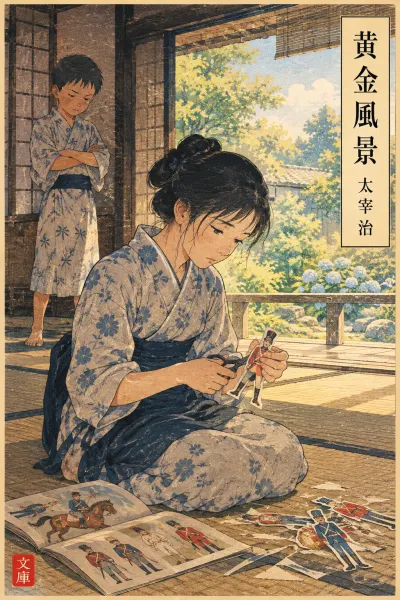
台所で、何もせずに、ただのっそりつっ立っている姿を、私はよく見かけたものであるが、子供心にも、うすみっともなく、妙に疳にさわって、おい、お慶、日は短いのだぞ、などと大人びた、いま思っても脊筋の寒くなるような非道の言葉を投げつけて、それで足りずに一度はお慶をよびつけ、私の絵本の観兵式の何百人となくうようよしている兵隊、馬に乗っている者もあり、旗持っている者もあり、銃担っている者もあり、そのひとりひとりの兵隊の形を鋏でもって切り抜かせ、不器用なお慶は、朝から昼飯も食わず日暮頃までかかって、やっと三十人くらい、それも大将の鬚を片方切り落したり、銃持つ兵隊の手を、熊の手みたいに恐ろしく大きく切り抜いたり、そうしていちいち私に怒鳴られ、夏のころであった、お慶は汗かきなので、切り抜かれた兵隊たちはみんな、お慶の手の汗で、びしょびしょ濡れて、私は遂に癇癪をおこし、お慶を蹴った。I often caught sight of her in the kitchen, doing nothing, merely standing there like a lump, and even to my child's mind the sight was faintly unsightly and grated strangely on my nerves, so that I would fling cruel words at her, grown-up words that send a chill down my spine even now, such as "Hey, Okei, the days are short, you know!" Not content with that, I once summoned her and made her cut out with scissors, one by one, the figures of the soldiers swarming by the hundreds at the military review in my picture book, some on horseback, some bearing flags, some shouldering rifles. Clumsy Okei worked from morning until nearly dusk without even eating her midday meal, and managed at last about thirty of them; even then she would snip off half of the general's moustache, or cut the hand of a soldier holding a rifle frightfully large, like a bear's paw, and each time I shouted at her. It was summertime, and Okei sweated easily, so the soldiers she had cut out were all soaked through with the sweat of her hands, and at last I lost my temper and kicked her.
たしかに肩を蹴った筈なのに、お慶は右の頬をおさえ、がばと泣き伏し、泣き泣きいった。I am quite sure I kicked her shoulder, yet Okei clutched her right cheek, flung herself down sobbing, and said through her tears:
「親にさえ顔を踏まれたことはない。一生おぼえております」うめくような口調で、とぎれ、とぎれそういったので、私は、流石にいやな気がした。"Not even my own parents ever trod on my face. I shall remember this as long as I live." She said it in a moaning voice, in broken pieces, and even I felt wretched.
そのほかにも、私はほとんどそれが天命でもあるかのように、お慶をいびった。Besides that, I persecuted Okei almost as though it were a mission Heaven had given me.
いまでも、多少はそうであるが、私には無智な魯鈍の者は、とても堪忍できぬのだ。It is still somewhat so even now: ignorant, dull-witted people are something I simply cannot abide.
一昨年、私は家を追われ、一夜のうちに窮迫し、巷をさまよい、諸所に泣きつき、その日その日のいのち繋ぎ、やや文筆でもって、自活できるあてがつきはじめたと思ったとたん、病を得た。The year before last I was driven from my home, fell into destitution overnight, wandered the streets, went pleading tearfully to one place after another, and kept myself alive from one day to the next; and just when I thought I was beginning to see some prospect of supporting myself, after a fashion, by my pen, I fell ill.
ひとびとの情で一夏、千葉県船橋町、泥の海のすぐ近くに小さい家を借り、自炊の保養をすることができ、毎夜毎夜、寝巻をしぼる程の寝汗とたたかい、それでも仕事はしなければならず、毎朝々々のつめたい一合の牛乳だけが、ただそれだけが、奇妙に生きているよろこびとして感じられ、庭の隅の夾竹桃の花が咲いたのを、めらめら火が燃えているようにしか感じられなかったほど、私の頭もほとほと痛み疲れていた。Through the kindness of others I was able, for one summer, to rent a small house close by the muddy sea at Funabashi in Chiba Prefecture and to recuperate there, cooking for myself. Night after night I fought night sweats heavy enough to wring out my nightclothes, and still I had to work; the single cold cup of milk each morning, that alone, came strangely to feel like the joy of being alive. My head was so utterly sore and weary that when the oleander in the corner of the garden came into bloom, I could see it only as fire flaring up.
そのころのこと、戸籍調べの四十に近い、痩せて小柄のお巡りが玄関で、帳簿の私の名前と、それから無精髯のばし放題の私の顔とを、つくづく見比べ、おや、あなたは……のお坊ちゃんじゃございませんか?It was around that time that a policeman checking the household registers, a thin, small man of nearly forty, stood at my entrance and looked long and hard from my name in his ledger to my face, overgrown with untended stubble. "Why, aren't you the young master of the ... family?"
そう言うお巡りのことばには、強い故郷の訛があったので、「そうです」私はふてぶてしく答えた。The policeman's speech carried a strong accent from my home region, so "I am," I answered insolently.
「あなたは?」"And you?"
お巡りは痩せた顔にくるしいばかりにいっぱいの笑をたたえて、The policeman's thin face filled with a smile so broad it seemed almost painful, and he said:
「やあ。やはりそうでしたか。お忘れかもしれないけれど、かれこれ二十年ちかくまえ、私はKで馬車やをしていました」"Well, well. So it is you after all. You may not remember me, but nearly twenty years ago now, I drove a carriage in K."
Vocabulary
| Word | Meaning | JLPT |
|---|---|---|
| 女中じょちゅう | maid, female household servantOld-fashioned word for a live-in maid. It is avoided today in favour of お手伝いさん. | — |
| のろくさいのろくさい | slow, sluggish, dawdlingColloquial and scornful. It comes from のろい (slow) plus 〜くさい, which adds a sense of distaste. | — |
| ぼんやりぼんやり | absent-mindedly, in a dazeOften used as ぼんやりする, 'to be vacant or lost in thought'. | N3 |
| 足りないたりる | (in the negative) not all there, simple-minded (lit. 'insufficient')dictionary form: 足りるLiterally 'not enough'. Used of a person, it is a blunt euphemism for low intelligence. | N4 |
| 疳にさわってかんにさわる | to get on one's nerves, to irritatedictionary form: 疳にさわるToday usually written 癇に障る. | — |
| 不器用ぶきよう | clumsy, unskilful with one's handsThe opposite of 器用 (deft). | — |
| 癇癪かんしゃく | temper, fit of anger癇癪をおこす means 'to lose one's temper, throw a tantrum'. | — |
| 流石さすが | even so, as might be expected (here: even someone like me)The kanji spelling is ateji and is usually written in kana today. | N2 |
| いびったいびる | to torment, to bully (someone weaker)dictionary form: いびるSuggests petty, persistent harassment, such as a mother-in-law picking on a bride. | — |
| 堪忍かんにんする | to put up with, to tolerate, to forgivedictionary form: 堪忍するIn Kansai speech, 堪忍して also means 'forgive me'. | — |
| 窮迫きゅうはくする | to be reduced to dire povertydictionary form: 窮迫するA formal, written word. | — |
| 寝汗ねあせ | night sweatsA classic symptom of tuberculosis in literature of this period. | — |
| 戸籍こせき | family register (official household record)戸籍調べ was a door-to-door police check of who lived in each household. | N1 |
| ふてぶてしくふてぶてしい | insolent, brazen, surlydictionary form: ふてぶてしいDescribes a defiant attitude that shows no shame. | — |
Grammar
〜させる (causative) N4 to make / have someone do
むく (peel) becomes むかせる, 'make her peel'. In the next sentences 切り抜く becomes 切り抜かせ, showing the narrator ordering Okei to do tasks. With 〜ても it means 'even when I made her peel'.
林檎の皮をむかせても
Even when I set her to peeling an apple
〜たものである N3 used to (habitual past, with nostalgia or reflection)
Past tense plus ものだ/ものである looks back on something that happened repeatedly in the past. Here it frames the narrator's memory of often seeing Okei idle in the kitchen.
台所で、何もせずに、ただのっそりつっ立っている姿を、私はよく見かけたものであるが
I often caught sight of her standing in the kitchen, doing nothing, merely standing there like a lump, but
〜はずなのに N3 even though it should have been that…
筈 (はず) expresses the speaker's firm belief, and のに adds a contrast with what actually happened. The narrator is sure he kicked her shoulder, yet she holds her cheek.
たしかに肩を蹴った筈なのに
Though I am quite sure I kicked her shoulder
〜さえ〜ない N3 not even…
さえ marks an extreme case: even the most likely people, her parents, never did this. It stresses how outrageous the narrator's act was.
親にさえ顔を踏まれたことはない
Not even my own parents ever trod on my face
〜かのように N2 as if…, as though…
It attaches to a clause to compare an action with something that is not literally true. The narrator bullied Okei as though it were his destiny.
私はほとんどそれが天命でもあるかのように、お慶をいびった
I persecuted Okei almost as though it were a mission Heaven had given me
〜たとたん N3 just as…, the moment that…
It follows the past form of a verb and shows that something happened right at the moment the first action occurred, often unexpectedly. Here, the very moment the narrator thought he could finally support himself, he fell ill.
自活できるあてがつきはじめたと思ったとたん、病を得た
Just when I thought I was beginning to see some prospect of supporting myself, I fell ill