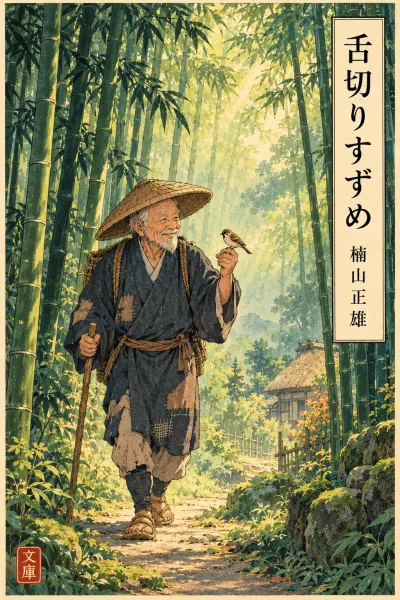
 N5 · easy
Simplified retelling · JLPT N5
舌切りすずめ Shitakirisuzume in easy Japanese (N5)
This is our own simplified retelling of The Sparrow with the Snipped Tongue, written for N5 learners and checked word by word against the N5 vocabulary list. A few story words and grammar patterns go beyond N5; the notes below give each one's level. It keeps the characters, events and ending of the original. When it feels easy, move on to the N4 version or the original text.
The story in brief
An old woman cuts the tongue of the old man's pet sparrow for eating her starch, and the sparrow flies away. The old man finds the sparrow's little house in a bamboo thicket, is treated to a feast, and takes home the light basket, which is full of treasure. The greedy old woman takes the heavy basket, but when she opens it on the road, monsters come out and call her greedy, and she runs home in fright.
AI translation · independently checked
むかし、あるところに、おじいさんとおばあさんがいました。Long, long ago, in a certain place, there lived an old man and an old woman.
二人には子どもがいませんでした。The two of them had no children.
おじいさんは小さいすずめをかごに入れて、たいせつにしていました。The old man kept a little sparrow in a cage and took great care of it.
ある あさ、おじいさんは山へ行きました。One morning, the old man went to the hills.
おばあさんは外でせんたくをしていました。The old woman was doing the washing outside.
そのあいだに、すずめはかごから出て、おばあさんののりをぜんぶ食べました。Meanwhile, the sparrow came out of its cage and ate up all of the old woman's starch.
おばあさんはとてもおこりました。The old woman was very angry.
わるいおばあさんは、はさみですずめのしたをきりました。The wicked old woman cut the sparrow's tongue with her scissors.
そして「どこかへ行って。」といいました。Then she said, "Go away!"
すずめは「いたい、いたい。」となきながら、とんで行きました。Crying, "It hurts, it hurts!", the sparrow flew away.
よる、おじいさんが山からかえりました。At night, the old man came home from the hills.
すずめはいませんでした。The sparrow was not there.
おばあさんの話を聞いて、おじいさんはとてもこまりました。When he heard what the old woman had to say, the old man was very troubled.
つぎの あさ、おじいさんは出かけました。The next morning, the old man set out.
「すずめさん、どこですか。チュウ、チュウ。」とよびながら、とおくまで歩きました。Calling, "Little sparrow, where are you? Tweet, tweet!", he walked a long, long way.
すると、大きなやぶの中から「ここですよ。チュウ、チュウ。」というこえがしました。Then, from inside a big bamboo thicket, a voice said, "Here I am! Tweet, tweet!"
やぶの中に、小さいあかいいえがありました。In the thicket there was a small red house.
すずめがもんの前でまっていました。The sparrow was waiting in front of the gate.
すずめは「のりを食べて、すみませんでした。」といいました。The sparrow said, "I am so sorry for eating your starch."
おじいさんは「また あえて、よかったです。」といいました。The old man said, "I'm so glad I could see you again."
すずめは友だちをよんで、おいしいりょうりをたくさん出しました。The sparrow called its friends and served lots of delicious food.
みんなでうたをうたって、あそびました。Everyone sang songs together and had fun.
おじいさんはとても楽しかったです。The old man had a wonderful time.
くらくなりました。It grew dark.
おじいさんは「おばあさんがまっていますから、かえります。」といいました。The old man said, "The old woman is waiting for me, so I'll go home now."
すずめは、おもいつづらと かるいつづらを出して、「おみやげです。どちらがいいですか。」とききました。The sparrow brought out a heavy wicker basket and a light wicker basket and asked, "These are gifts for you. Which one would you like?"
おじいさんは「わたしは年をとっていますから、かるいほうをください。」といいました。The old man said, "I'm getting old, so please give me the light one."
いえでつづらをあけると、中から きれいなたからものが たくさん出てきました。When he opened the basket at home, lots of beautiful treasures came out of it.
おばあさんは「どうして おもいほうを とらなかったのですか。わたしが おもいほうを とってきます。」といいました。The old woman said, "Why didn't you take the heavy one? I'll go and get the heavy one myself."
おじいさんは「行かないでください。」といいましたが、おばあさんは くらいよるのみちを 出かけました。The old man said, "Please don't go," but the old woman set off down the road in the dark night.
おばあさんも すずめのいえに つきました。The old woman, too, arrived at the sparrow's house.
「はやく おみやげを出して。」とおばあさんはいいました。"Hurry up and bring out my gift," said the old woman.
すずめは つづらを二つ出しました。The sparrow brought out two baskets.
おばあさんは おもいほうをもって、「さようなら」もいわないで、出て行きました。The old woman took the heavy one and left without even saying "Goodbye."
つづらは だんだん おもくなりました。The basket grew heavier and heavier.
おばあさんは「中に たからものが たくさんあるでしょう。」といって、みちで つづらをあけました。Saying, "There must be lots of treasure inside," the old woman opened the basket right there on the road.
すると、中から たくさんのおばけが出てきました。Then a whole crowd of monsters came out of it.
おばけは「よくばりな おばあさんだ。」と、大きなこえでいいました。The monsters said in loud voices, "What a greedy old woman!"
おばあさんは「たいへんだ。」といって、いえまで はしってかえりました。The old woman cried, "Oh, no!" and ran all the way home.
そして、おじいさんに話しました。Then she told the old man what had happened.
おじいさんは「わるいことや よくばりは よくないですよ。」といいました。The old man said, "Doing bad things and being greedy are wrong, you know."
おばあさんは「もう いやです。」といいました。The old woman said, "I've had enough of all this."
Vocabulary
| Word | Meaning | JLPT |
|---|---|---|
| かごかご | cage; basketWritten 籠 in kanji. Here it means a birdcage. | N3 |
| たいせつたいせつ | important; preciousWritten 大切. たいせつにする means "to take good care of". | N5 |
| せんたくせんたく | washing; laundryWritten 洗濯. せんたくをする means "to do the washing". | N5 |
| のりのり | starch paste (for stiffening washed clothes)Written 糊. It can also mean glue. It is not the same word as のり (seaweed). | N2 |
| したした | tongueWritten 舌. Do not confuse it with した (下, "under"). | N5 |
| こまりましたこまる | to be troubled; to not know what to dodictionary form: こまるWritten 困る. It is often used in the past tense: こまりました. | N5 |
| やぶやぶ | thicket (here, of bamboo)Written 藪. It means a place full of thick bushes or bamboo. | — |
| もんもん | gateWritten 門. | N3 |
| つづらつづら | wicker basket; woven box with a lidAn old-fashioned basket made of woven vines. It was used for carrying or storing things. | — |
| おみやげおみやげ | gift; present to take homeWritten お土産. It is a gift you bring back from a trip or a visit. | N4 |
| たからものたからもの | treasureWritten 宝物. | — |
| おばけおばけ | monster; ghostWritten お化け. It is a general word for spooky creatures. | — |
| よくばりよくばり | greedy; a greedy personWritten 欲張り. It works like a な-adjective: よくばりなおばあさん. | N2 |
| いやいや | unpleasant; (I) don't want (it)Written 嫌. もういやです means "I've had enough." | N5 |
Grammar
〜ながら N4 while doing ~
Add ながら to the verb's ます-stem (なき → なきながら) to show that two actions happen at the same time. The main action comes at the end of the sentence.
すずめは「いたい、いたい。」となきながら、とんで行きました。
Crying, "It hurts, it hurts!", the sparrow flew away.
〜から (reason) N5 because ~; so ~
から after a sentence gives the reason for what comes next. Here, the old woman is waiting, so the old man goes home.
おばあさんがまっていますから、かえります。
The old woman is waiting for me, so I'll go home now.
〜くなる N5 to become ~
To use なる with an い-adjective, change the final い to く: くらい → くらくなる ("to get dark") and おもい → おもくなる ("to get heavy").
くらくなりました。
It grew dark.
〜ないでください N5 please don't ~
Add でください to the plain negative form of a verb (行かない → 行かないでください) to politely ask someone not to do something.
おじいさんは「行かないでください。」といいましたが
The old man said, "Please don't go," but…
〜でしょう N5 probably ~; I'm sure ~
でしょう at the end of a sentence shows that the speaker thinks something is likely. Here, the old woman is sure there is treasure inside.
中に たからものが たくさんあるでしょう。
There must be lots of treasure inside.
〜ないで N4 without doing ~
The plain negative form + で means "without doing" one thing before or while doing another. The old woman leaves without saying goodbye.
「さようなら」もいわないで、出て行きました。
…left without even saying "Goodbye."