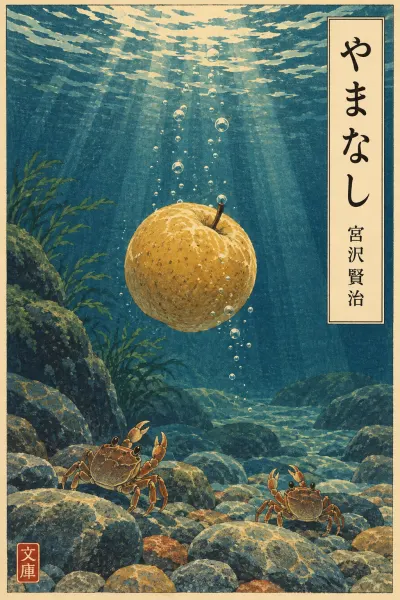
Part 1 of 2 · JLPT N3
やまなし(一、五月) Yamanashi, part 1: Kuramubon, the Fish and the Kingfisher
In this part
Two crab brothers at the bottom of a mountain stream talk about the mysterious Kuramubon while bubbles drift overhead and a fish swims back and forth. Suddenly something blue and gleaming plunges into the water and the fish vanishes, leaving the little crabs frozen with fear. Their father tells them it was a bird called a kingfisher and comforts them as white birch petals float down the stream.
AI translation · independently checked
小さな谷川の底を写した二枚の青い幻燈です。These are two blue magic-lantern slides showing the bottom of a little mountain stream.
二疋の蟹の子供らが青じろい水の底で話していました。Two crab children were talking at the bottom of the pale bluish-white water.
『クラムボンはわらったよ。』"Kuramubon laughed."
『クラムボンはかぷかぷわらったよ。』"Kuramubon laughed, kapu-kapu."
『クラムボンは跳ねてわらったよ。』"Kuramubon jumped and laughed."
『クラムボンはかぷかぷわらったよ。』"Kuramubon laughed, kapu-kapu."
上の方や横の方は、青くくらく鋼のように見えます。Above them and all around, everything looked blue and dark, like steel.
そのなめらかな天井を、つぶつぶ暗い泡が流れて行きます。Across that smooth ceiling, dark little bubbles went drifting by, tsubu-tsubu.
『クラムボンはわらっていたよ。』"Kuramubon was laughing."
『クラムボンはかぷかぷわらったよ。』"Kuramubon laughed, kapu-kapu."
『それならなぜクラムボンはわらったの。』"Then why did Kuramubon laugh?"
『知らない。』"Don't know."
つぶつぶ泡が流れて行きます。The bubbles went drifting by, tsubu-tsubu.
蟹の子供らもぽっぽっぽっとつづけて五六粒泡を吐きました。The crab children, too, blew out five or six bubbles, one after another — pop, pop, pop.
それはゆれながら水銀のように光って斜めに上の方へのぼって行きました。Wobbling as they went, the bubbles shone like quicksilver and rose slantwise toward the surface.
つうと銀のいろの腹をひるがえして、一疋の魚が頭の上を過ぎて行きました。Gliding smoothly, turning its silver belly over, a fish passed over their heads.
『クラムボンは死んだよ。』"Kuramubon died."
『クラムボンは殺されたよ。』"Kuramubon was killed."
『クラムボンは死んでしまったよ………。』"Kuramubon's gone and died..."
『殺されたよ。』"It was killed."
『それならなぜ殺された。』兄さんの蟹は、その右側の四本の脚の中の二本を、弟の平べったい頭にのせながら云いました。"Then why was it killed?" said the older crab, resting two of the four legs on his right side on his little brother's flat head.
『わからない。』"I don't know."
魚がまたツウと戻って下流のほうへ行きました。The fish glided back again and went off downstream.
『クラムボンはわらったよ。』"Kuramubon laughed."
『わらった。』"It laughed."
にわかにパッと明るくなり、日光の黄金は夢のように水の中に降って来ました。All at once everything grew bright, and the gold of the sunlight came falling into the water like a dream.
波から来る光の網が、底の白い磐の上で美しくゆらゆらのびたりちぢんだりしました。The net of light cast by the waves stretched and shrank, swaying beautifully over the white rocks on the bottom.
泡や小さなごみからはまっすぐな影の棒が、斜めに水の中に並んで立ちました。From the bubbles and the little specks of dirt, straight rods of shadow stood slanting in rows through the water.
魚がこんどはそこら中の黄金の光をまるっきりくちゃくちゃにしておまけに自分は鉄いろに変に底びかりして、又上流の方へのぼりました。This time the fish crumpled the golden light all around into a complete muddle, and on top of that gave off a strange iron-coloured gleam from below, as it swam back upstream.
『お魚はなぜああ行ったり来たりするの。』"Why does the fish keep going back and forth like that?"
弟の蟹がまぶしそうに眼を動かしながらたずねました。asked the younger crab, moving his eyes as if the light dazzled him.
『何か悪いことをしてるんだよとってるんだよ。』"It's up to something bad. It's catching things."
『とってるの。』"Catching things?"
『うん。』"Yeah."
そのお魚がまた上流から戻って来ました。The fish came back down from upstream again.
今度はゆっくり落ちついて、ひれも尾も動かさずただ水にだけ流されながらお口を環のように円くしてやって来ました。This time it came slowly and calmly, moving neither fins nor tail, just letting the water carry it along, its mouth made round like a ring.
その影は黒くしずかに底の光の網の上をすべりました。Its shadow slid dark and silent over the net of light on the bottom.
『お魚は……。』"The fish..."
その時です。It was at that very moment.
俄に天井に白い泡がたって、青びかりのまるでぎらぎらする鉄砲弾のようなものが、いきなり飛込んで来ました。Suddenly white bubbles rose on the ceiling, and something blue and gleaming, just like a glittering bullet, came plunging straight in.
兄さんの蟹ははっきりとその青いもののさきがコンパスのように黒く尖っているのも見ました。The older crab clearly saw that the tip of the blue thing was black and sharp, like the point of a pair of compasses.
と思ううちに、魚の白い腹がぎらっと光って一ぺんひるがえり、上の方へのぼったようでしたが、それっきりもう青いものも魚のかたちも見えず光の黄金の網はゆらゆらゆれ、泡はつぶつぶ流れました。The next instant, the fish's white belly flashed and flipped over once, and it seemed to go upward — but after that there was no sign of the blue thing or the fish, only the golden net of light swaying and swaying, and the bubbles drifting by, tsubu-tsubu.
二疋はまるで声も出ず居すくまってしまいました。The two crabs could not make a sound; they just crouched there, frozen stiff.
お父さんの蟹が出て来ました。The father crab came out.
『どうしたい。ぶるぶるふるえているじゃないか。』"What's the matter? You're shaking all over!"
『お父さん、いまおかしなものが来たよ。』"Dad, a weird thing came just now!"
『どんなもんだ。』"What sort of thing?"
『青くてね、光るんだよ。はじがこんなに黒く尖ってるの。それが来たらお魚が上へのぼって行ったよ。』"It was blue, see, and it shone. Its end was all black and pointy, like this. And when it came, the fish went up and away."
『そいつの眼が赤かったかい。』"Were its eyes red?"
『わからない。』"I don't know."
『ふうん。しかし、そいつは鳥だよ。かわせみと云うんだ。大丈夫だ、安心しろ。おれたちはかまわないんだから。』"Hmm. Well, that was a bird. It's called a kingfisher. It's all right, don't you worry. It leaves the likes of us alone."
『お父さん、お魚はどこへ行ったの。』"Dad, where did the fish go?"
『魚かい。魚はこわい所へ行った』"The fish? The fish went to a frightening place."
『こわいよ、お父さん。』"I'm scared, Dad."
『いいいい、大丈夫だ。心配するな。そら、樺の花が流れて来た。ごらん、きれいだろう。』"There, there, it's all right. Don't worry. Look, here come some birch blossoms floating down. See? Aren't they pretty?"
泡と一緒に、白い樺の花びらが天井をたくさんすべって来ました。Along with the bubbles, lots of white birch petals came sliding across the ceiling.
『こわいよ、お父さん。』弟の蟹も云いました。"I'm scared, Dad," said the younger crab too.
光の網はゆらゆら、のびたりちぢんだり、花びらの影はしずかに砂をすべりました。The net of light swayed, stretching and shrinking, and the shadows of the petals slid silently over the sand.
Vocabulary
| Word | Meaning | JLPT |
|---|---|---|
| 幻燈げんとう | magic lantern; a projected lantern slideOld spelling of 幻灯. An early slide projector, used here as the frame for the story. | — |
| 谷川たにがわ | mountain stream; a stream running through a valley谷 (valley) + 川 (river), with rendaku か → が. | — |
| 疋ひき | counter for small animalsOlder kanji for 匹. It changes sound: いっぴき, にひき, さんびき. | N1 |
| 鋼はがね | steelAlso read こう in compounds, e.g. 鉄鋼 (てっこう). | — |
| 泡あわ | bubble; foam | N3 |
| 吐きましたはく | to breathe out; to blow out (bubbles)dictionary form: 吐くAlso means 'to vomit' or 'to spit', depending on context. | N3 |
| 水銀すいぎん | mercury; quicksilverLiterally 'water silver'. | — |
| ひるがえしてひるがえす | to turn over; to flip (one's body) overdictionary form: 翻すUsed for a fish turning its body so the belly flashes. | — |
| にわかににわかに | suddenly; all at oncedictionary form: 俄かにLiterary word; the same word is written 俄に later on. | — |
| 上流かみ | じょうりゅうNormally read じょうりゅう. Here the author assigns it the reading かみ ('upper part of a river'). | — |
| 尖ってとがる | to be pointed; to be sharpdictionary form: 尖る | N2 |
| 居すくまっていすくまる | to crouch frozen (with fear); to be unable to movedictionary form: 居竦まるBuilt from 居る + 竦む (to cower). | — |
| かわせみかわせみ | kingfisherdictionary form: 翡翠A small blue bird that dives into water to catch fish. | — |
| 樺かば | birch (tree)Also called 白樺 (しらかば), 'white birch'. | — |
Grammar
〜たり〜たりする N4 doing things like A and B; alternating between A and B
Two verbs in the た-form plus り, followed by する, list actions or describe something that keeps switching between two states. Here the net of light repeatedly stretches and shrinks.
底の白い磐の上で美しくゆらゆらのびたりちぢんだりしました
stretched and shrank, swaying beautifully over the white rocks on the bottom
〜ながら N4 while doing ~
Attached to the verb stem, ながら shows that two actions happen at the same time by the same subject. The older brother speaks while resting his legs on his brother's head.
弟の平べったい頭にのせながら云いました
said, resting them on his little brother's flat head
〜てしまう N4 to end up doing ~; to do completely (often with regret or surprise)
The て-form + しまう stresses that something happened completely or could not be helped. Here the crabs end up frozen with fright.
二疋はまるで声も出ず居すくまってしまいました
The two crabs could not make a sound; they just crouched there, frozen stiff.
〜のように / 〜ような N4 like ~; resembling ~
Noun + のように modifies a verb or adjective, and noun + のような modifies a noun. The story uses many of these similes, such as 'like steel', 'like quicksilver' and 'like a bullet'.
上の方や横の方は、青くくらく鋼のように見えます
Above them and all around, everything looked blue and dark, like steel.
と思ううちに N2 no sooner than; in the very moment one notices
Literally 'while one is thinking', this literary expression marks something happening almost instantly after the previous event. It links what the crab has just seen to the sudden disappearance of the fish.
と思ううちに、魚の白い腹がぎらっと光って一ぺんひるがえり
The next instant, the fish's white belly flashed and flipped over once
Plain imperative 〜しろ / 〜するな N3 do ~! / don't ~!
The blunt command form (しろ) and the negative command (dictionary form + な) are typical of masculine speech. Here they sound gruff but comforting, like a father talking to his children.
大丈夫だ、安心しろ。
It's all right, don't you worry.