Intermediate · JLPT N3
やまなしYamanashi — The Wild Pear in the Stream
- JLPT N3
- 2,583 characters
- 2 parts
- about 22 minutes
- 2 easier versions
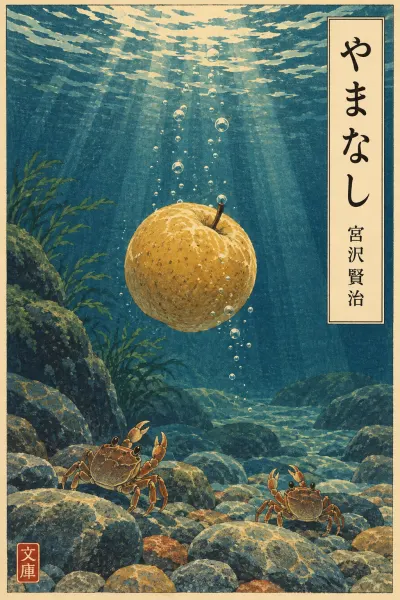
"Yamanashi" is a short prose poem told from the bottom of a mountain stream, where two young crab brothers and their father watch the world above them through the moving water. The narrator presents it as two slides in a magic-lantern show, one set on a bright day in May and one on a moonlit night in December. Very little "happens" in the usual sense. Instead the story is built from light, color, bubbles and sudden shapes crashing in from above, filtered through the crabs' limited understanding. The brothers chatter about something called Kuramubon, which laughs and then dies, and which the story never explains. The tone is dreamy and quietly unsettling, with a gentle warmth in the father's voice. For learners, the sentences are mostly short and the vocabulary is concrete (water, fish, bubbles, the moon). The real challenge is the density of onomatopoeia and mimetic words, a few older kanji spellings, and imagery that invites you to feel it rather than decode it. Rereading pays off: once the words are familiar, the sound of the text comes through clearly.
Contents
Easier versions
This story is also retold in simpler Japanese. Reading an easier version first makes the original much more approachable.
Before you read
- Don't try to translate every sound word. かぷかぷ, つぶつぶ, ゆらゆら, ぎらぎら and similar words carry the atmosphere. Learn the common ones (ゆらゆら = swaying, つぶつぶ = in little beads) and let the rest work as sound.
- Learn the core vocabulary first: 蟹 (かに), 泡 (あわ), 魚 (さかな), かわせみ (kingfisher), 天井 (the water's surface as the crabs' 'ceiling'), 樺の花 (birch blossoms), and やまなし itself. With these, most scenes become easy to follow.
- Watch for older spellings. 云う is simply 言う, and 疋 is an older form of the counter 匹 for small animals.
- Notice the two voices. The narrator's frame is polite and ends with the formal であります. The dialogue is plain speech: the brothers use childish forms like 〜だい and 〜かないや, and the father speaks gruffly with おれ, ねろ and 行かんぞ.
- Compare the two parts side by side. May and December mirror each other: something falls into the water in both, and the brothers are frightened both times. Noticing these parallels helps you guess meanings and see how the story is built.
Words to know
The most useful words from the notes across the story.
| Word | Meaning | JLPT |
|---|---|---|
| 泡あわ | bubble; foam | N3 |
| かわせみかわせみ | kingfisherdictionary form: 翡翠A small blue bird that dives into water to catch fish. | — |
| 景色けしき | scenery, viewHere it means the landscape of the stream bed as the crabs see it. | N4 |
| 吐きましたはく | to breathe out; to blow out (bubbles)dictionary form: 吐くAlso means 'to vomit' or 'to spit', depending on context. | N3 |
| わざとわざと | on purpose, deliberately | N3 |
| 尖ってとがる | to be pointed; to be sharpdictionary form: 尖る | N2 |
| 透とおりすきとおる | to be transparent; to shine clear throughdictionary form: 透きとおるThe modern spelling is 透き通る. | N2 |
| ひとりでにひとりでに | by itself, naturally, on its own | N2 |
| 疋ひき | counter for small animalsOlder kanji for 匹. It changes sound: いっぴき, にひき, さんびき. | N1 |
| 天井てんじょう | ceilingFrom the crabs' point of view, the water surface is the 'ceiling'. | N1 |
| 幻燈げんとう | magic lantern; a projected lantern slideOld spelling of 幻灯. An early slide projector, used here as the frame for the story. | — |
| 谷川たにがわ | mountain stream; a stream running through a valley谷 (valley) + 川 (river), with rendaku か → が. | — |
| 鋼はがね | steelAlso read こう in compounds, e.g. 鉄鋼 (てっこう). | — |
| 水銀すいぎん | mercury; quicksilverLiterally 'water silver'. | — |
| ひるがえしてひるがえす | to turn over; to flip (one's body) overdictionary form: 翻すUsed for a fish turning its body so the belly flashes. | — |
Plot summary
Show the full summary (contains spoilers)
In May, two crab brothers lie on the streambed talking about Kuramubon, which laughed and then was killed. A fish swims back and forth overhead. Suddenly something blue and sharp plunges into the water and the fish vanishes. The terrified brothers call their father, who explains it was a kingfisher. He tells them it won't bother crabs, and white birch petals drift down over them. In December the brothers are bigger and hold a bubble-blowing contest, each insisting his bubbles are larger. Their father tells them to go to sleep and promises to take them to Isado tomorrow. Then a dark round thing drops in with a splash. They fear another kingfisher, but it is a wild pear. They follow its sweet smell until it catches in branches. The father says that in two days it will sink and turn into fine wine. The family goes home, and the narrator ends his lantern show.
About the author
Miyazawa Kenji was a poet and writer of children's stories from Hanamaki in Iwate Prefecture. He studied agricultural science in Morioka and later taught at an agricultural school. He devoted much of his life to helping local farmers improve their methods and their cultural lives. He was a devout Buddhist, and his faith, love of nature and interest in science run through his writing. His fame came after his death, with works such as 銀河鉄道の夜, 風の又三郎 and the poem 雨ニモマケズ.