Part 2 of 2 · JLPT N3
やまなし(二、十二月) Yamanashi, part 2: Bubbles, Moonlight and a Falling Pear
In this part
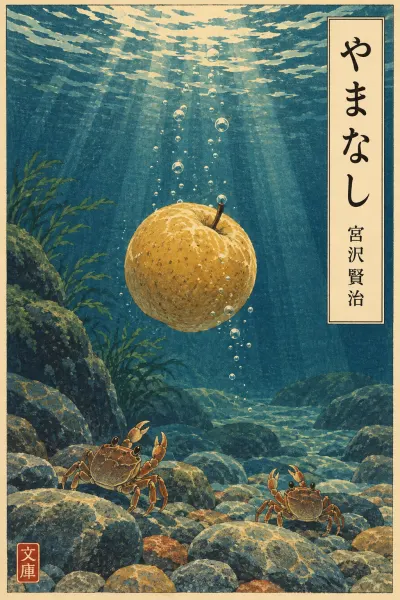
On a bright December night the crab brothers stay up and argue over whose bubbles are bigger until their father tells them to go to bed. A dark object splashes into the stream. The children fear it is a kingfisher, but it is a ripe wild pear, and the three crabs follow its lovely scent downstream. The father says that in a few days it will sink and turn into wine by itself, and the family goes home as the narrator ends the magic-lantern show.
AI translation · independently checked
蟹の子供らはもうよほど大きくなり、底の景色も夏から秋の間にすっかり変りました。The crab children had grown quite big by now, and between summer and autumn the scenery on the stream bed had changed completely.
白い柔かな円石もころがって来、小さな錐の形の水晶の粒や、金雲母のかけらもながれて来てとまりました。Soft, round white stones had come rolling in, and tiny grains of crystal shaped like gimlets and flakes of gold mica had drifted down and come to rest there.
そのつめたい水の底まで、ラムネの瓶の月光がいっぱいに透とおり天井では波が青じろい火を、燃したり消したりしているよう、あたりはしんとして、ただいかにも遠くからというように、その波の音がひびいて来るだけです。The moonlight shone clear and full all the way down to that cold bottom, like light through the glass of a soda bottle. Up on the ceiling the waves seemed to be lighting and putting out pale blue fires. All around it was hushed, and the only sound was the echo of those waves, as if it came from very far away.
蟹の子供らは、あんまり月が明るく水がきれいなので睡らないで外に出て、しばらくだまって泡をはいて天上の方を見ていました。The moon was so bright and the water so clear that the crab children did not go to sleep. They came outside instead, and for a while they blew bubbles in silence and gazed up toward the heavens.
『やっぱり僕の泡は大きいね。』"See? My bubbles really are bigger."
『兄さん、わざと大きく吐いてるんだい。僕だってわざとならもっと大きく吐けるよ。』"You're blowing them big on purpose, that's why! If I did it on purpose, I could blow even bigger ones."
『吐いてごらん。おや、たったそれきりだろう。いいかい、兄さんが吐くから見ておいで。そら、ね、大きいだろう。』"Go on, blow one, then. Huh, is that all? Okay, watch your big brother blow one. There, see? Isn't it big?"
『大きかないや、おんなじだい。』"It's not big! It's just the same!"
『近くだから自分のが大きく見えるんだよ。そんなら一緒に吐いてみよう。いいかい、そら。』"Yours only looks bigger to you because it's close. All right then, let's blow together. Ready? Go!"
『やっぱり僕の方大きいよ。』"Mine's still bigger."
『本当かい。じゃ、も一つはくよ。』"Really? Okay, I'll blow another one."
『だめだい、そんなにのびあがっては。』"No fair, stretching yourself up like that!"
またお父さんの蟹が出て来ました。Then Father Crab came out again.
『もうねろねろ。遅いぞ、あしたイサドへ連れて行かんぞ。』"Bed now, bed! It's late. Keep this up and I won't take you to Isado tomorrow."
『お父さん、僕たちの泡どっち大きいの』"Dad, whose bubbles are bigger?"
『それは兄さんの方だろう』"Your big brother's, I'd say."
『そうじゃないよ、僕の方大きいんだよ』弟の蟹は泣きそうになりました。"No they're not, mine are bigger!" The little crab was close to tears.
そのとき、トブン。Just then: ker-plunk!
黒い円い大きなものが、天井から落ちてずうっとしずんで又上へのぼって行きました。Something big, round and black dropped from the ceiling, sank all the way down, and then rose back up again.
キラキラッと黄金のぶちがひかりました。Golden spots flashed and glittered.
『かわせみだ』子供らの蟹は頸をすくめて云いました。"A kingfisher!" said the crab children, ducking their heads.
お父さんの蟹は、遠めがねのような両方の眼をあらん限り延ばして、よくよく見てから云いました。Father Crab stretched out both his telescope-like eyes as far as they would go, took a long, careful look, and said:
『そうじゃない、あれはやまなしだ、流れて行くぞ、ついて行って見よう、ああいい匂いだな』"No, it isn't. That's a wild pear. It's drifting away. Let's follow it and see. Ah, what a lovely smell!"
なるほど、そこらの月あかりの水の中は、やまなしのいい匂いでいっぱいでした。Sure enough, the moonlit water all around was full of the wild pear's lovely smell.
三疋はぼかぼか流れて行くやまなしのあとを追いました。The three of them went after the wild pear as it bobbed along downstream.
その横あるきと、底の黒い三つの影法師が、合せて六つ踊るようにして、やまなしの円い影を追いました。Their sideways scuttling bodies and their three black shadows on the bottom, six in all, chased the round shadow of the pear as if they were dancing.
間もなく水はサラサラ鳴り、天井の波はいよいよ青い焔をあげ、やまなしは横になって木の枝にひっかかってとまり、その上には月光の虹がもかもか集まりました。Soon the water began to murmur and swish, and the waves on the ceiling sent up ever brighter blue flames. The pear rolled onto its side, caught on a branch and stopped, and above it a rainbow of moonlight gathered in soft, billowing clouds.
『どうだ、やっぱりやまなしだよ、よく熟している、いい匂いだろう。』"There, what did I tell you? It's a wild pear. It's nice and ripe. Doesn't it smell good?"
『おいしそうだね、お父さん』"It looks delicious, Dad."
『待て待て、もう二日ばかり待つとね、こいつは下へ沈んで来る、それからひとりでにおいしいお酒ができるから、さあ、もう帰って寝よう、おいで』"Wait, wait. In two more days or so it'll sink down here, and then it'll turn into lovely wine all by itself. Come on now, let's go home to bed. Come along."
親子の蟹は三疋自分等の穴に帰って行きます。Father and sons, all three crabs, go back to their own hole.
波はいよいよ青じろい焔をゆらゆらとあげました、それは又金剛石の粉をはいているようでした。The waves sent up their pale blue flames, swaying higher and higher. It also looked as though they were breathing out diamond dust.
**
私の幻燈はこれでおしまいであります。And that is the end of my magic-lantern show.
Vocabulary
| Word | Meaning | JLPT |
|---|---|---|
| 景色けしき | scenery, viewHere it means the landscape of the stream bed as the crabs see it. | N4 |
| 水晶すいしょう | rock crystal, quartz | — |
| 透とおりすきとおる | to be transparent; to shine clear throughdictionary form: 透きとおるThe modern spelling is 透き通る. | N2 |
| 天井てんじょう | ceilingFrom the crabs' point of view, the water surface is the 'ceiling'. | N1 |
| 泡あわ | bubble, foam | N3 |
| わざとわざと | on purpose, deliberately | N3 |
| のびあがってのびあがる | to stretch oneself up, stand on tiptoedictionary form: 伸び上がる | — |
| かわせみかわせみ | kingfisherdictionary form: 翡翠In the May scene a kingfisher dives in and snatches a fish, which is why the children are afraid. | — |
| すくめてすくめる | to duck, draw in (the neck or shoulders)dictionary form: 竦めるThe set phrase 首をすくめる means to duck one's head in fear. 頸 is an older kanji for 首. | — |
| あらん限りあらんかぎり | as far as possible, with all one's mightThis is a literary phrase meaning 'to whatever extent there is'. | — |
| 熟してじゅくす | to ripendictionary form: 熟す | — |
| ひとりでにひとりでに | by itself, naturally, on its own | N2 |
| 影法師かげぼうし | shadow (of a person or figure)This is a slightly old-fashioned, poetic word for a shadow shape. | — |
| 金剛石こんごうせき | diamondThis is an old word; modern Japanese says ダイヤモンド. | — |
Grammar
〜てごらん / 〜ておいで N4 go ahead and try ~ / go and ~
〜てごらん is a gentle command meaning 'try doing ~', used by adults or older siblings to children. 〜ておいで (from おいでなさい) softly tells someone to do something, here 'watch'.
吐いてごらん。
Go on, blow one.
〜かない (〜くはない) N2 isn't ~ (colloquial)
大きかない is a casual, childish contraction of 大きくはない. The final や and だい add a pouting, emphatic tone.
大きかないや、おんなじだい。
It's not big! It's just the same!
〜ん (negative) + ぞ N3 won't ~ (gruff masculine speech)
ん replaces ない in older or rough speech, so 行かん = 行かない. The particle ぞ adds a firm, warning tone typical of a stern father.
あしたイサドへ連れて行かんぞ。
I won't take you to Isado tomorrow.
〜そうになる N3 to be about to ~, come close to ~
The verb stem plus そうになる describes something that almost happens. Here the younger crab nearly bursts into tears.
弟の蟹は泣きそうになりました。
The little crab was close to tears.
〜たり〜たりする N5 doing ~ and ~ (alternately)
Two contrasting actions are paired to show them repeating back and forth. Here the waves seem to light fires and put them out, over and over.
波が青じろい火を、燃したり消したりしているよう
the waves seemed to be lighting and putting out pale blue fires
〜であります N1 is (formal, oratorical)
であります is a very formal, speech-like copula, like a presenter addressing an audience. It frames the whole story as a lantern-slide performance.
私の幻燈はこれでおしまいであります。
And that is the end of my magic-lantern show.