 N4 · easy
Simplified retelling · JLPT N4
飴だま Amedama in easy Japanese (N4)
This is our own simplified retelling of The Samurai and the Last Sweet, written for N4 learners and checked word by word against the N4 vocabulary list. A few story words and grammar patterns go beyond N4; the notes below give each one's level. It keeps the characters, events and ending of the original. When it feels easy, move on to the original text.
The story in brief
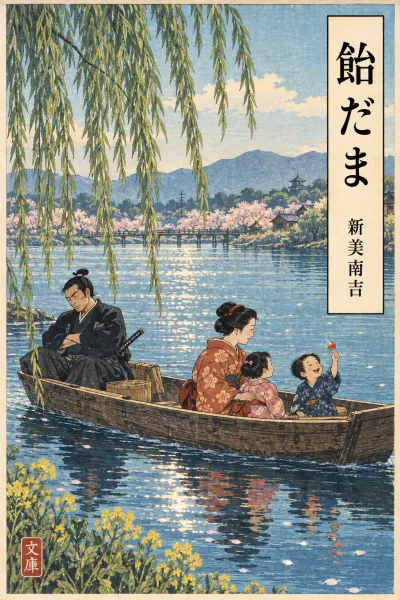
On a warm spring day, a mother and her two small children ride a river ferry with a fierce-looking samurai, who soon dozes off. The children both want the last candy drop and start crying, and the samurai wakes and draws his sword, frightening the mother. Instead of harming anyone, he cuts the candy in half, gives each child a piece, and goes back to sleep.
AI translation · independently checked
春の、あたたかい日のことです。It happened on a warm day in spring.
川をわたる小さなふねに、女の人がのりました。A woman got onto a small boat that crossed the river.
女の人は、二人の小さい子どもといっしょに旅行していました。The woman was travelling with her two small children.
ふねが出る前に、「ちょっと待ってくれ。」という大きなこえが聞こえました。Just before the boat left, a loud voice called out, "Wait a moment!"
一人のさむらいが、手をふりながら走って来ました。A samurai came running, waving his hand.
そして、ふねにとびのりました。Then he jumped onto the boat.
ふねは出ました。The boat set off.
さむらいは、ふねのまん中にすわりました。The samurai sat down in the middle of the boat.
日がとてもあたたかいので、さむらいはいねむりを始めました。Because the sun was so warm, the samurai began to doze.
さむらいは黒いひげがあって、強そうな人でした。The samurai had a black beard and looked strong.
でも、ねむりながら、あたまが前や後ろにゆれていました。But as he slept, his head kept nodding forward and back.
子どもたちはそれを見て、おかしくてわらいました。The children saw this, and it was so funny that they laughed.
お母さんは口の前にゆびを立てて、「しずかにしていなさい。」といいました。Their mother put a finger to her lips and said, "Be quiet now."
さむらいがおこったら、たいへんだからです。If the samurai got angry, there would be terrible trouble.
子どもたちはしずかになりました。The children became quiet.
しばらくして、一人の子どもが手を出しました。After a while, one of the children held out a hand.
「お母さん、あめだまをください。」"Mama, give me a candy drop!"
すると、もう一人の子どもも、「お母さん、わたしにも。」といいました。Then the other child said, "Mama, me too!"
お母さんは、着物の中から紙のふくろを出しました。Their mother took a paper bag out from inside her kimono.
でも、あめだまはもう一つしかありませんでした。But there was only one candy drop left.
「わたしにください。」"Give it to me!"
「わたしにください。」"No, give it to me!"
二人の子どもは、りょうほうから手を出しました。The two children held out their hands from both sides.
あめだまは一つだけです。There was only one candy drop.
お母さんはこまってしまいました。Their mother did not know what to do.
「いい子だから、待っていてね。向こうに着いたら、買ってあげるからね。」"Be good and wait, all right? When we get to the other side, I'll buy you some."
お母さんはこういいました。That is what their mother said.
でも、子どもたちは「ほしいよ、ほしいよ。」となきつづけました。But the children kept crying, "I want it! I want it!"
ねむっていたはずのさむらいは、目を大きく開けていました。The samurai, who should have been asleep, had his eyes wide open.
そして、子どもたちを見ていました。And he was looking at the children.
お母さんはびっくりしました。The mother was startled.
「子どもたちがうるさくて、おさむらいさんは起きてしまった。きっとおこっている。」と思いました。"The children were so noisy that they woke the samurai. He must be angry," she thought.
「しずかにしなさい。」と、お母さんは子どもたちにやさしくいいました。"Please be quiet," the mother told the children gently.
でも、子どもたちはしずかになりませんでした。But the children would not be quiet.
すると、さむらいはかたなをぬきました。Then the samurai drew his sword.
そして、お母さんと子どもたちの前に来ました。And he came and stood in front of the mother and her children.
お母さんのかおは、白くなりました。The mother's face went white.
お母さんは子どもたちの前に出ました。She stepped out in front of her children.
さむらいが子どもたちを切ると思ったのです。She thought the samurai was going to cut them down.
「あめだまを出せ。」と、さむらいはいいました。"Hand over that candy," said the samurai.
お母さんは、こわいと思いながら、あめだまをさむらいにわたしました。Feeling afraid, the mother handed the candy drop to the samurai.
さむらいは、あめだまをふねの上におきました。The samurai put the candy drop down on the boat.
そして、かたなであめだまを二つに切りました。Then he cut it in two with his sword.
それから、「さあ。」といって、二人の子どもにはんぶんずつあげました。After that, he said, "Here," and gave each of the two children half.
さむらいは、前にすわっていたところにもどりました。The samurai went back to the place where he had been sitting before.
そして、またいねむりを始めました。And he began to doze again.
Vocabulary
| Word | Meaning | JLPT |
|---|---|---|
| わたるわたる | to cross (a river, road, bridge)dictionary form: 渡るTakes を for the place crossed: 川をわたる. Compare わたす "to hand over" in the same story. | N5 |
| いねむりいねむり | dozing off, nodding off (while sitting)dictionary form: 居眠りSleeping without meaning to, e.g. on a train or in class. いねむりをする / いねむりを始める. | N3 |
| ひげひげ | beard, moustachedictionary form: 髭ひげがある = to have a beard. | N4 |
| ゆれてゆれる | to sway, to rock, to shakedictionary form: 揺れるIntransitive: the thing itself moves. Used for boats, earthquakes, and here a nodding head. | N4 |
| おかしくておかしい | funny, comicaldictionary form: おかしいCan also mean "strange"; here it means funny, since the children laugh. | N4 |
| ふくろふくろ | bag, sackdictionary form: 袋紙のふくろ = paper bag. | N3 |
| こまってこまる | to be at a loss, not know what to dodictionary form: 困るVery common for being troubled or stuck with a problem. | N5 |
| なきつづけましたなきつづける | to keep cryingdictionary form: 泣き続けるVerb stem + つづける = to keep doing something. | — |
| びっくりびっくり | surprised, startledUsed with する: びっくりしました. | N4 |
| うるさくてうるさい | noisy, louddictionary form: うるさいAlso used to complain: うるさい! = "Be quiet!" | N5 |
| かたなかたな | sword (a samurai's sword)dictionary form: 刀Key story word; the kanji 刀 is also inside 切る. | N3 |
| ぬきましたぬく | to draw (a sword), to pull outdictionary form: 抜くかたなをぬく = to draw a sword. | N3 |
| はんぶんはんぶん | halfdictionary form: 半分はんぶんずつ = half each. | N5 |
| もどりましたもどる | to go back, to return (to a place)dictionary form: 戻るPlace + に + もどる. | N4 |
Grammar
〜ながら N4 while doing ~
Verb stem + ながら joins two actions done at the same time by the same person. The main action comes last: here he runs, and waves while running.
一人のさむらいが、手をふりながら走って来ました。
A samurai came running, waving his hand.
〜たら N4 if / when ~
The plain past form + ら makes a condition: "if the samurai got angry". Here the sentence ends with からです, giving the reason for the mother's warning.
さむらいがおこったら、たいへんだからです。
If the samurai got angry, there would be terrible trouble.
〜しか〜ない N4 only ~ (and nothing more)
しか is always used with a negative verb. It stresses that the amount is small or not enough: only one candy for two children.
でも、あめだまはもう一つしかありませんでした。
But there was only one candy drop left.
〜てしまう N4 to end up ~ (often with regret)
Te-form + しまう shows that something happened completely, often something unwanted. こまってしまいました means the mother was left really stuck.
お母さんはこまってしまいました。
Their mother did not know what to do.
〜はず N4 should be ~, is supposed to be ~
はず shows what the speaker expects to be true. ねむっていたはずの describes the samurai as someone who was supposed to be asleep, but in fact was awake.
ねむっていたはずのさむらいは、目を大きく開けていました。
The samurai, who should have been asleep, had his eyes wide open.
〜ずつ N4 ~ each
ずつ after an amount means that each person gets the same amount. はんぶんずつ = half each.
二人の子どもにはんぶんずつあげました。
He gave each of the two children half.