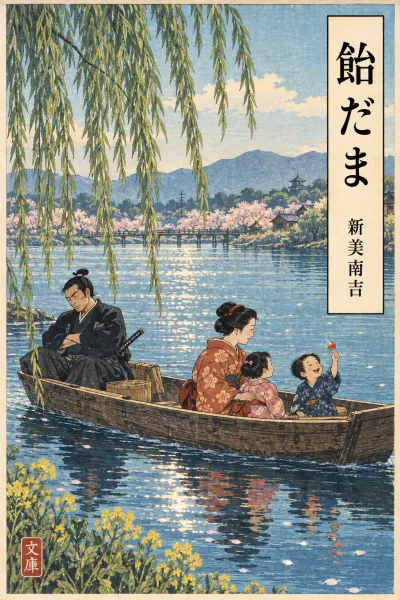
 N5 · easy
Simplified retelling · JLPT N5
飴だま Amedama in easy Japanese (N5)
This is our own simplified retelling of The Samurai and the Last Sweet, written for N5 learners and checked word by word against the N5 vocabulary list. A few story words and grammar patterns go beyond N5; the notes below give each one's level. It keeps the characters, events and ending of the original. When it feels easy, move on to the N4 version or the original text.
The story in brief
On a warm spring day, a woman and her two small children ride a boat across a river, and a samurai boards at the last moment and dozes off. When the children noisily keep asking for the last sweet, the samurai wakes and draws his sword, frightening the mother. He cuts the sweet in two, gives each child half, and goes back to sleep.
AI translation · independently checked
春です。It is spring.
とても あたたかいです。It is very warm.
川の ふねに、女の 人が のりました。A woman got on a boat on the river.
小さい 子どもが 二人 いっしょです。Two small children are with her.
ふねが 出る 前に、男の 人が 一人 はしって 来ました。Before the boat set off, a man came running.
「ちょっと まって ください。」と いいました。"Wait a moment, please," he said.
その 人は さむらいでした。The man was a samurai.
さむらいも ふねに のりました。The samurai got on the boat too.
ふねが 出ました。The boat set off.
さむらいは ふねの 中に すわりました。The samurai sat down in the boat.
とても あたたかいので、さむらいは いねむりを しました。Because it was so warm, the samurai dozed off.
さむらいは くろい ひげが あります。The samurai has a black beard.
つよい 人です。He is a strong man.
でも、いねむりを して いる さむらいは、ちょっと おもしろいです。But a samurai nodding off to sleep is a little funny.
子どもたちは わらいました。The children laughed.
お母さんは 「しずかに して ください。」と いいました。Their mother said, "Please be quiet."
さむらいが おこったら、たいへんです。If the samurai got angry, it would be terrible.
子どもたちは しずかに なりました。The children became quiet.
少し あとで、一人の 子どもが てを 出しました。A little later, one of the children held out a hand.
「お母さん、あめを ください。」と いいました。"Mummy, give me a sweet," the child said.
もう 一人の 子どもも 「わたしにも ください。」と いいました。The other child also said, "Give me one too."
お母さんは 紙の ふくろを 出しました。Their mother took out a paper bag.
でも、あめは もう 一つしか ありませんでした。But there was only one sweet left.
「わたしに ください。」"Give it to me!"
「わたしに ください。」"Give it to me!"
二人は いいました。The two of them said so.
あめは 一つだけです。There is only one sweet.
お母さんは こまりました。Their mother did not know what to do.
「むこうに ついたら、あめを かいますよ。だから、まって ください。」"When we get to the other side, I'll buy you sweets. So please wait."
でも、子どもたちは 「ください、ください。」と いいました。But the children kept saying, "Give it to me, give it to me!"
いねむりを して いた さむらいが、めを あけました。The samurai who had been dozing opened his eyes.
そして、子どもたちを 見て いました。And he was looking at the children.
お母さんは 小さい こえで いいました。Their mother spoke in a small voice.
「さむらいが おこって いますよ。しずかに して ください。」でも、子どもたちは しずかに なりませんでした。"The samurai is angry, you know. Please be quiet." But the children did not become quiet.
その とき、さむらいが かたなを 出しました。At that moment, the samurai drew his sword.
そして、お母さんと 子どもたちの 前に 来ました。Then he came up in front of the mother and her children.
お母さんは とても こわく なりました。The mother became very frightened.
お母さんは 子どもたちの 前に たちました。She stood in front of her children.
「あめを 出して ください。」と さむらいは いいました。"Hand me the sweet," said the samurai.
お母さんは あめを さむらいに わたしました。The mother handed the sweet to the samurai.
さむらいは あめを ふねの 上に おきました。The samurai put the sweet down on the boat.
そして、かたなで あめを 二つに きりました。Then, with his sword, he cut the sweet in two.
「さあ、どうぞ。」"There. Here you are."
さむらいは 一人の 子どもに 半分、もう 一人の 子どもにも 半分 あげました。The samurai gave half to one child, and half to the other child too.
それから、さむらいは 前の ところに かえりました。After that, the samurai went back to where he had been.
そして、また いねむりを しました。And he dozed off again.
Vocabulary
| Word | Meaning | JLPT |
|---|---|---|
| あたたかいあたたかい | warm (weather)Written 暖かい for weather; a pleasant, mild warmth, not 'hot'. | N5 |
| のりましたのる | to get on, to board (a boat)dictionary form: 乗るUses the particle に: ふねに のる 'get on a boat'. | N5 |
| いっしょいっしょ | together, with (someone)dictionary form: 一緒Often seen as いっしょに 'together'. | N5 |
| さむらいさむらい | samurai (a sword-carrying warrior)dictionary form: 侍 | N1 |
| いねむりいねむり | dozing off, nodding off while sittingdictionary form: 居眠りUsed with する: いねむりを する. Not proper sleep in bed. | N3 |
| ひげひげ | beard, moustachedictionary form: 髭 | N4 |
| おこったらおこる | to get angrydictionary form: 怒る | N4 |
| たいへんたいへん | terrible, serious troubledictionary form: 大変Also means 'very' or 'hard work' in other contexts. | N5 |
| ふくろふくろ | bagdictionary form: 袋 | N3 |
| こまりましたこまる | to be troubled, not know what to dodictionary form: 困る | N5 |
| かたなかたな | sword (a samurai's sword)dictionary form: 刀 | N3 |
| わたしましたわたす | to hand over, to pass (to someone)dictionary form: 渡す | N5 |
| きりましたきる | to cutdictionary form: 切るDifferent verb from 着る 'to wear', which is also read きる. | N5 |
| 半分はんぶん | half | N5 |
Grammar
〜る 前に N5 before doing ~
Put a verb in dictionary form before 前に to say something happens before that action. The verb stays in dictionary form even when the story is in the past.
ふねが 出る 前に、男の 人が 一人 はしって 来ました。
Before the boat set off, a man came running.
〜ので N4 because, so
ので gives a reason in a soft, natural way. After an い-adjective it attaches directly: あたたかいので.
とても あたたかいので、さむらいは いねむりを しました。
Because it was so warm, the samurai dozed off.
〜たら N4 if / when ~
Add ら to the た-form of a verb. It means 'if' or 'when' something happens, and the た here does not make it past tense: さむらいが おこったら means 'if the samurai gets angry', and むこうに ついたら means 'when we get to the other side'.
さむらいが おこったら、たいへんです。
If the samurai got angry, it would be terrible.
〜しか 〜ない N4 only ~ (nothing more)
しか is always used with a negative verb. 一つしか ありませんでした literally means 'there was not except one', so it stresses that one is too few.
あめは もう 一つしか ありませんでした。
There was only one sweet left.
〜に なる / 〜く なる N5 to become ~
With な-adjectives use に なる (しずか → しずかに なる); with い-adjectives change い to く (こわい → こわく なる).
お母さんは とても こわく なりました。
The mother became very frightened.
〜て いる N5 is ~ing (ongoing action)
The て-form plus いる shows an action in progress. Here いねむりを して いる describes the samurai, like an adjective: 'the dozing samurai'.
いねむりを して いる さむらいは、ちょっと おもしろいです。
A samurai nodding off to sleep is a little funny.