Part 2 of 4 · JLPT N3
僕の帽子のお話 Boku no Bōshi no Ohanashi, part 2: Chasing the Runaway Cap Through the Night
In this part
The boy spots his missing cap caught in the lattice door. When he goes to pick it up, it rolls away down the dark street and keeps escaping him all the way to school. At the main gate the cap turns and dares him to catch it, and as he leaps at it they both pass through the iron gate and he suddenly finds himself in the Plum class, where Mr Iimoto is holding up a one-sen coin.
AI translation · independently checked
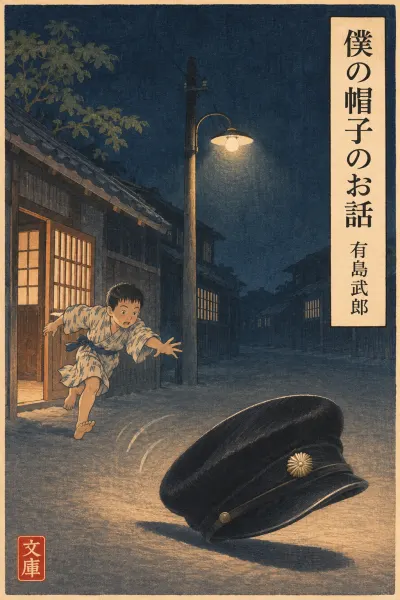
そうしたら中の口の格子戸に黒いものが挟まっているのを見つけ出しました。Just then I noticed something black caught in the lattice door of the side entrance.
電燈の光でよく見ると、驚いたことにはそれが僕の帽子らしいのです。When I looked closely by the electric light, to my great surprise it seemed to be my cap.
僕は夢中になって、そこにあった草履をひっかけて飛び出しました。Hardly knowing what I was doing, I slipped my feet into the straw sandals lying there and dashed out.
そして格子戸を開けて、ひしゃげた帽子を拾おうとしたら、不思議にも格子戸がひとりでに音もなく開いて、帽子がひょいと往来の方へ転がり出ました。Then I opened the lattice door and went to pick up the squashed cap, and, strange to say, the door slid open all by itself without a sound, and the cap went tumbling out, hop, toward the street.
格子戸のむこうには雨戸が締まっているはずなのに、今夜に限ってそれも開いていました。The storm shutters on the other side of the lattice door ought to have been closed, but tonight of all nights they were open too.
けれども僕はそんなことを考えてはいられませんでした。But I could not stop to think about such things.
帽子がどこかに見えなくならない中にと思って、慌てて僕も格子戸のあきまから駈け出しました。Thinking I must catch it before it vanished somewhere, I hurried out through the gap in the lattice door after it.
見ると帽子は投げられた円盤のように二、三間先きをくるくるとまわって行きます。When I looked, the cap was spinning round and round a few yards ahead of me, like a thrown discus.
風も吹いていないのに不思議なことでした。It was very strange, for there was no wind blowing at all.
僕は何しろ一生懸命に駈け出して帽子に追いつきました。Anyway, I ran as hard as I could and caught up with the cap.
まあよかったと安心しながら、それを拾おうとすると、帽子は上手に僕の手からぬけ出して、ころころと二、三間先に転がって行くではありませんか。"Oh, good," I thought with relief, and I reached down to pick it up, but the cap slipped neatly out of my hands and went rolling, roll, roll, a few yards further on. Can you believe it?
僕は大急ぎで立ち上がってまたあとを追いかけました。I jumped up in a great hurry and ran after it again.
そんな風にして、帽子は僕につかまりそうになると、二間転がり、三間転がりして、どこまでも僕から逃げのびました。And so it went on: whenever I was about to catch the cap, it would roll a couple of yards, then a few yards more, and it kept getting away from me no matter how far I went.
四つ角の学校の、道具を売っているおばさんの所まで来ると帽子のやつ、そこに立ち止まって、独楽のように三、四遍横まわりをしたかと思うと、調子をつけるつもりかちょっと飛び上がって、地面に落ちるや否や学校の方を向いて驚くほど早く走りはじめました。When it reached the shop at the crossroads where the lady sells things for school, the rascal of a cap stopped, spun sideways three or four times like a top, then gave a little hop as if to get into its stride, and the moment it touched the ground it turned toward the school and began to run surprisingly fast.
見る見る歯医者の家の前を通り過ぎて、始終僕たちをからかう小僧のいる酒屋の天水桶に飛び乗って、そこでまたきりきり舞いをして桶のむこうに落ちたと思うと、今度は斜むこうの三軒長屋の格子窓の中ほどの所を、風に吹きつけられたようにかすめて通って、それからまた往来の上を人通りがないのでいい気になって走ります。In no time it had passed the dentist's house and jumped up onto the rain barrel of the sake shop, where the shop boy who is always teasing us works. It whirled round and round there and dropped down behind the barrel, and next it skimmed past the middle of the lattice window of the row of three houses diagonally across the street, as though blown there by the wind. Then it ran on along the street again, very pleased with itself because there was nobody about.
僕も帽子の走るとおりを、右に行ったり左に行ったりしながら追いかけました。I chased after it too, going right and left just the way the cap ran.
夜のことだからそこいらは気味の悪いほど暗いのだけれども、帽子だけははっきりとしていて、徽章までちゃんと見えていました。Because it was night, everything around was so dark it was frightening, but the cap alone stood out clearly, and I could even see its badge quite plainly.
それだのに帽子はどうしてもつかまりません。And yet, try as I might, I could not catch the cap.
始めの中は面白くも思いましたが、その中に口惜しくなり、腹が立ち、しまいには情けなくなって、泣き出しそうになりました。At first I thought it was fun, but before long I grew vexed, then angry, and in the end I felt so miserable that I almost burst into tears.
それでも僕は我慢していました。Even so, I held back.
そして、And then,
「おおい、待ってくれえ」"Hey! Wait for me!"
と声を出してしまいました。I called out before I could stop myself.
人間の言葉が帽子にわかるはずはないとおもいながらも、声を出さずにはいられなくなってしまったのです。Although I knew a cap could not possibly understand human words, I simply could not help shouting.
そうしたら、どうでしょう、帽子が――その時はもう学校の正門の所まで来ていましたが――急に立ちどまって、こっちを振り向いて、And then, what do you think? The cap (by that time it had already reached the main gate of the school) suddenly stopped, turned round to face me,
「やあい、追いつかれるものなら、追いついて見ろ」"Ya-ya! Catch me if you can! Go on, try!"
といいました。and said so.
確かに帽子がそういったのです。It was the cap that said it, I am quite sure.
それを聞くと、僕は「何糞」と敗けない気が出て、いきなりその帽子に飛びつこうとしましたら、帽子も僕も一緒になって学校の正門の鉄の扉を何の苦もなくつき抜けていました。When I heard that, I thought, "Why, you!" and I was not going to be beaten, so I sprang at the cap all at once, and the cap and I together went straight through the iron doors of the school's main gate without the slightest trouble.
あっと思うと僕は梅組の教室の中にいました。Before I knew it, I was inside the classroom of the Plum class.
僕の組は松組なのに、どうして梅組にはいりこんだか分りません。My class is the Pine class, so I don't know how I got into the Plum class.
飯本先生が一銭銅貨を一枚皆に見せていらっしゃいました。Mr Iimoto was showing everyone a one-sen copper coin.
Vocabulary
| Word | Meaning | JLPT |
|---|---|---|
| 格子戸こうしど | lattice door (a sliding door with a wooden grid)格子 = lattice, grid; 戸 = door. Typical of older Japanese houses. | — |
| 挟まってはさまる | to be caught or wedged (between things)dictionary form: 挟まるIntransitive; the transitive partner is 挟む (to put between, to pinch). | N2 |
| 夢中むちゅう | frantic, absorbed; 夢中になって = without thinkingLiterally 'in a dream'. Also used for being crazy about a hobby. | N3 |
| 往来おうらい | the street, the roadOld-fashioned word for a road used by people; literally 'going and coming'. | — |
| 雨戸あまど | storm shutters (wooden shutters closed at night)雨 is read あま here, as in 雨具 (あまぐ). | N2 |
| 間けん | ken, an old unit of length (about 1.8 metres)二、三間 is roughly four or five metres. After 三 it is read げん. | — |
| 逃げのびましたにげのびる | to get away, to escape successfullydictionary form: 逃げのびる〜のびる adds the sense of getting safely out of reach. | — |
| からかうからかう | to tease, to make fun of | N2 |
| 天水桶てんすいおけ | rain barrel (kept outside for fire-fighting)天水 = rainwater, literally 'water from heaven'. | — |
| 徽章きしょう | badge, emblem (here, the school badge on the cap)Usually written 記章 today. | — |
| 口惜しくくやしい | frustrated, vexed, chagrineddictionary form: 口惜しいOld spelling of 悔しい. | N2 |
| 情けなくなさけない | miserable, pathetic, wretcheddictionary form: 情けない | — |
| 何糞なにくそ | Why, you! / I won't give in!Rough exclamation of defiance, said to spur oneself on. | — |
| 銅貨どうか | copper coin一銭 = one sen, a hundredth of a yen; 銭 (せん) has no English equivalent. | — |
Grammar
〜に限って N2 of all times; only on this occasion
Attached to a time word, it stresses that something unusual happened exactly then. 今夜に限って means 'tonight of all nights', hinting that the shutters are normally closed.
今夜に限ってそれも開いていました。
Tonight of all nights they were open too.
〜てはいられない N2 cannot afford to keep doing; cannot stay doing
The て-form plus はいられない means the situation does not allow one to go on doing something. Here the boy has no time to wonder about the open shutters.
僕はそんなことを考えてはいられませんでした。
I could not stop to think about such things.
〜ない中(うち)に N3 before something happens; while it has not yet happened
A negative verb plus うちに means acting before an unwanted change takes place. 中 is an older way of writing うち.
帽子がどこかに見えなくならない中にと思って
Thinking I must catch it before the cap vanished somewhere
〜ではありませんか N2 Can you believe it? / Isn't it so?
At the end of a narrative sentence it expresses surprise and invites the listener to share it. It is not a real question.
ころころと二、三間先に転がって行くではありませんか。
It went rolling a few yards further on. Can you believe it?
〜や否や N1 as soon as; the moment that
Dictionary form plus や否や means the second action follows immediately after the first. It is literary and rather formal.
地面に落ちるや否や学校の方を向いて驚くほど早く走りはじめました。
The moment it touched the ground it turned toward the school and began to run surprisingly fast.
〜ずにはいられない N2 cannot help doing
The ず-negative plus にはいられない means one cannot stop oneself from doing something. Here the boy shouts even though he knows the cap cannot understand.
声を出さずにはいられなくなってしまったのです。
I simply could not help calling out.